Parvati's Penance
ages 11-14
When beauty alone cannot win Shiva, Parvati leaves her father's palace and lives as an ascetic through summer heat, monsoon rain and winter snow. A young hermit comes to test her by mocking Shiva, and she answers him so fiercely that the hermit reveals who he really is.
Written for Pujadeep and checked against the sources listed.
The story
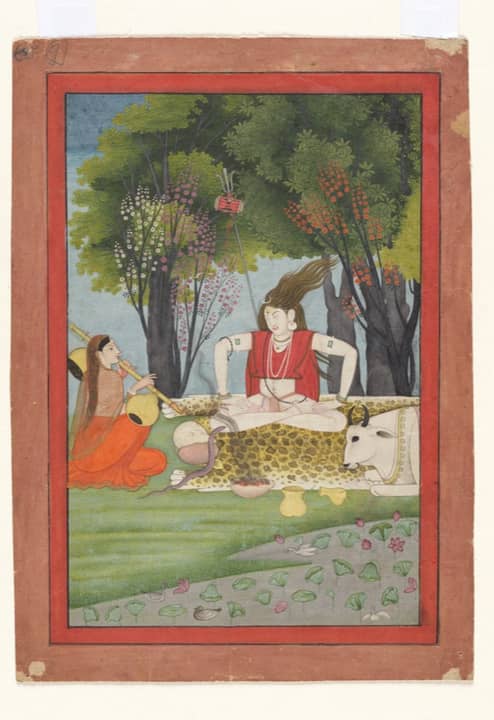
Parvati, the daughter of Himalaya, loved Shiva. But Shiva was lost in meditation, and when Kama, the god of love, tried to stir his heart, Shiva burned Kama to ashes with the fire of his third eye and went away. Parvati's beauty, it seemed, was not enough.
So Parvati decided to win him another way: by penance, tapas. Her mother Mena held her and begged her not to go. "Your body is too delicate for such hard vows," she said. But Parvati's will was stronger than her mother's tears. Her father found her a quiet mountain, and there she went.
She took off her pearls and silks and put on rough bark-cloth. She slept on the bare ground with her arm for a pillow. She watered the young trees as if they were her children, and the deer grew so tame that they ate grain from her hand.
Then she made her penance harder still. In summer she sat between four blazing fires with the sun beating down on her head. In the monsoon she lay on a rock while the rain poured down and lightning flashed. In winter she lay on the cold ground while the snow blew round her. At last she gave up even eating fallen leaves, and so the sages called her Aparna, "she who does not take even a leaf".
One day a young hermit came by, with matted hair, a deerskin and a staff. Parvati welcomed him. He asked her gently why someone so young and well-loved would live like this. When her friend told him that Parvati wanted only Shiva, the hermit pretended to be shocked.
"Shiva?" he said. "He wears snakes for bracelets and an elephant's hide for clothes. He smears himself with ashes, lives among the cremation grounds and rides an old bull. No one even knows who his parents were. How can you, a princess, want him?"
Parvati's eyes flashed with anger. "You do not understand him," she said. "Small minds always mock the great. Shiva needs no riches because he is the source of all riches. He lives among the ashes, yet he rules the three worlds. Even Indra bows at his feet. Who can count the day when the Lord of Brahma began? Whatever you say, my heart is his. Friend, send this boy away. Whoever speaks ill of the great does wrong, and so does whoever stays to listen."
She turned to leave. But as she turned, the hermit changed. There in front of her stood Shiva himself. Parvati stood still, one foot raised to go and one foot planted, like a river stopped for a moment by a rock. With the crescent moon shining on his forehead, Shiva spoke gently: "Gentle one, from today I am yours, won by your penance." All her tiredness vanished.
Families who keep Hartalika Teej often take from this story that a steady heart, which knows what it loves and is not shaken by mockery, is stronger than beauty and stronger than doubt.
Something to do together
Talk it over together: what is something you have kept working at even when it was hard or people laughed? Then each person writes one goal on a card and one small daily step toward it, and you check on each other's steps for a week.
Hartalika Teej: the festival this story belongs to
More stories
For grown-ups
The story ends above. Here, for grown-ups: how families tell it in other ways, and the books it comes from.
How the story differs, and where it comes from
How the story differs
Hartalika Teej is kept by many women in North India and Maharashtra, often with a fast, in memory of Parvati's penance. The name is usually explained by a later story in which Parvati's friends led her away to the forest so that she would not be married to anyone but Shiva; that story is not in Kalidasa's poem.
Where the story comes from
- Kalidasa, Kumarasambhava, canto 5 (with the burning of Kama in canto 3) (Canto 5: Uma resolves on penance, her mother's plea, the bark garment, the trees and fawns, the four fires and the seasons, the name Aparna, the hermit's visit and mockery, her reply, Shiva revealed)
- The Birth of the War-God (Kumarasambhava), a poem by Kalidasa, translated into English verse by Ralph T. H. Griffith (London: Wm. H. Allen, 1853) (Canto III, Kama burned by the fire of Shiva's eye, pp. 30–31 (leaves n43–n44); canto V, 'Uma's reward', pp. 41–54 (leaves n54–n67))
Sources
- The Birth of the War-God (Kumarasambhava), a poem by Kalidasa, translated into English verse by Ralph T. H. Griffith (London: Wm. H. Allen, 1853) (Canto III, pp. 30–31 (leaves n43–n44); canto V, pp. 41–54 (leaves n54–n67))
Source and licence
- Our explanation
- Written for this site from the sources listed here, and checked against them. Free to quote with credit.
- Checked
- Checked against the sources listed, October 13, 2026.
- Updated
- October 25, 2026