The King, the Merchant and the Sage
ages 11-14
A king who has lost his kingdom and a merchant thrown out by his own family meet in a sage's forest home. Both still worry about the people who wronged them, and they ask the sage why. His answer becomes the Devi Mahatmya, and at the end the goddess asks each of them what he wants.
Written for Pujadeep and checked against the sources listed.
The story
Long ago there was a king named Suratha who ruled well and cared for his people like his own children. But enemy kings defeated him in war, and when he came home, his own ministers, greedy and disloyal, took his treasury and his army. So one day the king rode out alone, saying he was going hunting, and left his city behind.
In a deep forest he found the peaceful hermitage of the sage Medhas, where even the wild animals lived calmly, and he stayed there. But his mind would not rest. "Is my city being ruled fairly?" he wondered. "My great war-elephant, my treasure, the people who served me: what has become of them all?"
Near the hermitage he met a sad-looking man. "I am Samadhi, a merchant," the man said. "My own wife and sons wanted my wealth, and they threw me out of my home. And yet I keep wondering whether they are well, whether they are happy."
"Why do you still care about people who drove you out?" asked the king. "That is just what I ask myself," said the merchant. "I know they do not love me, and still my heart goes out to them. I do not understand it." So the two of them went to the sage together.
"We both know what has happened," said the king, "and we both see the faults in those we cling to. Yet our minds keep pulling us back. Why are we deluded, even though we know?" The sage smiled. "Look at the birds," he said. "Even when they are hungry themselves, they drop grain into the beaks of their young. Every creature is held by this pull of 'mine'. It is the power of the great goddess, Mahamaya. She binds the world, and when she is pleased, she is also the one who sets it free."
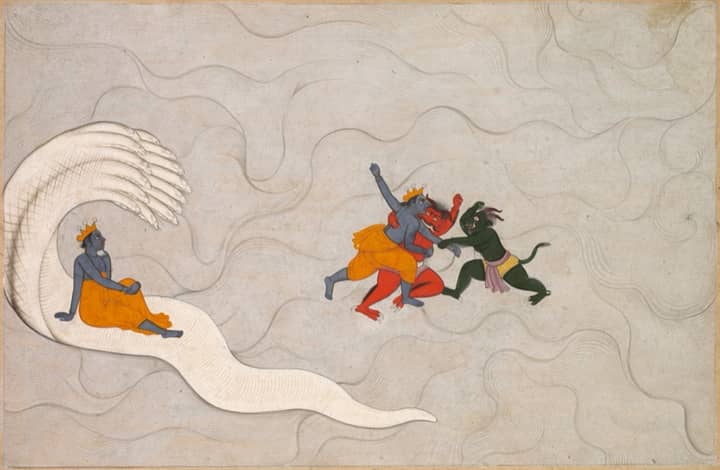
"Who is this goddess?" asked the king. And the sage began to tell her story: how she woke Vishnu from his sleep at the end of an age, so that he could protect Brahma; how the gods' powers joined together to become Durga, who overcame the buffalo king Mahisha; and how again and again she came to save the world. That long telling, in thirteen chapters, is the Devi Mahatmya, which many families read aloud at Navratri.
When the sage finished, the king and the merchant went to a sandbank by a river. They made an image of the goddess out of earth and worshipped her with flowers, incense, fire and water. They ate very little and kept their minds on her, and they did this for three years.
Then the goddess appeared before them. "Ask for what you want," she said. The king asked for his kingdom back in this life, and a kingdom that would never be lost in the next. The goddess granted it: he would win back his throne, and one day be born again as Savarni, a Manu, a father of the human race. Then she turned to the merchant.
Samadhi did not ask for his wealth or his family. He asked for knowledge: the wisdom to understand "what is mine" and "who I am", the kind of knowing that loosens the knots that had held him. "It shall be yours, fully," said the goddess, and she vanished. Families who read this story at Navratri often notice that two people facing the same sorrow asked for very different gifts, and they ask themselves which gift they would choose.
Something to do together
Talk it over together: if the goddess asked you, "What do you want?", what would you ask for, and why? Then each person names one thing they keep worrying about even though they know they cannot change it, and you talk about how to let it go.
Chaitra Navratri: the festival this story belongs to
More stories
For grown-ups
The story ends above. Here, for grown-ups: how families tell it in other ways, and the books it comes from.
How the story differs, and where it comes from
How the story differs
The Devi Mahatmya is read in both the spring Navratri of Chaitra and the autumn Navratri of Ashvina, and many families read one or more of its thirteen chapters each day. Some later tellings, especially in Bengal, say that King Suratha's worship began the spring Navratri; the Markandeya Purana itself does not name a season. In the text the two men also offer blood from their own bodies, a form of offering that most families today replace with flowers and fruit.
Where the story comes from
- Markandeya Purana, Devi Mahatmya (Durga Saptashati), chapter 1 and chapter 13; cantos 81 and 93 of the Markandeya Purana in Pargiter's numbering (Canto 81 (Suratha's loss, the hermitage of Medhas, the merchant Samadhi, their question, Mahamaya, Madhu and Kaitabha); canto 93 (the earthen image on the sandbank, three years of worship, the goddess's boons))
- The Markandeya Purana, translated with notes by F. Eden Pargiter (Bibliotheca Indica; Calcutta: Asiatic Society, 1904) (Canto LXXXI, pp. 465–472 (leaves n510–n517); canto XCIII, pp. 522–523 (leaves n567–n568))
Sources
- The Markandeya Purana, translated with notes by F. Eden Pargiter (Bibliotheca Indica; Calcutta: Asiatic Society, 1904) (Cantos LXXXI and XCIII, pp. 465–472, 522–523 (leaves n510–n517, n567–n568))
Source and licence
- Our explanation
- Written for this site from the sources listed here, and checked against them. Free to quote with credit.
- Checked
- Checked against the sources listed, October 13, 2026.
- Updated
- October 15, 2026