Nachiketa and Yama
ages 11-14
A boy who questions his father's empty gifts is sent to Yama, the lord of death. Offered three wishes, he turns down wealth, long life and every pleasure, and asks what happens when a person dies. Yama teaches him about the Self that is never born and never dies.
Written for Pujadeep and checked against the sources listed.
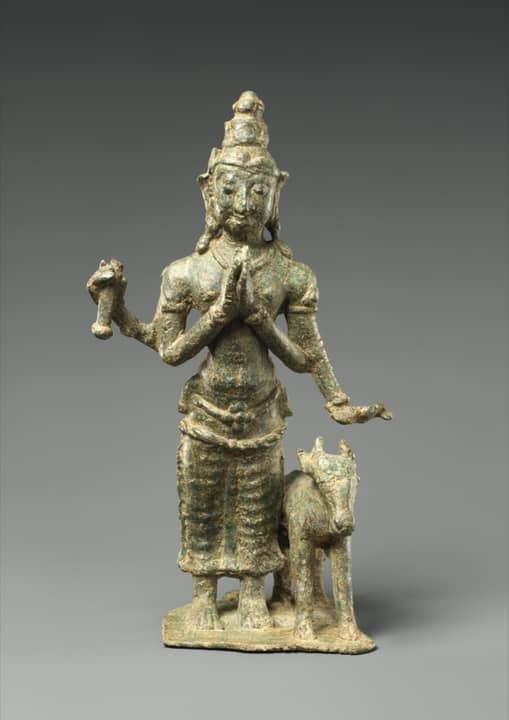
The story
Long ago a man named Vajashravasa, also called Gautama, held a great sacrifice in which he promised to give away everything he owned. His son Nachiketa was still a boy. He watched the cows being led off as gifts to the priests, and he noticed something. They were old cows: they had drunk their last water, eaten their last grass and given their last milk, and they would never have calves again.
Nachiketa was troubled. A gift should be worth something, he thought, and these gifts were worth almost nothing. And if his father had promised everything, then his son must be given too. "Father, to whom will you give me?" he asked. His father did not answer. Nachiketa asked a second time, and a third. At last his father snapped, "I give you to Death!"
Nachiketa took his father at his word and set out for the house of Yama, the lord of death. On the way he thought: "Many have gone before me, and many will come after. People ripen like corn and fall, and like corn they spring up again."
Yama was away. For three nights Nachiketa waited at his door with nothing to eat or drink, and no one welcomed him. When Yama came home, his attendants told him that a young Brahmin guest had been kept waiting without food, which was a grave fault for any household. Yama hurried to him and bowed. "You have stayed three nights in my house without eating, an honoured guest," he said. "For each night, choose a boon."
Nachiketa's first wish was for his father. "Let my father be calm and kind to me again, and let him know me and greet me when I return." Yama agreed. "He will sleep peacefully, his anger gone, when he sees you freed from the mouth of death."
For his second wish, Nachiketa asked about the sacred fire that leads to heaven, the world where there is no fear, no old age, no hunger or thirst. Yama taught him the fire ritual: which bricks to use, how many, and how to lay them. Nachiketa repeated it all back without a mistake. Yama was so pleased that he named the fire after him, the Nachiketa fire, and gave him a many-coloured chain as an extra gift.
Then came the third wish. "When a person dies," said Nachiketa, "some say that they still exist, and some say that they do not. Teach me the truth of this. That is my third wish."
Yama hesitated. "Even the gods have had doubts about this," he said. "It is subtle and hard to understand. Choose another wish, Nachiketa. Do not press me on this one." But Nachiketa held firm. "If even the gods have doubted, and there is no other teacher like you, then no other wish can equal this one."
So Yama tested him. "Ask for sons and grandsons who will live a hundred years," he said. "Ask for herds of cattle, elephants, gold and horses. Ask to rule the wide earth and to live as many years as you like. Ask for chariots and music and companions more delightful than any human has known. Only do not ask me about death."
Nachiketa answered: "These things last only until tomorrow, and they wear out the strength of the senses. Even the longest life is short. Keep your horses, keep your dancing and singing. No one is made happy by wealth. The wish I chose is the only one I will choose."
Yama was delighted. "There is the good, and there is the pleasant," he told Nachiketa. "They pull a person in different directions. The wise choose the good; the foolish choose the pleasant out of greed. You have looked at every pleasure and set them all aside. You truly want to know."
Then Yama began to teach. He spoke of the Self, the atman, hidden in the heart of every creature, smaller than the smallest thing and greater than the greatest. The Self that knows, he said, is never born and never dies. It did not come from anything, and nothing came from it. It is ancient and unending, and it is not destroyed when the body is destroyed. Readers of the Bhagavad Gita meet almost the same words in its second chapter.
Yama gave Nachiketa a picture that people still use. "Think of the Self as the rider in a chariot," he said. "The body is the chariot. The intellect is the charioteer, and the mind is the reins. The senses are the horses, and the things of the world are the roads they run along. When the charioteer is wise and holds the reins firmly, the horses stay on the road and the journey reaches its end. When he is careless, the horses run wild."
Yama taught him the sacred syllable Om, which, he said, all the Vedas point to. And he gave him a call that has rung through the centuries: "Arise! Awake! Find the great teachers and learn from them. The path is as narrow as the edge of a razor, hard to walk, say the wise."
The Upanishad ends by saying that Nachiketa, having learned this from Death, became free of passion and of death. Great teachers such as Shankara, Ramanuja and Madhva each wrote on this Upanishad and read Yama's teaching in their own ways. Families often take from the story that a young person's honest questions deserve real answers, even from the wisest teacher of all.
Something to do together
Talk it over together: if you could ask the wisest teacher in the world one big question, what would it be? Then draw Yama's chariot and label the rider, the charioteer, the reins, the horses and the roads, and talk about which "horses" are hardest to steer in your own day.
More stories
For grown-ups
The story ends above. Here, for grown-ups: how families tell it in other ways, and the books it comes from.
How the story differs, and where it comes from
How the story differs
The story is older than this Upanishad: the Taittiriya Brahmana of the Black Yajurveda also tells of Nachiketas and Death, as Max Müller notes in his introduction. Müller thought three verses of the first part, about the fire named after Nachiketa and the extra gift, may have been added later. In modern India, Swami Vivekananda made the call "Arise, awake" famous. In that verse the word vara can mean the best teachers, as Shankara reads it and as this story tells it, or the boons Nachiketa was given, as Max Müller translates it. Shankara, Ramanuja and Madhva each read the Self's relation to Brahman differently; none of their readings is given here as the Upanishad's only sense.
Where the story comes from
- Katha Upanishad (Kathopanishad), first adhyaya, vallis 1–3, with the closing verse of the second adhyaya (2.3.18) (1.1 (the gift of old cows, the father's words, three nights at Yama's door, the three boons, the temptations); 1.2 (the good and the pleasant, the Self, Om); 1.3 (the chariot, 'arise, awake'))
- The Upanishads, Part II, translated by F. Max Müller (The Sacred Books of the East, vol. XV; Oxford: Clarendon Press, 1884) (Katha-upanishad, I Adhyaya, Vallis 1–3, pp. 1–15 (leaves n58–n72); the closing verse (II Adhyaya, 6th Valli, verse 18 in Müller's numbering), p. 24 (leaf n81))
Sources
- The Upanishads, Part II, translated by F. Max Müller (The Sacred Books of the East, vol. XV; Oxford: Clarendon Press, 1884) (Introduction, pp. xxi–xxv (leaves n24–n28); Katha-upanishad, I Adhyaya, Vallis 1–3, pp. 1–15 (leaves n58–n72); the closing verse, p. 24 (leaf n81))
- Bhagavad Gita, 2.20 (almost the same verse as Katha Upanishad 1.2.18)
Source and licence
- Our explanation
- Written for this site from the sources listed here, and checked against them. Free to quote with credit.
- Checked
- Checked against the sources listed, October 12, 2026.
- Updated
- October 15, 2026