Vamana and King Mahabali
ages 7-10
A small boy asks the generous king Mahabali for three steps of land, then grows until two steps cover the earth and the sky. The story is told in two ways: as the Bhagavata tells it, and as families in Kerala tell it at Onam, when Mahabali comes home to visit his people.
Written for Pujadeep and checked against the sources listed.
The story
This story is told in two ways, and both are dear to the families who tell them. Here is the first, from the Bhagavata Purana.
Bali was the king of the asuras, the rivals of the gods, and he was the grandson of Prahlad. He was brave, and he was famous for never saying no to anyone who asked him for a gift. By the strength of his great sacrifices, offerings made into a sacred fire, he had won heaven itself, and the gods had lost their home. Aditi, the mother of the gods, was full of sorrow, and she prayed to Vishnu.
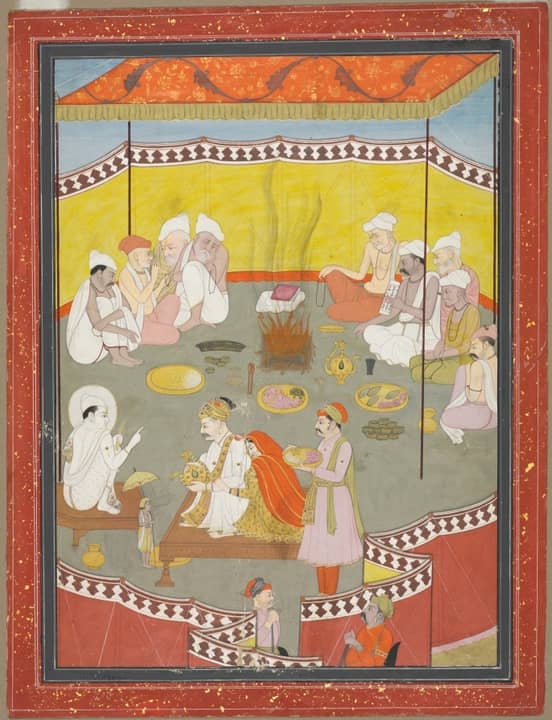
So Vishnu was born as Aditi's son, on the twelfth day of the bright half of the moon. He grew into a small boy called Vamana. At his sacred-thread ceremony the gods gave him gifts: a deerskin, a staff, a water pot, an umbrella and a bowl for alms. Then he walked to the place where King Bali was holding a great sacrifice.
Bali welcomed the shining boy, washed his feet, and said, "Ask me for anything." Vamana said, "I ask only for as much land as I can cover in three steps." Bali laughed. "Only three steps? Ask for more!" But Vamana wanted nothing more.
Bali's teacher, the sage Shukra, warned him: "This is Vishnu in disguise. He will take everything you have." But Bali answered, "I have given my word. There is nothing worse than breaking a promise." His wife Vindhyavali brought a golden jar of water, and Bali poured it to seal his gift.
Then Vamana began to grow. He grew taller than the trees, taller than the mountains, until the earth, the sky and the stars were all inside him. With one step he covered the whole earth. With the second he covered the heavens. "Where shall I put my third step?" he asked.
Bali's soldiers were angry, but Bali told them to put down their weapons. He bowed his head. "My word will not be false," he said. "Place your third step on my head." Then his grandfather Prahlad came and praised Vishnu, and Brahma said that Bali, who had given away everything, deserved kindness. In the Bhagavata, Vishnu blesses Bali for his truthfulness and gives him a kingdom of his own.
The second telling is the one families in Kerala share at Onam. In it, Mahabali was a wise and loving king. In his time there was peace, plenty and happiness everywhere. No one told lies, no one cheated, and all people were treated as equals.
The gods grew worried about how great Mahabali had become, and they asked Vishnu for help. Vishnu came as the boy Vamana and asked for three steps of land. Mahabali gladly agreed. With two steps Vamana measured the earth and the sky, and for the third, Mahabali offered his own head, and he was sent down to the world below.
Mahabali's people were heartbroken, and they prayed for their king. So Vishnu allowed Mahabali to come back once every year to visit the land he loved. That day is Thiruvonam. On Onam, families in Kerala decorate their homes with carpets of flowers, wear new clothes and share a great feast, so that when Mahabali comes, he will find his people as happy as they were in his time.
Families who tell either story often take from it that a promise kept, even at great cost, is never forgotten.
Something to do together
Make a small pookalam together: arrange flower petals, leaves or coloured paper in circles on the floor or a tray. Then take turns making "three steps" across the room, small ones and giant ones, and talk about a promise that someone in your family kept.
Onam: the festival this story belongs to
More stories
For grown-ups
The story ends above. Here, for grown-ups: how families tell it in other ways, and the books it comes from.
How the story differs, and where it comes from
How the story differs
In the Bhagavata, Bali is honoured for keeping his word, Vishnu gives him the kingdom of Sutala below the earth, and he is promised a future place among the gods. In Kerala, Mahabali is remembered as the beloved king of a golden age, and the old Onam song sings of a time when all people were equal. Both tellings honour Mahabali's generosity. Vamana's birthday, Vamana Jayanti, is also kept on the twelfth day of the bright half of Bhadrapada in many places.
Where the story comes from
- Bhagavata Purana, Book 8 (Ashtama Skandha), chapters 15–23 (8.15 (Bali wins heaven); 8.16–18 (Aditi's prayer, Vamana's birth and thread ceremony); 8.19–20 (the three steps, Shukra's warning, Vindhyavali, the cosmic form); 8.21–22 (Bali bound, his head offered, Prahlada and Brahma); 8.22–23 (Bali's reward))
- A Prose English Translation of Srimadbhagavatam, Books VII–XII bound in one, edited and published by Manmatha Nath Dutt (Calcutta: Elysium Press, 1895–96) (Book VIII, chapters XV–XXIII, pp. 51–78 (leaves n338–n365) and pp. 79–80 (leaves n72–n73, bound out of order after the end of Book VI): Bali to be Indra in the Savarni Manvantara and to live in Sutala till then (p. 78), Bali and Prahlada sent to Sutala (pp. 79–80))
- Kerala's Onam telling of Mahabali's reign and yearly visit (living family and temple tradition of Kerala, recorded in 1906 in the Travancore State Manual)
- The Travancore State Manual, by V. Nagam Aiya, vol. II (Trivandrum: Travancore Government Press, 1906) ('National festivals: Onam', pp. 364–365 (leaves n407–n410))
Sources
- A Prose English Translation of Srimadbhagavatam, Books VII–XII bound in one, edited and published by Manmatha Nath Dutt (Calcutta: Elysium Press, 1895–96) (Book VIII, chapters XV–XXIII, pp. 51–80 (leaves n338–n365, n72–n73))
- The Travancore State Manual, by V. Nagam Aiya, vol. II (Trivandrum: Travancore Government Press, 1906) (pp. 364–365 (leaves n407–n410))
- Nirnayasindhu of Kamalakara Bhatta, edited with notes by Pandit Shivadatta (Bombay: Khemraj Shrikrishnadas, Shri Venkateshwar Steam Press, Samvat 1965 = 1908) (Second pariccheda, bright half of Bhadrapada, 'Vamana Dvadashi', pp. 97–98 (leaves n132–n133), checked on the page images: the vow for Vamana's birth, with the Bhagavata, Book 8 (8.18.5), quoted for his birth on the twelfth day with the Shravana star)
- Hindu Holidays and Ceremonials, with dissertations on origin, folklore and symbols, by B. A. Gupte (Calcutta: Thacker, Spink, 1916) ('Vaman 12th', p. 234 (leaf n289), checked on the page image: the twelfth day of the bright half of Bhadrapad with the Shravan star, the day on which Vamana is said to have been born)
Source and licence
- Our explanation
- Written for this site from the sources listed here, and checked against them. Free to quote with credit.
- Checked
- Checked against the sources listed, October 15, 2026.
- Updated
- October 27, 2026