The Churning of the Ocean
ages 7-10
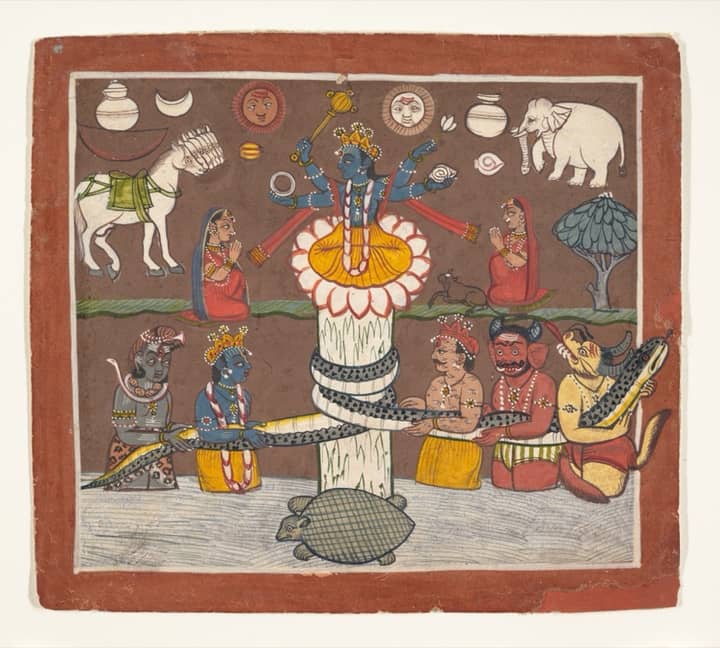
The devas and the asuras work together to churn the Ocean of Milk for the nectar of immortality. Vishnu holds up the mountain as a giant tortoise, Shiva drinks the poison that rises first, and wonderful treasures, Lakshmi among them, come up from the waves.
Written for Pujadeep and checked against the sources listed.
The story
Long ago, the devas, the gods of heaven, had grown weak, and the asuras, their rivals, had grown strong. The devas went to Brahma, and Brahma led them to the shore of the Ocean of Milk, where they all prayed to Vishnu for help.
Vishnu appeared, shining like the sun rising a thousand times over. "Make peace with the asuras," he said. "Together, churn the Ocean of Milk. From it will come amrita, the nectar that makes those who drink it live for ever. Leave the rest to me."
So the devas went to Bali, the king of the asuras, and the two sides agreed to work together. They pulled up Mount Mandara to use as a churning stick, just as families churn curd with a wooden stick to make butter. For a rope they asked Vasuki, the king of serpents, to wind himself round the mountain. Vasuki agreed, because he too was promised a share of the nectar.
The devas took hold of Vasuki's head. But the asuras said, "Why should we hold the tail? We are just as great as you!" So Vishnu and the devas smiled and took the tail, and the asuras took the head. Then they pulled, back and forth, back and forth.
But the mountain was too heavy. With nothing beneath it, it began to sink into the ocean. Then Vishnu became a giant tortoise, Kurma, and dived under the sea. He held the mountain up on his broad back, and the churning began again. To Kurma, the mountain turning on his shell felt like a pleasant scratch.
Vasuki's breath came out hot and smoky, and the asuras at his head grew hot and tired, while soft clouds sprinkled rain on the devas at his tail. The ocean swirled and foamed, and the fish and sea creatures rushed about.
Then something dangerous rose from the water: a dark poison called halahala, spreading over the waves and filling the air. No one knew what to do. They hurried to Shiva on Mount Kailasa. "Please help us!" they said.
Shiva felt for them. "It is right to protect those who are in trouble," he said to Parvati. He scooped up the poison in his palm and drank it. Parvati, who knew his power, was not afraid. The poison stayed in his throat and turned it blue, and from that day Shiva has been called Neelakantha, the blue-throated one.
The churning went on, and wonderful treasures rose from the waves one after another: Surabhi, the cow of plenty; Uchchaihshravas, a horse as bright as the moon; Airavata, a white elephant with four tusks; the shining jewel Kaustubha, which Vishnu wears; the Parijata tree with its sweet flowers; and the dancing apsaras of heaven.
Then, seated on a lotus, Lakshmi, the goddess of good fortune, rose from the ocean, glowing like lightning. The great elephants of the sky poured water over her from golden jars, and the ocean gave her silk to wear. Lakshmi looked at everyone there, and she chose Vishnu, placing a garland of lotuses round his neck.
Last of all came Dhanvantari, the healer and father of Ayurveda, carrying a pot of amrita. At once the asuras snatched the pot and ran off with it, quarrelling among themselves about who should drink first.
Then a beautiful woman appeared among the asuras, so charming that they stopped quarrelling. "Shall I share it out?" she asked. "Only promise to accept whatever I decide." The asuras agreed and sat down in rows. But she was Vishnu in disguise, called Mohini. She poured the amrita for the devas, and the asuras, who had given their word, sat quietly.
With the nectar, the devas grew strong again, and light and goodness returned to the three worlds. Families who tell this story often take from it that great treasures can come when everyone works together, and that sometimes one must take on the hardest part for the sake of all.
Something to do together
Churn your own butter. Pour some cream into a clean jar, close the lid tightly, and take turns shaking it, back and forth like the devas and asuras pulling the rope, until a lump of butter forms. Then name as many of the ocean's treasures as you can remember.
More stories
For grown-ups
The story ends above. Here, for grown-ups: how families tell it in other ways, and the books it comes from.
How the story differs, and where it comes from
How the story differs
The Vishnu Purana tells the churning a little differently: it begins with the sage Durvasa's curse on Indra, and in its account the serpents take the poison. Popular lists count fourteen treasures, the fourteen ratnas, and the lists vary from place to place. Later tradition says drops of amrita fell at four places, Prayagraj, Haridwar, Ujjain and Nashik, where the Kumbh Mela is held. Many families remember Dhanvantari at Dhanteras, just before Diwali.
Where the story comes from
- Bhagavata Purana, Book 8 (Ashtama Skandha), chapters 5–8 (and the start of chapter 9) (8.5–6 (the devas pray, Vishnu's counsel, peace with Bali); 8.7 (Mandara, Vasuki, Kurma, the poison drunk by Shiva); 8.8 (the treasures, Lakshmi, Dhanvantari, Mohini); 8.9 (Mohini shares out the nectar))
- A Prose English Translation of Srimadbhagavatam, Books VII–XII bound in one, edited and published by Manmatha Nath Dutt (Calcutta: Elysium Press, 1895–96) (Book VIII, chapters V–IX, pp. 14–33 (leaves n301–n320))
- Vishnu Purana, Book 1, chapter 9 (Durvasa's curse, the churning, the products of the ocean, the praise of Sri)
- The Vishnu Purana, a system of Hindu mythology and tradition, translated by H. H. Wilson (London: John Murray, 1840) (Book I, chapter IX, pp. 70–81 (leaves n168–n179))
Sources
- A Prose English Translation of Srimadbhagavatam, Books VII–XII bound in one, edited and published by Manmatha Nath Dutt (Calcutta: Elysium Press, 1895–96) (Book VIII, chapters V–IX, pp. 14–33 (leaves n301–n320))
- The Vishnu Purana, a system of Hindu mythology and tradition, translated by H. H. Wilson (London: John Murray, 1840) (Book I, chapter IX, pp. 70–81 (leaves n168–n179))
Source and licence
- Our explanation
- Written for this site from the sources listed here, and checked against them. Free to quote with credit.
- Checked
- Checked against the sources listed, October 12, 2026.
- Updated
- October 15, 2026