Rama and Ravana
ages 7-10
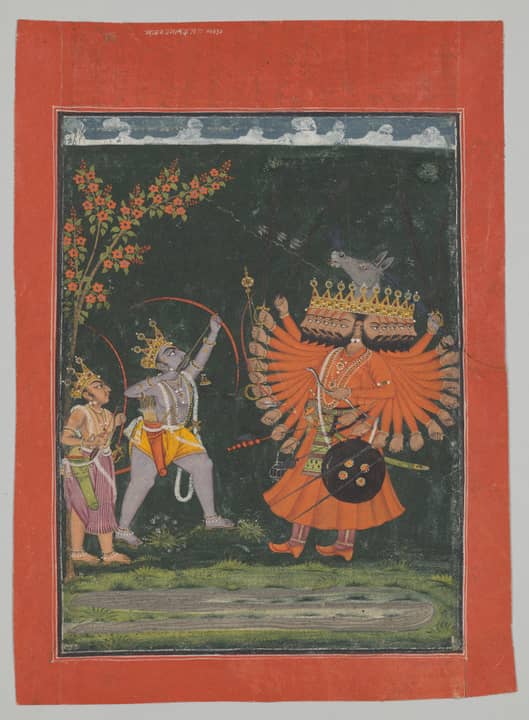
In the last battle at Lanka, Indra sends Rama his own chariot, a sage teaches him a hymn to the Sun, and Rama overcomes the ten-headed king Ravana. Then he tells Ravana's grieving brother that hatred ends when the enemy has fallen.
Written for Pujadeep and checked against the sources listed.
The story
Ravana, the ten-headed king of Lanka, had carried Sita away. Hanuman had found her in Lanka, and Rama had led a great army of vanaras, the brave monkey people of the forest, across the sea on a bridge of stones. Ravana's good brother Vibhishana had begged him to give Sita back, but Ravana would not listen, so Vibhishana had joined Rama.
The battle went on for many days. At last Ravana himself rode out in his great chariot, and Rama faced him on foot. Up in heaven, the gods watched and thought it was not a fair fight. So Indra, the king of the gods, sent down his own chariot, with his charioteer Matali, his bow, his armour and his arrows. "Climb up, Rama," said Matali. "The gods are with you."
The fight was long and fierce. Ravana's arrows turned into fiery snakes, but Rama answered with arrows blessed by Garuda, the king of birds, and the snakes fled. The sea rose up in great waves, and the earth trembled.
In the thick of the battle, the wise sage Agastya came and stood beside Rama. "Rama," he said gently, "praise the rising Sun, the light of all the worlds, who gives strength to everyone. Remember him, and you will find your strength." Rama bowed to the Sun and said the hymn, and new courage filled his heart.
Day and night the two great warriors fought, and neither would give way. Then Matali said, "Use the arrow that Brahma made." It was a wonderful arrow, feathered with the wind, its point bright with the sun and with fire, and as heavy as a mountain. The sage Agastya had given it to Rama long before.
Rama fitted the arrow to his bow and let it fly. It struck Ravana, and the mighty king of Lanka fell from his chariot and did not rise again. His army fled back into the city. The vanaras shouted for joy, music came down from the sky, a cool, sweet breeze began to blow, and flowers rained down on Rama.
But Vibhishana knelt beside his brother and wept. "He was brave," he said. "He was generous to his friends. If only he had listened." Rama put his hand on Vibhishana's shoulder. "Hatred ends when the enemy has fallen," he said. "Now the fight is over, and there is peace between us. Let his funeral rites be done with every honour, and I will help you."
Then Vibhishana was crowned king of Lanka, and Sita was free at last. Families who watch Ravana's effigy burn at Dussehra often take from this story that good can win over wrong, and that a true hero can be generous even to a fallen enemy.
Something to do together
Learn to greet the rising sun together: on Dussehra morning, stand facing east, fold your hands and say one thing you are thankful for. Then make a small paper "Ravana" and write on each of his ten heads one bad habit you would like to let go of, before you fold it away.
Dussehra: the festival this story belongs to
More stories
For grown-ups
The story ends above. Here, for grown-ups: how families tell it in other ways, and the books it comes from.
How the story differs, and where it comes from
How the story differs
Across North India, Dussehra ends the Ramlila plays of the nights before, and huge effigies of Ravana, Kumbhakarna and Meghanada are burned; that custom comes from later tradition, not from Valmiki. In Bengal and eastern India the same day, Vijayadashami, ends Durga Puja, and in the South it closes Navaratri. Some tellings say Rama worshipped the goddess before this battle; Valmiki tells instead of the hymn to the Sun.
Where the story comes from
- Valmiki Ramayana, Book 6 (Yuddha Kanda), cantos 103–114 in Griffith's numbering (Canto 103 (Indra's chariot); 106 (Agastya and the hymn to the Sun, the Aditya Hridaya); 109–110 (the last fight and Ravana's fall); 111 (Vibhishan's lament and Rama's reply); 114 (Vibhishan consecrated))
- The Rámáyan of Válmíki, translated into English verse by Ralph T. H. Griffith, vol. V: Book VI and an outline of Book VII (London: Trübner; Benares: E. J. Lazarus, 1874) (Book VI, cantos CIII–CXI, pp. 245–258 (leaves n256–n269); canto CXIV, pp. 265–266 (leaves n276–n277))
Sources
- The Rámáyan of Válmíki, translated into English verse by Ralph T. H. Griffith, vol. V: Book VI and an outline of Book VII (London: Trübner; Benares: E. J. Lazarus, 1874) (Book VI, cantos CIII–CXI, pp. 245–258 (leaves n256–n269); canto CXIV, pp. 265–266 (leaves n276–n277))
Source and licence
- Our explanation
- Written for this site from the sources listed here, and checked against them. Free to quote with credit.
- Checked
- Checked against the sources listed, October 15, 2026.
- Updated
- October 27, 2026