Prahlad and the Fire of Holika
ages 7-10
The boy Prahlad loves Vishnu, though his father, the proud king Hiranyakashipu, forbids it. Nothing his father does can shake him, not even fire, and at last Vishnu comes as Narasimha. At Holi, families remember the night the fire spared Prahlad.
Written for Pujadeep and checked against the sources listed.
The story
Long ago the daityas, the rivals of the gods, had a mighty king called Hiranyakashipu. He had taken over the heavens and pushed the gods aside. He was so proud that he ordered everyone to worship him and no one else.
But his son Prahlad was different. Prahlad was gentle and kind to everyone, and he loved Lord Vishnu with all his heart. Even at lessons, when his teachers taught him how to rule and how to beat his enemies, he thought only of Vishnu, and he told his schoolmates about Vishnu too.
One day the king sat Prahlad on his lap. "Tell me, my son, what is the best thing you have learned?" he asked. Prahlad answered, "To remember Vishnu, who is in everyone." The king's face turned dark with anger.
Hiranyakashipu tried everything to turn Prahlad away from Vishnu. He sent fierce elephants, but they could not hurt the boy. He sent snakes, but Prahlad felt no pain. His cooks put poison in Prahlad's food, but the boy said Vishnu's name and ate it, and it did him no harm. Each time, Prahlad only prayed, calm and unafraid.
Then the king had a great pile of wood built around Prahlad and set it alight. The wind blew the flames high. But Prahlad called out, "Father, this fire does not burn me. All around me the sky is cool and sweet, and lotus flowers are blooming."
The story that families tell at Holi adds this. The king had a sister named Holika, who believed that fire could not touch her. She sat in the middle of a blazing fire with Prahlad on her lap. But the fire did not touch Prahlad at all, and it was Holika who was burned away. Prahlad walked out of the flames safe and smiling.
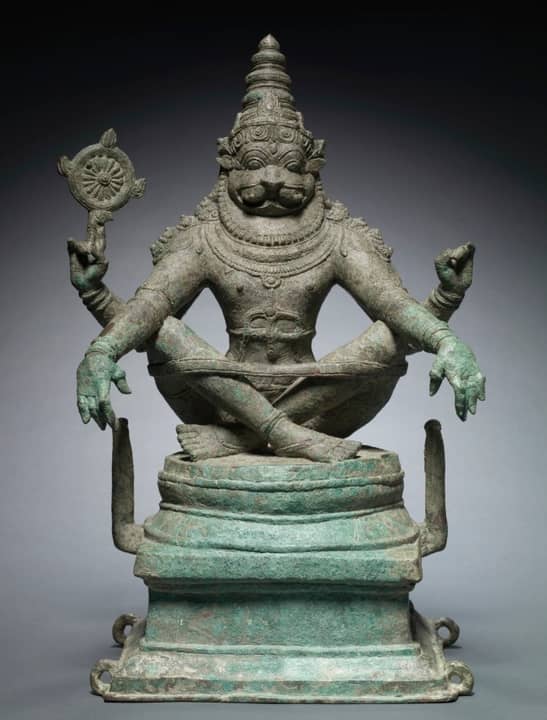
At last Hiranyakashipu shouted, "Where is this Vishnu of yours? Is he in this pillar?" and he struck the pillar of his hall. With a mighty roar the pillar broke open, and out came Vishnu as Narasimha, with the body of a man and the face of a lion. Narasimha seized the proud king, and the king's reign of cruelty came to an end.
Narasimha was still roaring with anger, and no one dared to go near him. But Prahlad walked up, bowed, and sang his praises, and Narasimha grew calm. "Ask me for any gift," he said. Prahlad asked only one thing: "Please forgive my father for what he did."
Prahlad grew up to be a wise and gentle king. Families who light the Holika bonfire often take from this story that goodness and faith can come safely through the fire, and that the brightest colours come the morning after.
Something to do together
Make a paper bonfire together: cut flame shapes from red, orange and yellow paper and stick them round a small paper figure of Prahlad, so that the flames make a circle that never touches him. On Holi morning, mix a few natural colours, such as turmeric and beetroot water, and paint a picture of the morning after.
Holi: the festival this story belongs to
More stories
For grown-ups
The story ends above. Here, for grown-ups: how families tell it in other ways, and the books it comes from.
How the story differs, and where it comes from
How the story differs
The Vishnu Purana and the Bhagavata tell of Prahlad and the fire that would not burn him, but they do not name Holika. The Holika episode is the folk telling of North India that families share at Holika Dahan, the bonfire on the night before Holi; William Crooke recorded it in 1896, with other accounts of how Holi began. In his record the fire comes after the pillar, and the legend is placed at Deokali near Erich in the Jhansi district of Bundelkhand. In parts of India the bonfire is also called Kama Dahanam and remembers a different story, of Shiva and Kamadeva.
Where the story comes from
- Vishnu Purana, Book 1, chapters 16–20 (1.17 (Prahlada's devotion, the serpents, the elephants, the fire that does not burn him); 1.18 (the poisoned food); 1.20 (Vishnu appears, Prahlada asks pardon for his father, the man-lion))
- The Vishnu Purana, a system of Hindu mythology and tradition, translated by H. H. Wilson (London: John Murray, 1840) (Book I, chapters XVI–XX, pp. 125–146 (leaves n223–n244); the fire on p. 129 (leaf n227))
- Bhagavata Purana, Book 7 (Saptama Skandha), chapters 4–10 (7.4–5 (Prahlada at school and on his father's lap); 7.8 (the pillar and Narasimha); 7.9–10 (Prahlada's praise calms Narasimha))
- A Prose English Translation of Srimadbhagavatam, Books VII–XII bound in one, edited and published by Manmatha Nath Dutt (Calcutta: Elysium Press, 1895–96) (Book VII, chapters IV–VIII, pp. 20–26 (leaves n25–n31) and pp. 29–45 (leaves n220–n236; these pages are bound into Book X in this scan))
- The Popular Religion and Folk-Lore of Northern India, by W. Crooke, new edition, vol. II (Westminster: Archibald Constable, 1896) (Chapter VI, 'The Holi: its origin', p. 313 (leaf n336): the Holika telling)
Sources
- The Vishnu Purana, a system of Hindu mythology and tradition, translated by H. H. Wilson (London: John Murray, 1840) (Book I, chapters XVI–XX, pp. 125–146 (leaves n223–n244))
- A Prose English Translation of Srimadbhagavatam, Books VII–XII bound in one, edited and published by Manmatha Nath Dutt (Calcutta: Elysium Press, 1895–96) (Book VII, chapters IV–VIII, pp. 20–45 (leaves n25–n31, n220–n236))
- The Popular Religion and Folk-Lore of Northern India, by W. Crooke, new edition, vol. II (Westminster: Archibald Constable, 1896) (p. 313 (leaf n336))
Source and licence
- Our explanation
- Written for this site from the sources listed here, and checked against them. Free to quote with credit.
- Checked
- Checked against the sources listed, October 12, 2026.
- Updated
- October 27, 2026