Hanuman Leaps for the Sun
ages 7-10
On the shore of the ocean, old Jambavan reminds Hanuman of his childhood: how, as a hungry baby, he leapt into the sky to pick the rising sun like a fruit, and how the wind god's son was given his name. Remembering who he is, Hanuman rises to cross the sea.
Written for Pujadeep and checked against the sources listed.
The story
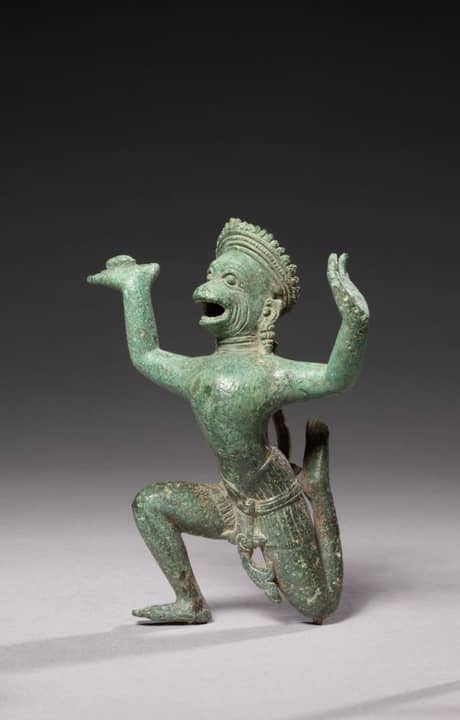
The army of vanaras, the brave monkey people of the forest, sat on the shore of the great southern ocean. Somewhere across that water, in the island city of Lanka, Sita was waiting for Rama. But the sea was a hundred yojanas wide. A yojana is an old measure for a long distance, so the sea was very, very wide, and no one knew how to cross it. One by one, the others said how far each of them could jump, but none could jump so far. Hanuman sat apart, quiet and still.
Old Jambavan, the wise king of the bears, came and sat beside him. "Why so silent, Hanuman?" he asked. "You are as strong as Sugriva and as brave as Rama himself. Have you forgotten who you are? Let me tell you a story."
Long ago, said Jambavan, there lived a beautiful vanara woman named Anjana, the wife of the vanara chief Kesari. Vayu, the god of the wind, blessed her with a son who would have the strength and speed of the wind itself. That son was Hanuman.
One morning, baby Hanuman woke up hungry. His mother had gone into the forest to gather fruit. He looked up and saw the rising sun, round and red and glowing above the trees. "What a big, ripe fruit!" he thought. And he leapt.
Up, up, up he flew. The gods and the spirits of the sky stared in wonder. "Not even the wind moves this fast!" they said. "If he can do this as a baby, how strong will he be when he grows up?" Vayu flew beside his son, blowing cool air over him so that the sun's heat would not burn him. And Surya, the sun god, saw that this was only a child, and he did not burn him either.
But Indra, the king of the gods, saw a child racing across the sky towards the sun. He rode out on his great white elephant, Airavata. Hanuman saw the elephant and thought, "An even bigger fruit!" and he reached out for that too.
To stop him, Indra threw his thunderbolt. It caught Hanuman on the chin, and the little one tumbled back down to the earth.
Vayu gathered his son in his arms and carried him into a cave. He was so upset that he stopped blowing. Everywhere, the air stood still. Leaves did not rustle. Flags did not flutter. People and animals found it hard to breathe, and the whole world grew quiet and heavy.
The gods hurried to Brahma, the creator. Brahma led them all to the cave, where Vayu sat with Hanuman on his lap. Brahma blessed the child: no weapon would ever be able to slay him in battle. Indra promised that his thunderbolt would never harm Hanuman again.
Vayu's heart grew calm. He began to blow again, and the whole world breathed. From that day the child was called Hanuman. "Hanu" means jaw, and the name remembers the day the thunderbolt caught his chin.
"That baby was you," said Jambavan. "You are the son of the wind. You can leap across this ocean. Rise up, Hanuman!"
Hanuman stood up. As he remembered, he grew and grew, until he stood as tall as a hill above the cheering vanaras. He looked across the sea towards Lanka, ready for the greatest leap of his life. Families who tell this story often take from it that sometimes we need someone who loves us to remind us of our own strength.
Something to do together
Sit in a circle and take turns naming one strength of each person in the family, the way Jambavan reminded Hanuman of his. Then try a Hanuman leap outdoors in the morning: crouch low and jump as high as you can towards the rising sun, but never look straight at the sun.
Hanuman Jayanti: the festival this story belongs to
More stories
For grown-ups
The story ends above. Here, for grown-ups: how families tell it in other ways, and the books it comes from.
How the story differs, and where it comes from
How the story differs
Valmiki tells this story twice. In the Kishkindha Kanda, Jambavan tells it on the seashore. In the Uttara Kanda, the sage Agastya tells it to Rama with more detail, and says that sages once cursed the playful young Hanuman so that he would not know his full strength until someone reminded him. The Hanuman Chalisa remembers the sun as a sweet fruit that he swallowed. Different regions keep Hanuman Jayanti on different days: North India at the full moon of Chaitra, Telugu families in Andhra Pradesh and Telangana in Vaishakha, Karnataka in Margashirsha, Tamil Nadu and Kerala in the month of Margazhi, and Odisha at Pana Sankranti.
Where the story comes from
- Valmiki Ramayana, Book 4 (Kishkindha Kanda), canto 66 in Griffith's numbering (Jambavan tells Hanuman of his birth, his leap for the sun, Indra's thunderbolt, the wind god's grief, and the blessings of Brahma and Indra; Hanuman grows huge (canto 67))
- The Rámáyan of Válmíki, translated into English verse by Ralph T. H. Griffith, vol. IV: Books IV and V (London: Trübner; Benares: E. J. Lazarus, 1873) (Book IV, cantos LXVI–LXVII, pp. 271–275 (leaves n282–n286))
- Valmiki Ramayana, Book 7 (Uttara Kanda): Agastya tells Rama of Hanuman's boyhood (Section XL in Dutt's printing (in many other printings, the 35th and 36th chapters of the Uttara Kanda): the mother gone for fruit, the wind cooling the child, the sun not burning him, Airavata taken for a fruit, the wind withdrawing into a cave)
- The Ramayana, translated into English prose from the original Sanskrit of Valmiki: Uttarakandam, edited and published by Manmatha Nath Dutt (Calcutta, 1894) (Uttarakandam, Section XL, pp. 1688–1692 (leaves n143–n147))
Sources
- The Rámáyan of Válmíki, translated into English verse by Ralph T. H. Griffith, vol. IV: Books IV and V (London: Trübner; Benares: E. J. Lazarus, 1873) (Book IV, cantos LXVI–LXVII, pp. 271–275 (leaves n282–n286))
- The Ramayana, translated into English prose from the original Sanskrit of Valmiki: Uttarakandam, edited and published by Manmatha Nath Dutt (Calcutta, 1894) (Uttarakandam, Section XL, pp. 1688–1692 (leaves n143–n147))
- Hanuman Chalisa, chaupai 18 (the sun swallowed as a sweet fruit)
Source and licence
- Our explanation
- Written for this site from the sources listed here, and checked against them. Free to quote with credit.
- Checked
- Checked against the sources listed, October 12, 2026.
- Updated
- October 27, 2026