Durga and the Buffalo King
ages 7-10
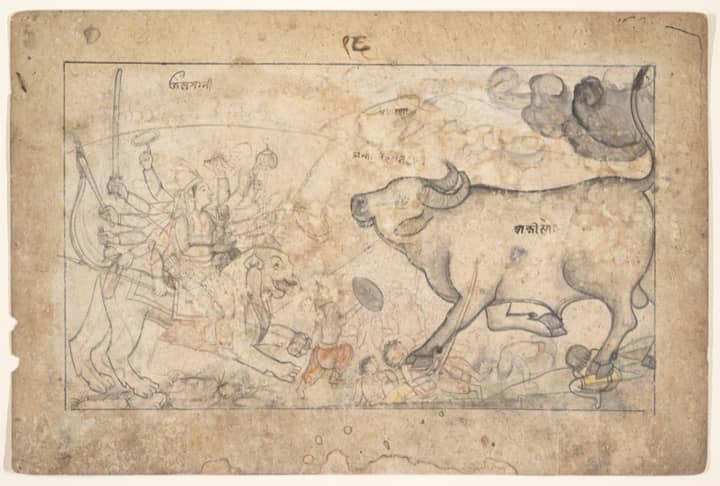
When the buffalo king Mahisha drives the gods out of heaven, their shining powers join together and become the goddess Durga. Riding a lion and carrying the gods' gifts, she overcomes Mahisha, however many shapes he takes.
Written for Pujadeep and checked against the sources listed.
The story
Long ago, the gods and the asuras, their proud rivals, fought for a hundred years. The asuras were led by Mahisha, a king who could take the shape of a huge buffalo. In the end the gods were beaten. Mahisha sat on Indra's throne and took over the work of the Sun, the Moon, the Wind, Fire and all the others. The gods had to wander the earth like ordinary people.
The gods went to Brahma, and together they went to Shiva and Vishnu and told them everything. When Vishnu and Shiva heard it, they grew so angry that a great light blazed out of their faces. Light came out of Brahma, out of Indra, out of every god, and all of it flowed together into one huge, shining glow, like a mountain on fire.
From that glow came a goddess, brighter than anything the gods had ever seen. Her face came from Shiva's light, her arms from Vishnu's, and every part of her from the light of a different god. She was Durga, also called Chandika and Ambika, the mother of the worlds.
Then the gods gave her their gifts. Shiva gave her a trident, Vishnu a discus, Varuna a conch shell, Agni a spear, and Vayu a bow and arrows. Indra gave her his thunderbolt and a bell. The Ocean gave her a pearl necklace and fresh clothes that would never wear out. Vishvakarma, the heavenly craftsman, gave her jewels and an axe, and Himavat, the king of the mountains, gave her a lion to ride.
The goddess gave a great roar of laughter that echoed across the sky. The earth shook and the seas trembled. "Victory to you!" cried the gods, and the sages bowed down before her.
Mahisha's whole army rushed at her, with chariots, elephants and horses beyond counting. But Durga, riding her lion, met them as if it were a game. With her many arms she turned aside every spear and arrow, and the great army melted away before her like dry grass before a fire. Mahisha's generals came at her one by one, and one by one she overcame them.
Then Mahisha himself came, as a giant buffalo. He pawed the ground until the earth cracked. With his horns he tossed mountains into the air, and with his tail he lashed the sea until it flooded the land. Durga threw her noose and caught him fast.
But Mahisha was full of tricks. He became a lion. Then he became a man with a sword and shield. Then he became a huge elephant. Then he was a buffalo again, roaring and throwing mountains. Durga laughed. "Roar while you can," she said. "Soon the gods will be the ones roaring with joy." She leapt up, pressed him down with her foot, and with her trident and sword she overcame him. The buffalo king fell, and his army was gone.
The gods sang the goddess's praises and showered her with flowers. "Whenever you are in trouble and you remember me," Durga told them, "I will come to help." Then she vanished. Families who keep Navratri often take from this story that when good people join their strength together, no wrong can stand before it for long.
Something to do together
Make a "gifts of the gods" picture together. Draw Durga in the middle, and around her draw each god's gift with an arrow to the god who gave it: Shiva's trident, Vishnu's discus, Varuna's conch, the mountains' lion. Then talk about what gift each person in your family brings when you all work together.
Navratri: the festival this story belongs to
More stories
For grown-ups
The story ends above. Here, for grown-ups: how families tell it in other ways, and the books it comes from.
How the story differs, and where it comes from
How the story differs
The Devi Mahatmya, also called the Durga Saptashati or Chandi Path, is read aloud in many homes and temples during Navratri. In Bengal, Durga Puja shows the goddess on her lion overcoming Mahishasura; in Gujarat, families dance garba around a lamp for the goddess; in South India many homes set out a Golu of dolls; and in Mysuru the tenth day, Dasara, is a great festival. The goddess is honoured as one great mother under many names.
Where the story comes from
- Markandeya Purana, Devi Mahatmya (Durga Saptashati), chapters 2–4; cantos 82–84 of the Markandeya Purana in Pargiter's numbering (Canto 82 (Mahisha's victory, the goddess formed from the gods' energies, their gifts, the destruction of his army); 83 (his generals, his changes of shape, his fall); 84 (the gods' hymn and her promise to come when remembered))
- The Markandeya Purana, translated with notes by F. Eden Pargiter (Bibliotheca Indica; Calcutta: Asiatic Society, 1904) (Cantos LXXXII–LXXXIV, pp. 473–488 (leaves n518–n533))
Sources
- The Markandeya Purana, translated with notes by F. Eden Pargiter (Bibliotheca Indica; Calcutta: Asiatic Society, 1904) (Cantos LXXXII–LXXXIV, pp. 473–488 (leaves n518–n533))
Source and licence
- Our explanation
- Written for this site from the sources listed here, and checked against them. Free to quote with credit.
- Checked
- Checked against the sources listed, October 12, 2026.
- Updated
- October 27, 2026