The Night Krishna Was Born
ages 3-6
Krishna is born at midnight in a prison in Mathura. The doors open by themselves, and his father Vasudeva carries him through the rain and across the river Yamuna to Gokul, where Yashoda and Nanda will bring him up.
Written for Pujadeep and checked against the sources listed.
The story
Long ago, in the city of Mathura, there lived an unkind king called Kamsa. He had heard that one day a son of his sister Devaki would put an end to his unkind rule. So he kept Devaki and her husband Vasudeva shut away in a prison, with guards at every door.
Then came a very special night. The sky was full of bright stars. The rivers flowed quietly. The lotus flowers opened, and the birds sang. A soft, sweet wind was blowing.
At midnight, a baby was born to Devaki. It was Krishna! At first he shone like the moon, with four arms, holding a conch, a lotus and more. Then he became a little baby, just like any other baby.
Vasudeva picked the baby up. And then something wonderful happened. All the guards fell fast asleep. The heavy locks opened. The big doors swung open by themselves.
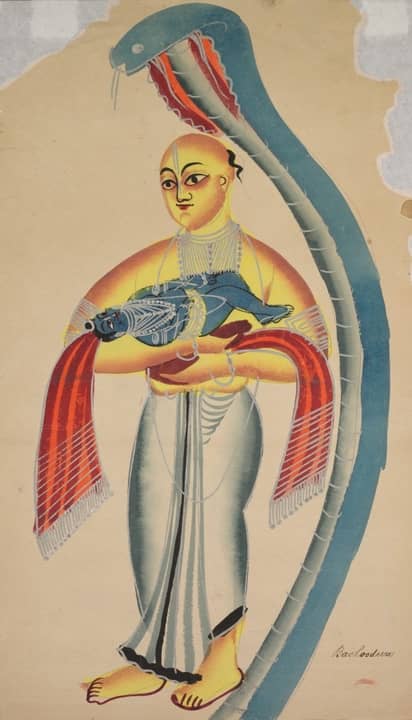
Outside, it was raining. Vasudeva walked out, holding Krishna close in his arms. Behind him came Shesha, the great serpent with many hoods. He spread his hoods over the baby like an umbrella, to keep him dry.
They came to the river Yamuna. The water was deep and full of waves. But the river made a path for them, and Vasudeva walked across to the other side.
On the other side was the village of Gokul. Everyone there was asleep. In Nanda's house, his wife Yashoda had just had a baby girl. Vasudeva gently laid Krishna beside Yashoda and took the baby girl back with him to Mathura.
In the morning, Yashoda woke up and saw a beautiful baby boy beside her. All of Gokul danced and sang. Krishna had come home to Gokul, where he would grow up with cows and butter and lots of love.
Families who tell this story often take from it that a little light can find its way through the darkest night.
Something to do together
Make a little cradle together from a shoebox and a soft cloth, and put a small doll or a flower in it for baby Krishna. Then use an umbrella or an open book to play Shesha, keeping the baby dry as you carry the cradle across the room.
Janmashtami: the festival this story belongs to
More stories
For grown-ups
The story ends above. Here, for grown-ups: how families tell it in other ways, and the books it comes from.
How the story differs, and where it comes from
How the story differs
Janmashtami is kept on the eighth day of the dark half of the month, and many families stay awake until midnight, the hour of the birth, singing and swinging a small cradle for baby Krishna. In Maharashtra the next day brings Dahi Handi; in Braj, the land around Mathura and Vrindavan, the festival lasts for days. Many tellings say Vasudeva carried Krishna in a basket on his head; the Bhagavata says he carried him in his arms.
Where the story comes from
- Bhagavata Purana, Book 10 (Dashama Skandha), chapter 3 (10.3.1–8 (the night of the birth); 10.3.9–46 (the four-armed form, then a baby); 10.3.47–53 (the sleeping guards, the opened doors, Shesha's hoods, the Yamuna, the exchange at Gokul))
- Le Bhâgavata Purâna ou Histoire poétique de Krïchna, tome quatrième (Livre X, première partie), traduit par M. Hauvette-Besnault (Paris: Imprimerie nationale, 1884) (Livre X, chapitre III, pp. 14–19 (leaves n36–n41))
- A Prose English Translation of Srimadbhagavatam, Books VII–XII bound in one, edited and published by Manmatha Nath Dutt (Calcutta: Elysium Press, 1895–96) (Book X, chapter III, pp. 13–19 (leaves n196–n202))
Sources
- Le Bhâgavata Purâna ou Histoire poétique de Krïchna, tome quatrième (Livre X, première partie), traduit par M. Hauvette-Besnault (Paris: Imprimerie nationale, 1884) (Livre X, chapitre III, pp. 14–19 (leaves n36–n41))
- A Prose English Translation of Srimadbhagavatam, Books VII–XII bound in one, edited and published by Manmatha Nath Dutt (Calcutta: Elysium Press, 1895–96) (Book X, chapter III, pp. 13–19 (leaves n196–n202))
Source and licence
- Our explanation
- Written for this site from the sources listed here, and checked against them. Free to quote with credit.
- Checked
- Checked against the sources listed, October 12, 2026.
- Updated
- October 15, 2026