Krishna and the Butter
ages 3-6
Little Krishna takes butter from the high pots of his village and shares it with his friends and the monkeys. When his mother Yashoda tries to tie him to a big stone mortar, every rope is two fingers too short, until Krishna lets himself be tied.
Written for Pujadeep and checked against the sources listed.
The story
In the village of Gokul lived a little boy called Krishna. He lived with his mother, Yashoda, and his father, Nanda. Every house in Gokul had cows. Every house had pots of milk, curd and butter.
Krishna loved butter more than anything. So the women of Gokul hung their butter pots up high. But Krishna had a plan. He pulled a stool over. He put a wooden mortar on top. Up he climbed! He made a little hole in the pot, and out came the butter. In dark rooms, the jewels he wore shone like little lamps, so he could always find the pots.
Krishna never ate alone. He gave butter to his friends. He gave butter to the monkeys too. The women came to Yashoda and told her all about it. Yashoda only laughed. She could not stay cross with her little boy.
One morning Yashoda was churning butter herself. She sang songs about Krishna as she worked. Krishna came running and climbed into her lap for some milk. Just then the milk on the stove began to boil over. Yashoda put Krishna down and hurried to the kitchen.
Krishna pouted. He cracked the churning pot with a stone. He took the fresh butter to a quiet room. There he sat on an upturned mortar and fed the butter to a monkey.
Yashoda came back and saw the cracked pot. She smiled, because she knew who had done it. She found Krishna and the monkey. Krishna jumped down and ran! Yashoda ran after him, and at last she caught him.
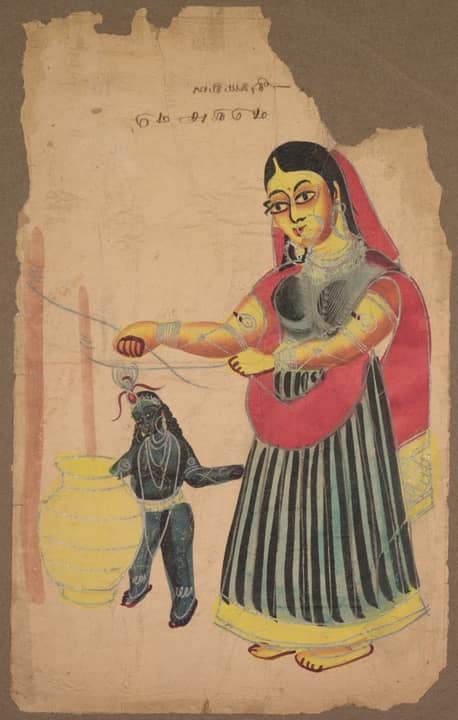
"Now you must stay in one place for a little while," said Yashoda. She took a rope to tie him to the big mortar. But the rope was two fingers too short. She tied on another rope. Still two fingers too short! She tied on every rope in the house. Always two fingers too short.
The other mothers laughed, and Yashoda laughed too. She was hot and tired. Krishna saw how tired his mother was. So he let the rope go round him, and this time it fitted.
That is why Krishna is also called Damodara, the one with a rope round his middle. Families who tell this story often take from it that love can hold the one whom no rope can hold.
Something to do together
Tie a soft ribbon round a teddy bear and pretend it is always two fingers too short. Then share a small snack with everyone at home, the way Krishna shared his butter.
More stories
For grown-ups
The story ends above. Here, for grown-ups: how families tell it in other ways, and the books it comes from.
How the story differs, and where it comes from
How the story differs
In Braj and across North India, songs call Krishna Makhan Chor, the butter thief. In Maharashtra, the Dahi Handi game at Janmashtami remembers his butter pots: young people stand on each other's shoulders to reach a pot of curd hung up high. In Kerala and Tamil Nadu, families love the child Krishna as Unnikrishnan and Kannan.
Where the story comes from
- Bhagavata Purana, Book 10 (Dashama Skandha), chapters 8–9 (10.8.29–31 (Krishna takes butter and shares it with the monkeys); 10.9.1–21 (Yashoda ties him to the mortar))
- Le Bhâgavata Purâna ou Histoire poétique de Krïchna, tome quatrième (Livre X, première partie), traduit par M. Hauvette-Besnault (Paris: Imprimerie nationale, 1884) (Livre X, chapitre VIII, stances 29–31, p. 42 (leaf n64); chapitre IX, stances 1–21, pp. 45–47 (leaves n67–n69))
- A Prose English Translation of Srimadbhagavatam, Books VII–XII bound in one, edited and published by Manmatha Nath Dutt (Calcutta: Elysium Press, 1895–96) (Book X, chapter VIII, pp. 39–40 (leaves n44–n45); chapter IX is missing from this scan)
Sources
- Le Bhâgavata Purâna ou Histoire poétique de Krïchna, tome quatrième (Livre X, première partie), traduit par M. Hauvette-Besnault (Paris: Imprimerie nationale, 1884) (Livre X, chapitres VIII–IX, pp. 39–47 (leaves n61–n69))
- A Prose English Translation of Srimadbhagavatam, Books VII–XII bound in one, edited and published by Manmatha Nath Dutt (Calcutta: Elysium Press, 1895–96) (Book X, chapter VIII, pp. 39–40 (leaves n44–n45))
- The Vishnu Purana, a system of Hindu mythology and tradition, translated by H. H. Wilson (London: John Murray, 1840) (Book V, chapter VI, p. 509 (leaf n607): Krishna is called Damodara from the rope (dama) round his belly (udara))
Source and licence
- Our explanation
- Written for this site from the sources listed here, and checked against them. Free to quote with credit.
- Checked
- Checked against the sources listed, October 12, 2026.
- Updated
- October 15, 2026