Ganesha Writes the Mahabharata
ages 3-6
The sage Vyasa has a very long poem in his mind and needs someone to write it down. Ganesha agrees, but only if Vyasa never stops speaking, and Vyasa agrees, but only if Ganesha understands every line.
Written for Pujadeep and checked against the sources listed.
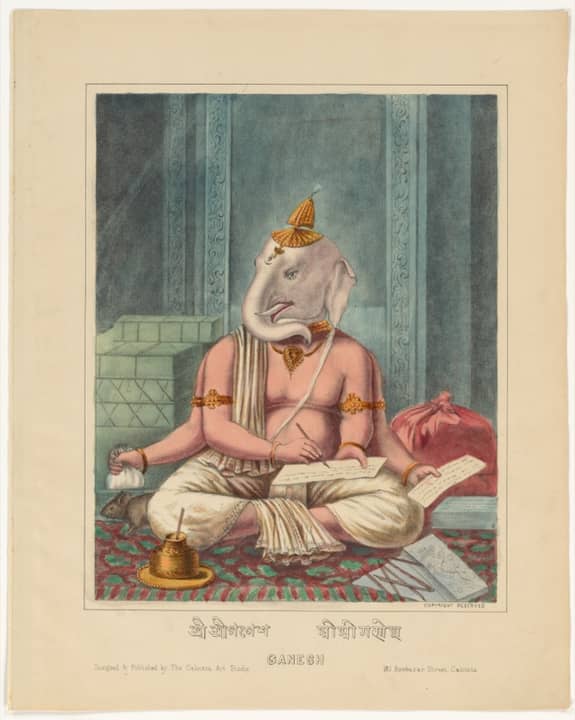
The story
Long ago there lived a wise sage called Vyasa. In his mind he had made a great, great story. It was the Mahabharata, one of the longest poems in the world.
But there was a problem. The story was so long that Vyasa needed someone to write it all down. Who could write so fast and so well?
Brahma, the creator, came to visit him. "Ask Ganesha," said Brahma. "He will write it for you."
So Vyasa thought of Ganesha, and Ganesha came at once. "Will you write my story?" asked Vyasa.
Ganesha smiled. "Yes," he said, "but my pen must never stop. You must keep telling, without a single break."
Vyasa smiled too. "All right," he said. "But you must understand every line before you write it." Ganesha said, "Om!" That meant yes.
So Vyasa began to tell, and Ganesha began to write. Scratch, scratch, scratch went his pen, fast, faster, fastest!
Whenever Vyasa needed a moment to think, he made up a very tricky verse. Then even clever Ganesha had to stop and think about what it meant. And while Ganesha thought, Vyasa made up the next part.
Day after day, they went on. And at last the whole Mahabharata was written down, for everyone to read. Families who tell this story often take from it that great work is done by people who listen well and think before they write.
Something to do together
Play "Vyasa and Ganesha". One person tells a short story without stopping, and the other draws or writes it as fast as they can. Then swap. If the storyteller needs a moment, they can ask a riddle, and the writer has to stop and think!
Ganesh Chaturthi: the festival this story belongs to
More stories
For grown-ups
The story ends above. Here, for grown-ups: how families tell it in other ways, and the books it comes from.
How the story differs, and where it comes from
How the story differs
Across India, many families add that Ganesha's pen broke as he wrote, and that he snapped off one of his own tusks and went on writing with it. That is why Ganesha is often shown with one tusk broken. This detail is loved in many retellings, but it is not in the Mahabharata passage itself. The passage about Ganesha as Vyasa's writer appears in the commonly printed Mahabharata; scholars of the Pune Critical Edition treat it as a later addition.
Where the story comes from
- Mahabharata, Book 1 (Adi Parva), Section 1 (Anukramanika), in the vulgate (Calcutta and Bombay) text (Vyasa, Brahma's visit, Ganesha's condition and Vyasa's counter-condition, the knotty verses; the Pune Critical Edition moves this passage to an appendix as a later addition)
- The Mahabharata of Krishna-Dwaipayana Vyasa, translated into English prose (K. M. Ganguli), published by Protap Chandra Roy: Adi Parva (Calcutta: Bharata Press, 1884) (Adi Parva, Section I, pp. 4–6 (leaves n37–n39))
Sources
- The Mahabharata of Krishna-Dwaipayana Vyasa, translated into English prose (K. M. Ganguli), published by Protap Chandra Roy: Adi Parva (Calcutta: Bharata Press, 1884) (Adi Parva, Section I, pp. 4–6 (leaves n37–n39))
Source and licence
- Our explanation
- Written for this site from the sources listed here, and checked against them. Free to quote with credit.
- Checked
- Checked against the sources listed, October 15, 2026.