Bhagavad Gita 4.41: meaning and translation
Chapter 4: Jnana Karma Sannyasa Yoga. Krishna says
Krishna tells Arjuna, whom he calls Dhananjaya, that actions do not bind one who has given up action through yoga, whose doubts are cut away by knowledge, and who is self-possessed (ātmavān).
Click or tap a word for its meaning and its dictionary page.
Text and layers
Text and layers
These choices stay in this browser.
Bhagavad Gita 4.41
योगसंन्यस्तकर्माणं ज्ञानसञ्छिन्नसंशयम् ।आत्मवन्तं न कर्माणि निबध्नन्ति धनञ्जय ॥
Yogasannyastakarmanam jnanasanchhinnasanshayamAtmavantam na karmani nibadhnanti dhananjaya
yogasaṃnyastakarmāṇaṃ jñānasañchinnasaṃśayam |ātmavantaṃ na karmāṇi nibadhnanti dhanañjaya ||
Our explanation Krishna tells Arjuna, whom he calls Dhananjaya, that actions do not bind one who has given up action through yoga, whose doubts are cut away by knowledge, and who is self-possessed (ātmavān). Both translators' notes explain ātmavān as watchful and free of carelessness.
हिंदी अर्थ कृष्ण अर्जुन (धनंजय) से कहते हैं कि जिसने योग के द्वारा कर्मों का संन्यास किया है, जिसके संशय ज्ञान से कट गए हैं, और जो आत्मवान है, उसे कर्म नहीं बाँधते। दोनों अनुवादकों की टिप्पणियाँ आत्मवान का अर्थ सजग और प्रमाद से रहित बताती हैं।
Word by word
Every word, with its dictionary page
Word by word
- योगसंन्यस्तकर्माणम् yogasaṃnyastakarmāṇam · who renounced action through yoga (compound (masculine), accusative singular) Dictionary: yoga, Monier-Williams 1899, p. 856, col. 2 “the act of yoking, joining, attaching”; saṃ-nyasta, Monier-Williams 1899, p. 1148, col. 1 “thrown down, laid aside, relinquished, abandoned”; karman, Monier-Williams 1899, p. 258, col. 2 “act, action, performance, business”
- ज्ञानसञ्छिन्नसंशयम् jñānasañchinnasaṃśayam · whose doubts knowledge has cut (compound (masculine), accusative singular) Dictionary: jñāna, Monier-Williams 1899, p. 426, col. 1 “knowing, becoming acquainted with, knowledge”; saṃ-chinna, Monier-Williams 1899, p. 1132, col. 3 “cut to pieces, cut off”; saṃ-śaya, Monier-Williams 1899, p. 1117, col. 3 “uncertainty, irresolution, hesitation, doubt”
- आत्मवन्तम् ātmavantam · self-possessed (adjective (masculine), accusative singular) Dictionary: ātma-vat, Monier-Williams 1899, p. 135, col. 3 “self-possessed, composed, prudent”
- न na · not (indeclinable) Dictionary: 2. na, Monier-Williams 1899, p. 523, col. 1 “ind. not, no, nor, neither”
- कर्माणि karmāṇi · actions (noun (neuter), nominative plural) Dictionary: karman, Monier-Williams 1899, p. 258, col. 2 “act, action, performance, business”
- निबध्नन्ति nibadhnanti · bind (present, 3rd person plural) Dictionary: ni-bandh, Monier-Williams 1899, p. 550, col. 1 “to bind on, tie, fasten to”
- धनञ्जय dhanañjaya · O Dhananjaya (Arjuna) (noun (masculine), vocative singular) Dictionary: dhanaṃ-jaya, Monier-Williams 1899, p. 508, col. 2 “N. of Arjuna”
Old translations
Kashinath Trimbak Telang, 1882. Public domain. Page 63.
Actions, O Dhanañgaya! do not fetter one who is self-possessed1, who has renounced action by devotion, and who has destroyed misgivings by knowledge.
Footnotes (the translator’s own) - Cautious, free from heedlessness. ↩
Compare 3 translations
Kashinath Trimbak Telang, 1882. Public domain. Page 63.
Actions, O Dhanañgaya! do not fetter one who is self-possessed1, who has renounced action by devotion, and who has destroyed misgivings by knowledge.
Footnotes (the translator’s own) - Cautious, free from heedlessness. ↩
You are reading this one
Annie Besant, 1895. Public domain. Page 57.
He who hath renounced actions by Yoga, who hath cloven asunder doubt by wisdom, who is ruled by the SELF,1 actions do not bind him, O Dhananjaya.
Footnotes (the translator’s own) - Madhusûdana explains âtmavantam as "always watchful." ↩
You are reading this one
Swami Swarupananda, 1909 (first printed 1907). Public domain. Page 104.
With work renounced by Yoga, and doubts rent asunder by knowledge, O Dhananjaya, actions do not bind him who is poised in the Self.
You are reading this one
Cite this verse
The translation: K. T. Telang, The Bhagavadgîtâ (The Sacred Books of the East, vol. VIII, Oxford: Clarendon Press, 1882), p. 63. Bhagavad Gita 4.41.
The translation: Annie Besant, The Bhagavad Gîtâ, or The Lord's Song (London: Theosophical Publishing Society, 1895), p. 57. Bhagavad Gita 4.41.
The translation: Swami Swarupananda, Srimad-Bhagavad-Gita (Mayavati: Prabuddha Bharata Press, 1909; first printed in Prabuddha Bharata, 1907–1909), p. 104. Bhagavad Gita 4.41.
Our explanation: “Bhagavad Gita 4.41: meaning and translation.” Pujadeep. Updated October 27, 2026. https://pujadeep.com/bhagavad-gita/4/41/
Pujadeep’s explanations are free to quote with credit: name Pujadeep and link to the page. How to credit
Classical readings, by school
No readings by school on this verse yet.
Share
Show the ways to share
Send one picture or the text to one chat. The picture names its source and the address of this page.
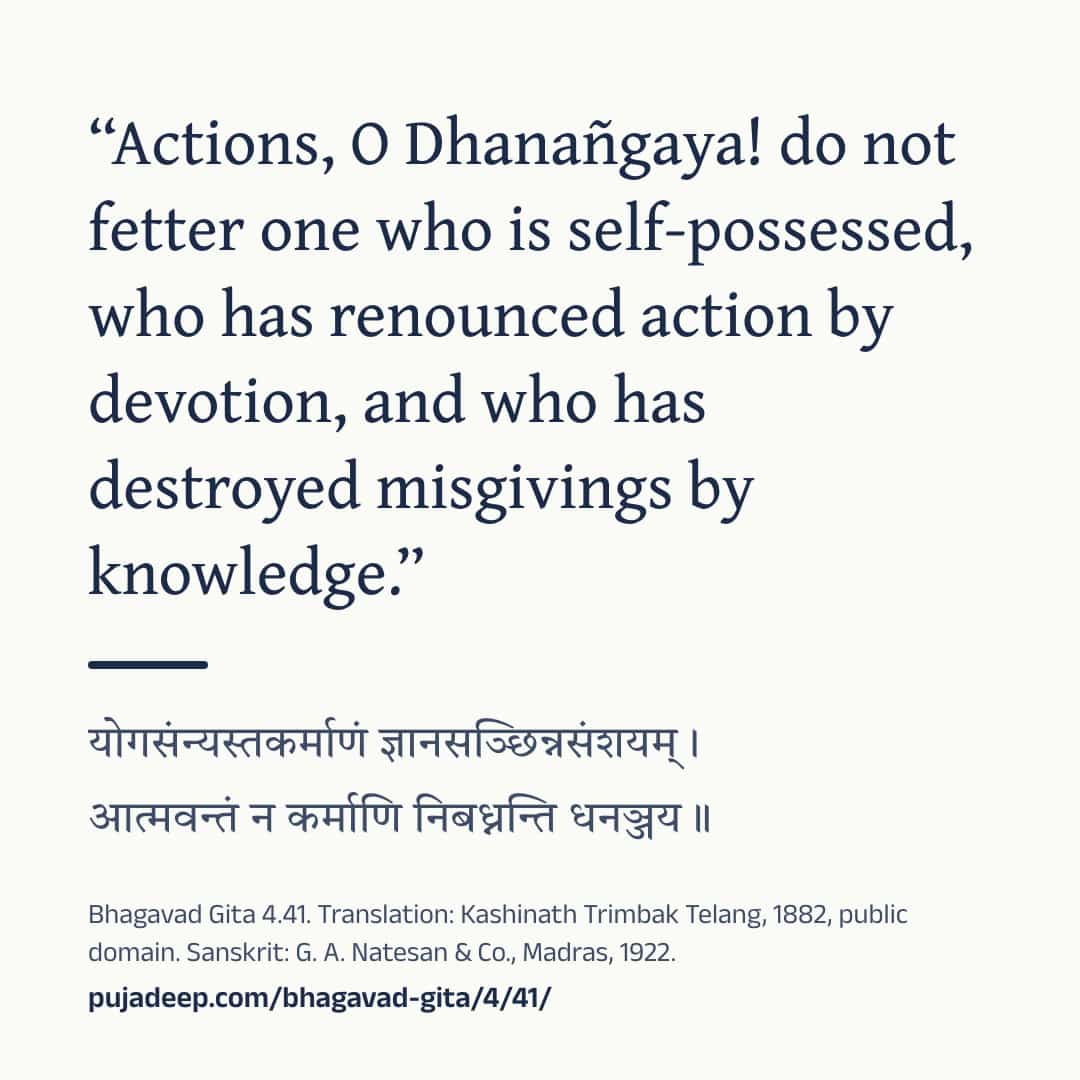
Drawing the picture
See the words
Bhagavad Gita 4.41

योगसंन्यस्तकर्माणं ज्ञानसञ्छिन्नसंशयम् ।
आत्मवन्तं न कर्माणि निबध्नन्ति धनञ्जय ॥

“Actions, O Dhanañgaya! do not fetter one who is self-possessed, who has renounced action by devotion, and who has destroyed misgivings by knowledge.”
(K. T. Telang, The Bhagavadgîtâ (The Sacred Books of the East, vol. VIII, Oxford: Clarendon Press, 1882), p. 63, public domain)

“He who hath renounced actions by Yoga, who hath cloven asunder doubt by wisdom, who is ruled by the SELF, actions do not bind him, O Dhananjaya.”
(Annie Besant, The Bhagavad Gîtâ, or The Lord's Song (London: Theosophical Publishing Society, 1895), p. 57, public domain)

“With work renounced by Yoga, and doubts rent asunder by knowledge, O Dhananjaya, actions do not bind him who is poised in the Self.”
(Swami Swarupananda, Srimad-Bhagavad-Gita (Mayavati: Prabuddha Bharata Press, 1909; first printed in Prabuddha Bharata, 1907–1909), p. 104, public domain)

Sanskrit: G. A. Natesan & Co., Madras, 1922.
https://pujadeep.com/bhagavad-gita/4/41/ Nothing is sent from this site. Your own app sends it, to the chat you choose. The picture quotes the translation you chose on this page, with its name and year.
Sanskrit text: The Bhagavad-Gita, or The Lord's Song, with the text in Devanagari and an English translation, 1922. Meanings: written for Pujadeep and checked against the cited edition. Source and changes
Questions families ask
Who speaks Bhagavad Gita 4.41?
Krishna speaks this verse, in chapter 4 (Jnana Karma Sannyasa Yoga).
Where does the Sanskrit text come from?
Sanskrit text: The Bhagavad-Gita, or The Lord's Song, with the text in Devanagari and an English translation, 1922. Meanings: written for Pujadeep and checked against the cited edition. See the source
Is the meaning on this page a translation?
Explanation written for this site from the sources listed here, and checked against the cited edition. It is not a translation and not the only way to read the text. Free to quote with credit.
Source and licence
- Sanskrit text
- The Bhagavad-Gita, or The Lord's Song, with the text in Devanagari and an English translation (Annie Besant, G. A. Natesan & Co., Madras, 1922). Public domain. The Sanskrit on these pages was read from this printing’s page images.
- Translation
- The Bhagavadgîtâ with the Sanatsugâtîya and the Anugîtâ, translated by Kâshinâth Trimbak Telang (The Sacred Books of the East, vol. VIII, ed. F. Max Müller) (Kashinath Trimbak Telang, F. Max Müller, Clarendon Press, Oxford, 1882). Public domain. Shown verbatim, as printed.
- Translation
- The Bhagavad Gîtâ, or The Lord's Song, translated by Annie Besant (Annie Besant, Theosophical Publishing Society, London, 1895). Public domain. Shown verbatim, as printed.
- Translation
- Srimad-Bhagavad-Gita, with Sanskrit Text; Paraphrase with Word-by-word Literal Translation; English Rendering and Comments, Index, &c., by the Swami Swarupananda (Himalayan Series, No. XX) (Swami Swarupananda, The Editors and Publishers, Advaita Ashrama, Mayavati, Prabuddha Bharata Press, Mayavati, Almora, Himalayas, 1909). Public domain. Shown verbatim, as printed.
- Common wording
- In this text, 32 words follow today's common wording, checked against sanskritdocuments.org; Sanskrit Wikisource; Gita Press, Gorakhpur; GRETIL, Göttingen and Bhaktivedanta Book Trust.
- Our explanation
- Explanation written for this site from the sources listed here, and checked against the cited edition. It is not a translation and not the only way to read the text. Free to quote with credit.
- Checked
- Checked against the cited edition, October 15, 2026.
- Updated
- October 27, 2026