Bhagavad Gita 4.40: meaning and translation
Chapter 4: Jnana Karma Sannyasa Yoga. Krishna says
Krishna says that a person without knowledge and without faith, whose mind is ruled by doubt, comes to ruin: for such a mind there is no happiness in this world or the next.
Click or tap a word for its meaning and its dictionary page.
Text and layers
Text and layers
These choices stay in this browser.
Bhagavad Gita 4.40
अज्ञश्चाश्रद्दधानश्च संशयात्मा विनश्यति ।नायं लोकोऽस्ति न परो न सुखं संशयात्मनः ॥
Ajnashchashraddadhanashcha sanshayatma vinashyatiNayam lokosti na paro na sukham sanshayatmanah
ajñaścāśraddadhānaśca saṃśayātmā vinaśyati |nāyaṃ loko’sti na paro na sukhaṃ saṃśayātmanaḥ ||
Our explanation Krishna says that a person without knowledge and without faith, whose mind is ruled by doubt, comes to ruin: for such a mind there is no happiness in this world or the next. The word is saṃśayātmā, one whose whole self is doubt (Telang: 'whose self is full of misgivings'). In 4.34 Krishna has just told Arjuna to ask questions of those who know, so the verse does not speak against honest questions.
हिंदी अर्थ कृष्ण कहते हैं कि जो ज्ञान और श्रद्धा से रहित है और जिसका मन संशय से भरा है, उसका पतन होता है: ऐसे मन के लिए न इस लोक में सुख है, न परलोक में। श्लोक का शब्द है संशयात्मा, यानी जिसका पूरा मन ही संशय बन गया हो (तेलंग: 'जिसका मन शंकाओं से भरा है')। श्लोक 34 में कृष्ण ने स्वयं अर्जुन से ज्ञानियों से प्रश्न पूछने को कहा है, इसलिए यह श्लोक सच्चे प्रश्नों के विरुद्ध नहीं है।
Word by word
Every word, with its dictionary page
Word by word
- अज्ञः ajñaḥ · without knowledge (adjective (masculine), nominative singular) Dictionary: a-jña, Monier-Williams 1899, p. 10, col. 3 “not knowing”
- च ca · and (indeclinable) Dictionary: 2. ca, Monier-Williams 1899, p. 380, col. 1 “and, both, also, moreover, as well as”
- अश्रद्दधानः aśraddadhānaḥ · without faith (present participle (masculine), nominative singular) Dictionary: a-śraddadhāna, Monier-Williams 1899, p. 114, col. 2 “not trusting in”
- च ca · and (indeclinable) Dictionary: 2. ca, Monier-Williams 1899, p. 380, col. 1 “and, both, also, moreover, as well as”
- संशयात्मा saṃśayātmā · whose self is doubt (compound (masculine), nominative singular) Dictionary: saṃ-śaya, Monier-Williams 1899, p. 1117, col. 3 “uncertainty, irresolution, hesitation, doubt”; ātman, Monier-Williams 1899, p. 135, col. 1 “the breath, RV.; the soul, principle of life and sensation”
- विनश्यति vinaśyati · comes to ruin (present, 3rd person singular) Dictionary: 2. vi-naś, Monier-Williams 1899, p. 969, col. 2 “to be utterly lost, perish, disappear”
- न na · not (indeclinable) Dictionary: 2. na, Monier-Williams 1899, p. 523, col. 1 “ind. not, no, nor, neither”
- अयम् ayam · this (pronoun (masculine), nominative singular) Dictionary: 1. idam, Monier-Williams 1899, p. 165, col. 2 “this, this here, referring to something near the speaker”
- लोकः lokaḥ · world (noun (masculine), nominative singular) Dictionary: loka, Monier-Williams 1899, p. 906, col. 1 “the wide space or world”
- अस्ति asti · is (present, 3rd person singular) Dictionary: 1. as, Monier-Williams 1899, p. 117, col. 2 “to be, live, exist, be present”
- न na · nor (indeclinable) Dictionary: 2. na, Monier-Williams 1899, p. 523, col. 1 “ind. not, no, nor, neither”
- परः paraḥ · the next (world) (adjective (masculine), nominative singular) Dictionary: 1. para, Monier-Williams 1899, p. 586, col. 1 “highest, supreme, chief”
- न na · nor (indeclinable) Dictionary: 2. na, Monier-Williams 1899, p. 523, col. 1 “ind. not, no, nor, neither”
- सुखम् sukham · happiness (noun (neuter), nominative singular) Dictionary: sukha, Monier-Williams 1899, p. 1221, col. 1 “ease, easiness, comfort, prosperity, pleasure, happiness”
- संशयात्मनः saṃśayātmanaḥ · for one whose self is doubt (compound (masculine), genitive singular) Dictionary: saṃ-śaya, Monier-Williams 1899, p. 1117, col. 3 “uncertainty, irresolution, hesitation, doubt”; ātman, Monier-Williams 1899, p. 135, col. 1 “the breath, RV.; the soul, principle of life and sensation”
Old translations
Kashinath Trimbak Telang, 1882. Public domain. Page 63.
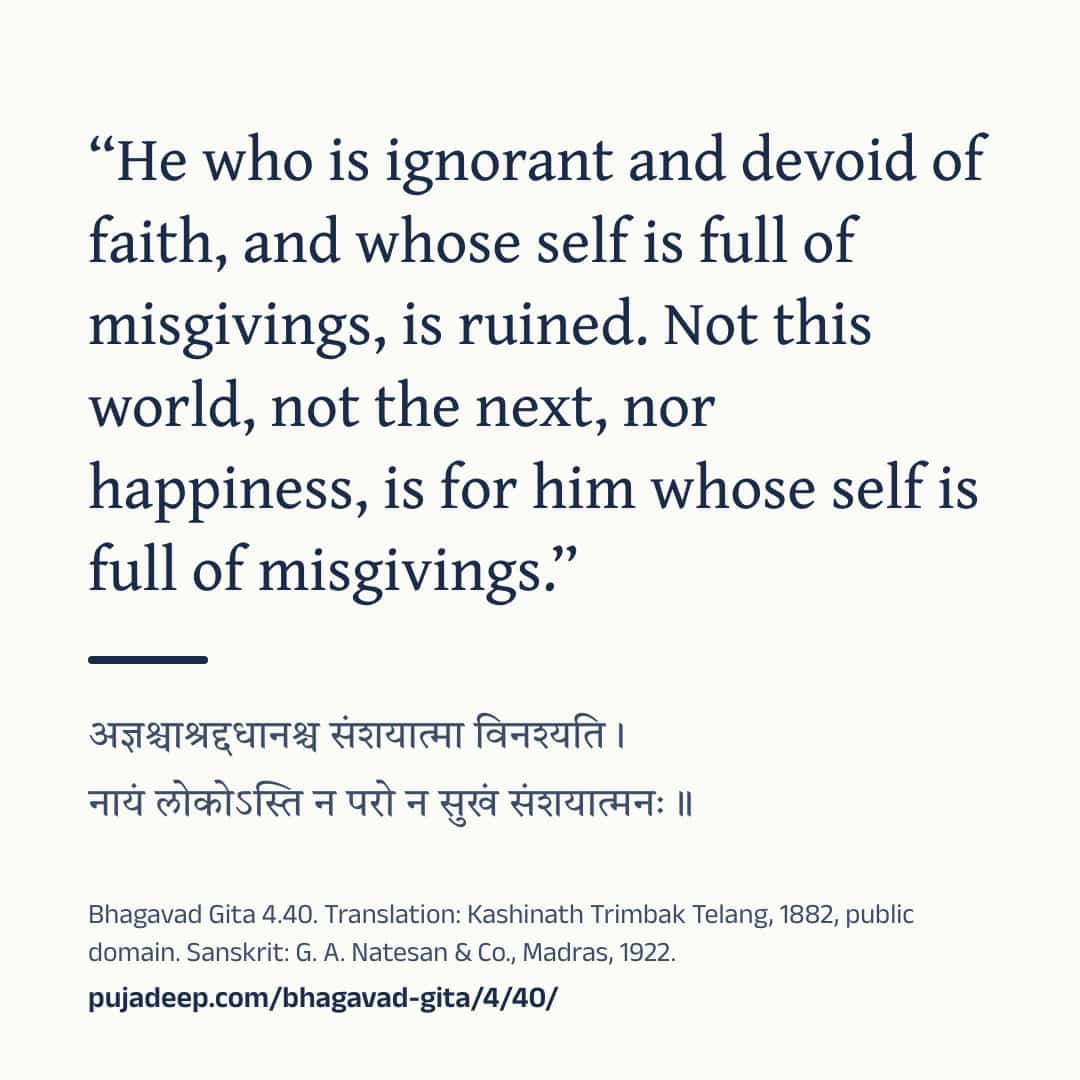
He who is ignorant and devoid of faith, and whose self is full of misgivings, is ruined. Not this world, not the next, nor happiness, is for him whose self is full of misgivings.
Compare 3 translations
Kashinath Trimbak Telang, 1882. Public domain. Page 63.
He who is ignorant and devoid of faith, and whose self is full of misgivings, is ruined. Not this world, not the next, nor happiness, is for him whose self is full of misgivings.
You are reading this one
Annie Besant, 1895. Public domain. Page 57.
But the ignorant, faithless, doubting self goeth to destruction; neither in this world nor in that beyond is there happiness for the doubting self.
You are reading this one
Swami Swarupananda, 1909 (first printed 1907). Public domain. Page 103.
The ignorant, the man without shraddha, the doubting self, goes to destruction. The doubting self has neither this world, nor the next, nor happiness.
You are reading this one
Cite this verse
The translation: K. T. Telang, The Bhagavadgîtâ (The Sacred Books of the East, vol. VIII, Oxford: Clarendon Press, 1882), p. 63. Bhagavad Gita 4.40.
The translation: Annie Besant, The Bhagavad Gîtâ, or The Lord's Song (London: Theosophical Publishing Society, 1895), p. 57. Bhagavad Gita 4.40.
The translation: Swami Swarupananda, Srimad-Bhagavad-Gita (Mayavati: Prabuddha Bharata Press, 1909; first printed in Prabuddha Bharata, 1907–1909), p. 103. Bhagavad Gita 4.40.
Our explanation: “Bhagavad Gita 4.40: meaning and translation.” Pujadeep. Updated October 27, 2026. https://pujadeep.com/bhagavad-gita/4/40/
Pujadeep’s explanations are free to quote with credit: name Pujadeep and link to the page. How to credit
Classical readings, by school
No readings by school on this verse yet.
Share
Show the ways to share
Send one picture or the text to one chat. The picture names its source and the address of this page.
Drawing the picture
See the words
Bhagavad Gita 4.40

अज्ञश्चाश्रद्दधानश्च संशयात्मा विनश्यति ।
नायं लोकोऽस्ति न परो न सुखं संशयात्मनः ॥

“He who is ignorant and devoid of faith, and whose self is full of misgivings, is ruined. Not this world, not the next, nor happiness, is for him whose self is full of misgivings.”
(K. T. Telang, The Bhagavadgîtâ (The Sacred Books of the East, vol. VIII, Oxford: Clarendon Press, 1882), p. 63, public domain)

“But the ignorant, faithless, doubting self goeth to destruction; neither in this world nor in that beyond is there happiness for the doubting self.”
(Annie Besant, The Bhagavad Gîtâ, or The Lord's Song (London: Theosophical Publishing Society, 1895), p. 57, public domain)

“The ignorant, the man without shraddha, the doubting self, goes to destruction. The doubting self has neither this world, nor the next, nor happiness.”
(Swami Swarupananda, Srimad-Bhagavad-Gita (Mayavati: Prabuddha Bharata Press, 1909; first printed in Prabuddha Bharata, 1907–1909), p. 103, public domain)

Sanskrit: G. A. Natesan & Co., Madras, 1922.
https://pujadeep.com/bhagavad-gita/4/40/ Nothing is sent from this site. Your own app sends it, to the chat you choose. The picture quotes the translation you chose on this page, with its name and year.
Sanskrit text: The Bhagavad-Gita, or The Lord's Song, with the text in Devanagari and an English translation, 1922. Meanings: written for Pujadeep and checked against the cited edition. Source and changes
Questions families ask
Who speaks Bhagavad Gita 4.40?
Krishna speaks this verse, in chapter 4 (Jnana Karma Sannyasa Yoga).
Where does the Sanskrit text come from?
Sanskrit text: The Bhagavad-Gita, or The Lord's Song, with the text in Devanagari and an English translation, 1922. Meanings: written for Pujadeep and checked against the cited edition. See the source
Is the meaning on this page a translation?
Explanation written for this site from the sources listed here, and checked against the cited edition. It is not a translation and not the only way to read the text. Free to quote with credit.
Source and licence
- Sanskrit text
- The Bhagavad-Gita, or The Lord's Song, with the text in Devanagari and an English translation (Annie Besant, G. A. Natesan & Co., Madras, 1922). Public domain. The Sanskrit on these pages was read from this printing’s page images.
- Translation
- The Bhagavadgîtâ with the Sanatsugâtîya and the Anugîtâ, translated by Kâshinâth Trimbak Telang (The Sacred Books of the East, vol. VIII, ed. F. Max Müller) (Kashinath Trimbak Telang, F. Max Müller, Clarendon Press, Oxford, 1882). Public domain. Shown verbatim, as printed.
- Translation
- The Bhagavad Gîtâ, or The Lord's Song, translated by Annie Besant (Annie Besant, Theosophical Publishing Society, London, 1895). Public domain. Shown verbatim, as printed.
- Translation
- Srimad-Bhagavad-Gita, with Sanskrit Text; Paraphrase with Word-by-word Literal Translation; English Rendering and Comments, Index, &c., by the Swami Swarupananda (Himalayan Series, No. XX) (Swami Swarupananda, The Editors and Publishers, Advaita Ashrama, Mayavati, Prabuddha Bharata Press, Mayavati, Almora, Himalayas, 1909). Public domain. Shown verbatim, as printed.
- Common wording
- In this text, 32 words follow today's common wording, checked against sanskritdocuments.org; Sanskrit Wikisource; Gita Press, Gorakhpur; GRETIL, Göttingen and Bhaktivedanta Book Trust.
- Our explanation
- Explanation written for this site from the sources listed here, and checked against the cited edition. It is not a translation and not the only way to read the text. Free to quote with credit.
- Checked
- Checked against the cited edition, October 15, 2026.
- Updated
- October 27, 2026