Bhagavad Gita 4.42: meaning and translation
Chapter 4: Jnana Karma Sannyasa Yoga. Krishna says
So, Krishna says, Arjuna should cut through this doubt in his heart, born of ignorance, with the sword of knowledge, take his stand in yoga, and rise.
Click or tap a word for its meaning and its dictionary page.
Text and layers
Text and layers
These choices stay in this browser.
Bhagavad Gita 4.42
तस्मादज्ञानसम्भूतं हृत्स्थं ज्ञानासिनाऽऽत्मनः ।छित्त्वैनं संशयं योगमातिष्ठोत्तिष्ठ भारत ॥
Tasmadajnanasambhutam hritstham jnanasinatmanahChhittvainam sanshayam yogamatishthottishtha bharata
tasmādajñānasambhūtaṃ hṛtsthaṃ jñānāsinā’’tmanaḥ |chittvainaṃ saṃśayaṃ yogamātiṣṭhottiṣṭha bhārata ||
Our explanation So, Krishna says, Arjuna should cut through this doubt in his heart, born of ignorance, with the sword of knowledge, take his stand in yoga, and rise. The chapter ends with the same call to stand up that Krishna first gave in chapter 2 (2.3).
हिंदी अर्थ इसलिए कृष्ण कहते हैं कि अर्जुन अज्ञान से जन्मे, हृदय में बसे इस संशय को ज्ञान की तलवार से काटकर योग में स्थित हों और उठ खड़े हों। अध्याय उसी पुकार पर समाप्त होता है जो कृष्ण ने अध्याय 2 (श्लोक 3) में दी थी: खड़े हो जाओ।
Word by word
Every word, with its dictionary page
Word by word
- तस्मात् tasmāt · therefore (indeclinable) Dictionary: tasmāt, Monier-Williams 1899, p. 441, col. 2 “from that, on that account, therefore”
- अज्ञानसम्भूतम् ajñānasambhūtam · born of ignorance (compound (masculine), accusative singular) Dictionary: a-jñāna, Monier-Williams 1899, p. 10, col. 3 “non-cognizance; ignorance”; sam-bhūta, Monier-Williams 1899, p. 1179, col. 2 “become, born, produced or arisen or proceeding from”
- हृत्स्थम् hṛtstham · in the heart (compound (masculine), accusative singular) Dictionary: hṛt-stha, Monier-Williams 1899, p. 1303, col. 1 “being in the heart”
- ज्ञानासिना jñānāsinā · with the sword of knowledge (compound (masculine), instrumental singular) Dictionary: jñāna, Monier-Williams 1899, p. 426, col. 1 “knowing, becoming acquainted with, knowledge”; asi, Monier-Williams 1899, p. 120, col. 2 “a sword, cimeter, knife”
- आत्मनः ātmanaḥ · of your own (self) (noun (masculine), genitive singular) Dictionary: ātman, Monier-Williams 1899, p. 135, col. 1 “the breath, RV.; the soul, principle of life and sensation”
- छित्त्वा chittvā · having cut (absolutive (having done)) Dictionary: 1. chid, Monier-Williams 1899, p. 406, col. 2 “to cut off, amputate, cut through”
- एनम् enam · this (pronoun (masculine), accusative singular) Dictionary: 1. ena, Monier-Williams 1899, p. 232, col. 1 “he, she, it; this, that”
- संशयम् saṃśayam · doubt (noun (masculine), accusative singular) Dictionary: saṃ-śaya, Monier-Williams 1899, p. 1117, col. 3 “uncertainty, irresolution, hesitation, doubt”
- योगम् yogam · yoga (noun (masculine), accusative singular) Dictionary: yoga, Monier-Williams 1899, p. 856, col. 2 “the act of yoking, joining, attaching”
- आतिष्ठ ātiṣṭha · take your stand in (imperative, 2nd person singular) Dictionary: 1. ā-sthā, Monier-Williams 1899, p. 161, col. 2 “to stand or remain on or by”
- उत्तिष्ठ uttiṣṭha · stand up (imperative, 2nd person singular) Dictionary: ut-thā, Monier-Williams 1899, p. 179, col. 3 “to stand up, spring up, rise”
- भारत bhārata · O Bharata (Arjuna) (noun (masculine), vocative singular) Dictionary: bhārata, Monier-Williams 1899, p. 753, col. 1
1 printing differs
Edition differences. Another printing or text reads this place differently.
- Spelling A digital text reads Same words. The 1922 edition marks the merged vowel with an avagraha (ऽ); this e-text does not. Edition: ज्ञानासिनाऽऽत्मनः.
Old translations
Kashinath Trimbak Telang, 1882. Public domain. Page 63.
Therefore, O descendant of Bharata! destroy, with the sword of knowledge, these misgivings of yours which fill your mind, and which are produced from ignorance. Engage in devotion. Arise!
Compare 3 translations
Kashinath Trimbak Telang, 1882. Public domain. Page 63.
Therefore, O descendant of Bharata! destroy, with the sword of knowledge, these misgivings of yours which fill your mind, and which are produced from ignorance. Engage in devotion. Arise!
You are reading this one
Annie Besant, 1895. Public domain. Page 57.
Therefore, with the sword of the wisdom of the SELF cleave asunder this ignorance-born doubt, dwelling in thy heart, and be established in Yoga. Stand up, O Bhârata!
You are reading this one
Swami Swarupananda, 1909 (first printed 1907). Public domain. Page 104.
Therefore, cutting with the sword of knowledge, this doubt about the Self, born of ignorance, residing in thy heart, take refuge in Yoga. Arise, O Bhârata!
You are reading this one
Cite this verse
The translation: K. T. Telang, The Bhagavadgîtâ (The Sacred Books of the East, vol. VIII, Oxford: Clarendon Press, 1882), p. 63. Bhagavad Gita 4.42.
The translation: Annie Besant, The Bhagavad Gîtâ, or The Lord's Song (London: Theosophical Publishing Society, 1895), p. 57. Bhagavad Gita 4.42.
The translation: Swami Swarupananda, Srimad-Bhagavad-Gita (Mayavati: Prabuddha Bharata Press, 1909; first printed in Prabuddha Bharata, 1907–1909), p. 104. Bhagavad Gita 4.42.
Our explanation: “Bhagavad Gita 4.42: meaning and translation.” Pujadeep. Updated October 27, 2026. https://pujadeep.com/bhagavad-gita/4/42/
Pujadeep’s explanations are free to quote with credit: name Pujadeep and link to the page. How to credit
Classical readings, by school
No readings by school on this verse yet.
Share
Show the ways to share
Send one picture or the text to one chat. The picture names its source and the address of this page.
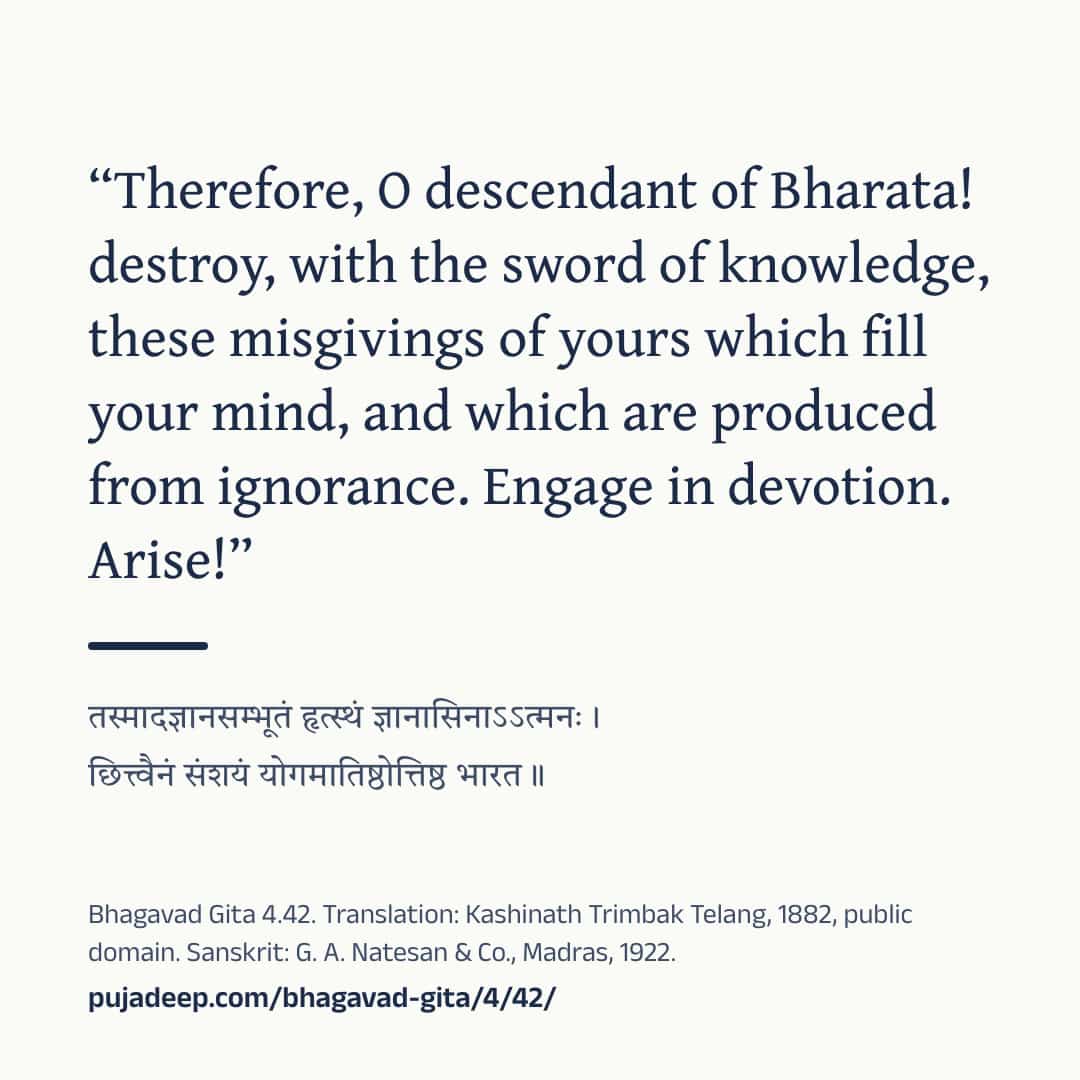
Drawing the picture
See the words
Bhagavad Gita 4.42

तस्मादज्ञानसम्भूतं हृत्स्थं ज्ञानासिनाऽऽत्मनः ।
छित्त्वैनं संशयं योगमातिष्ठोत्तिष्ठ भारत ॥

“Therefore, O descendant of Bharata! destroy, with the sword of knowledge, these misgivings of yours which fill your mind, and which are produced from ignorance. Engage in devotion. Arise!”
(K. T. Telang, The Bhagavadgîtâ (The Sacred Books of the East, vol. VIII, Oxford: Clarendon Press, 1882), p. 63, public domain)

“Therefore, with the sword of the wisdom of the SELF cleave asunder this ignorance-born doubt, dwelling in thy heart, and be established in Yoga. Stand up, O Bhârata!”
(Annie Besant, The Bhagavad Gîtâ, or The Lord's Song (London: Theosophical Publishing Society, 1895), p. 57, public domain)

“Therefore, cutting with the sword of knowledge, this doubt about the Self, born of ignorance, residing in thy heart, take refuge in Yoga. Arise, O Bhârata!”
(Swami Swarupananda, Srimad-Bhagavad-Gita (Mayavati: Prabuddha Bharata Press, 1909; first printed in Prabuddha Bharata, 1907–1909), p. 104, public domain)

Sanskrit: G. A. Natesan & Co., Madras, 1922.
https://pujadeep.com/bhagavad-gita/4/42/ Nothing is sent from this site. Your own app sends it, to the chat you choose. The picture quotes the translation you chose on this page, with its name and year.
Sanskrit text: The Bhagavad-Gita, or The Lord's Song, with the text in Devanagari and an English translation, 1922. Meanings: written for Pujadeep and checked against the cited edition. Source and changes
Questions families ask
Who speaks Bhagavad Gita 4.42?
Krishna speaks this verse, in chapter 4 (Jnana Karma Sannyasa Yoga).
Where does the Sanskrit text come from?
Sanskrit text: The Bhagavad-Gita, or The Lord's Song, with the text in Devanagari and an English translation, 1922. Meanings: written for Pujadeep and checked against the cited edition. See the source
Is the meaning on this page a translation?
Explanation written for this site from the sources listed here, and checked against the cited edition. It is not a translation and not the only way to read the text. Free to quote with credit.
Source and licence
- Sanskrit text
- The Bhagavad-Gita, or The Lord's Song, with the text in Devanagari and an English translation (Annie Besant, G. A. Natesan & Co., Madras, 1922). Public domain. The Sanskrit on these pages was read from this printing’s page images.
- Translation
- The Bhagavadgîtâ with the Sanatsugâtîya and the Anugîtâ, translated by Kâshinâth Trimbak Telang (The Sacred Books of the East, vol. VIII, ed. F. Max Müller) (Kashinath Trimbak Telang, F. Max Müller, Clarendon Press, Oxford, 1882). Public domain. Shown verbatim, as printed.
- Translation
- The Bhagavad Gîtâ, or The Lord's Song, translated by Annie Besant (Annie Besant, Theosophical Publishing Society, London, 1895). Public domain. Shown verbatim, as printed.
- Translation
- Srimad-Bhagavad-Gita, with Sanskrit Text; Paraphrase with Word-by-word Literal Translation; English Rendering and Comments, Index, &c., by the Swami Swarupananda (Himalayan Series, No. XX) (Swami Swarupananda, The Editors and Publishers, Advaita Ashrama, Mayavati, Prabuddha Bharata Press, Mayavati, Almora, Himalayas, 1909). Public domain. Shown verbatim, as printed.
- Common wording
- In this text, 32 words follow today's common wording, checked against sanskritdocuments.org; Sanskrit Wikisource; Gita Press, Gorakhpur; GRETIL, Göttingen and Bhaktivedanta Book Trust.
- Our explanation
- Explanation written for this site from the sources listed here, and checked against the cited edition. It is not a translation and not the only way to read the text. Free to quote with credit.
- Checked
- Checked against the cited edition, October 15, 2026.
- Updated
- October 27, 2026