Bhagavad Gita 4.33: meaning and translation
Chapter 4: Jnana Karma Sannyasa Yoga. Krishna says
The offering of knowledge is better than the offering of material things, Krishna says, because all action, in its entirety, comes to completion in knowledge.
Click or tap a word for its meaning and its dictionary page.
Text and layers
Text and layers
These choices stay in this browser.
Bhagavad Gita 4.33
श्रेयान्द्रव्यमयाद्यज्ञाज्ज्ञानयज्ञः परन्तप ।सर्वं कर्माखिलं पार्थ ज्ञाने परिसमाप्यते ॥
Shreyandravyamayadyajnajjnanayajnah parantapaSarvam karmakhilam partha jnane parisamapyate
śreyāndravyamayādyajñājjñānayajñaḥ parantapa |sarvaṃ karmākhilaṃ pārtha jñāne parisamāpyate ||
Our explanation The offering of knowledge is better than the offering of material things, Krishna says, because all action, in its entirety, comes to completion in knowledge.
हिंदी अर्थ कृष्ण कहते हैं कि द्रव्य से होने वाले यज्ञ से ज्ञान-यज्ञ श्रेष्ठ है, क्योंकि सारे कर्म ज्ञान में ही पूरे होते हैं।
Word by word
Every word, with its dictionary page
Word by word
- श्रेयान् śreyān · better (adjective (masculine), nominative singular) Dictionary: śreyas, Monier-Williams 1899, p. 1102, col. 2 “superior, preferable, better”
- द्रव्यमयात् dravyamayāt · made of material things (compound (masculine), ablative singular) Dictionary: dravya, Monier-Williams 1899, p. 501, col. 1 “a substance, thing, object”
- यज्ञात् yajñāt · than the offering (noun (masculine), ablative singular) Dictionary: yajña, Monier-Williams 1899, p. 839, col. 2 “worship, devotion, prayer, praise; act of worship or devotion, offering, oblation, sacrifice”
- ज्ञानयज्ञः jñānayajñaḥ · the offering of knowledge (compound (masculine), nominative singular) Dictionary: jñāna, Monier-Williams 1899, p. 426, col. 1 “knowing, becoming acquainted with, knowledge”; yajña, Monier-Williams 1899, p. 839, col. 2 “worship, devotion, prayer, praise; act of worship or devotion, offering, oblation, sacrifice”
- परन्तप parantapa · O scorcher of foes (noun (masculine), vocative singular) Dictionary: param-tapa, Monier-Williams 1899, p. 586, col. 3 “destroying foes (said of heroes)”
- सर्वम् sarvam · all (pronoun (neuter), nominative singular) Dictionary: sarva, Monier-Williams 1899, p. 1184, col. 3 “whole, entire, all, every”
- कर्म karma · action (noun (neuter), nominative singular) Dictionary: karman, Monier-Williams 1899, p. 258, col. 2 “act, action, performance, business”
- अखिलम् akhilam · entire (adjective (neuter), nominative singular) Dictionary: a-khila, Monier-Williams 1899, p. 4, col. 2 “without a gap, complete, whole”
- पार्थ pārtha · O Partha (noun (masculine), vocative singular) Dictionary: 2. pārtha, Monier-Williams 1899, p. 621, col. 3
- ज्ञाने jñāne · in knowledge (noun (neuter), locative singular) Dictionary: jñāna, Monier-Williams 1899, p. 426, col. 1 “knowing, becoming acquainted with, knowledge”
- परिसमाप्यते parisamāpyate · comes to completion (present passive, 3rd person singular) Dictionary: pari-sam-āp, Monier-Williams 1899, p. 603, col. 3 “to be fully completed, arrive at completion”
Old translations
Kashinath Trimbak Telang, 1882. Public domain. Page 62.
The sacrifice of knowledge, O terror of (your) foes! is superior to the sacrifice of wealth, for action, O son of Prithâ! is wholly and entirely comprehended in knowledge.
Compare 3 translations
Kashinath Trimbak Telang, 1882. Public domain. Page 62.
The sacrifice of knowledge, O terror of (your) foes! is superior to the sacrifice of wealth, for action, O son of Prithâ! is wholly and entirely comprehended in knowledge.
You are reading this one
Annie Besant, 1895. Public domain. Page 55.
Better than the sacrifice of wealth is the sacrifice of wisdom, O Parantapa. All actions in their entirety, O Pârtha, are contained in wisdom.
You are reading this one
Swami Swarupananda, 1909 (first printed 1907). Public domain. Page 100.
Knowledge-sacrifice, O scorcher of foes, is superior to sacrifice (performed) with (material) objects. All action in its entirety, O Pârtha, attains its consummation in knowledge.
You are reading this one
Cite this verse
The translation: K. T. Telang, The Bhagavadgîtâ (The Sacred Books of the East, vol. VIII, Oxford: Clarendon Press, 1882), p. 62. Bhagavad Gita 4.33.
The translation: Annie Besant, The Bhagavad Gîtâ, or The Lord's Song (London: Theosophical Publishing Society, 1895), p. 55. Bhagavad Gita 4.33.
The translation: Swami Swarupananda, Srimad-Bhagavad-Gita (Mayavati: Prabuddha Bharata Press, 1909; first printed in Prabuddha Bharata, 1907–1909), p. 100. Bhagavad Gita 4.33.
Our explanation: “Bhagavad Gita 4.33: meaning and translation.” Pujadeep. Updated October 27, 2026. https://pujadeep.com/bhagavad-gita/4/33/
Pujadeep’s explanations are free to quote with credit: name Pujadeep and link to the page. How to credit
Classical readings, by school
No readings by school on this verse yet.
Share
Show the ways to share
Send one picture or the text to one chat. The picture names its source and the address of this page.
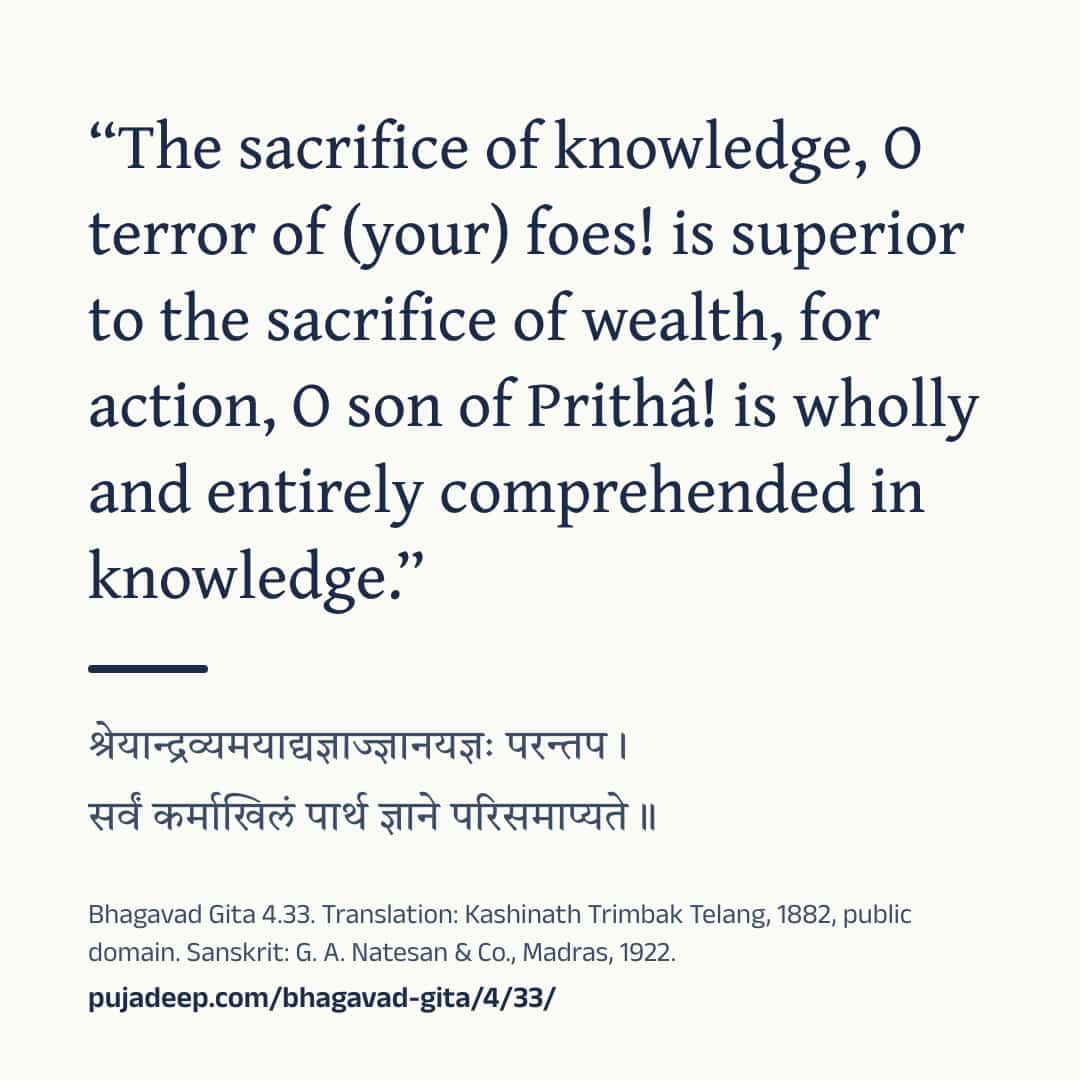
Drawing the picture
See the words
Bhagavad Gita 4.33

श्रेयान्द्रव्यमयाद्यज्ञाज्ज्ञानयज्ञः परन्तप ।
सर्वं कर्माखिलं पार्थ ज्ञाने परिसमाप्यते ॥

“The sacrifice of knowledge, O terror of (your) foes! is superior to the sacrifice of wealth, for action, O son of Prithâ! is wholly and entirely comprehended in knowledge.”
(K. T. Telang, The Bhagavadgîtâ (The Sacred Books of the East, vol. VIII, Oxford: Clarendon Press, 1882), p. 62, public domain)

“Better than the sacrifice of wealth is the sacrifice of wisdom, O Parantapa. All actions in their entirety, O Pârtha, are contained in wisdom.”
(Annie Besant, The Bhagavad Gîtâ, or The Lord's Song (London: Theosophical Publishing Society, 1895), p. 55, public domain)

“Knowledge-sacrifice, O scorcher of foes, is superior to sacrifice (performed) with (material) objects. All action in its entirety, O Pârtha, attains its consummation in knowledge.”
(Swami Swarupananda, Srimad-Bhagavad-Gita (Mayavati: Prabuddha Bharata Press, 1909; first printed in Prabuddha Bharata, 1907–1909), p. 100, public domain)

Sanskrit: G. A. Natesan & Co., Madras, 1922.
https://pujadeep.com/bhagavad-gita/4/33/ Nothing is sent from this site. Your own app sends it, to the chat you choose. The picture quotes the translation you chose on this page, with its name and year.
Sanskrit text: The Bhagavad-Gita, or The Lord's Song, with the text in Devanagari and an English translation, 1922. Meanings: written for Pujadeep and checked against the cited edition. Source and changes
Questions families ask
Who speaks Bhagavad Gita 4.33?
Krishna speaks this verse, in chapter 4 (Jnana Karma Sannyasa Yoga).
Where does the Sanskrit text come from?
Sanskrit text: The Bhagavad-Gita, or The Lord's Song, with the text in Devanagari and an English translation, 1922. Meanings: written for Pujadeep and checked against the cited edition. See the source
Is the meaning on this page a translation?
Explanation written for this site from the sources listed here, and checked against the cited edition. It is not a translation and not the only way to read the text. Free to quote with credit.
Source and licence
- Sanskrit text
- The Bhagavad-Gita, or The Lord's Song, with the text in Devanagari and an English translation (Annie Besant, G. A. Natesan & Co., Madras, 1922). Public domain. The Sanskrit on these pages was read from this printing’s page images.
- Translation
- The Bhagavadgîtâ with the Sanatsugâtîya and the Anugîtâ, translated by Kâshinâth Trimbak Telang (The Sacred Books of the East, vol. VIII, ed. F. Max Müller) (Kashinath Trimbak Telang, F. Max Müller, Clarendon Press, Oxford, 1882). Public domain. Shown verbatim, as printed.
- Translation
- The Bhagavad Gîtâ, or The Lord's Song, translated by Annie Besant (Annie Besant, Theosophical Publishing Society, London, 1895). Public domain. Shown verbatim, as printed.
- Translation
- Srimad-Bhagavad-Gita, with Sanskrit Text; Paraphrase with Word-by-word Literal Translation; English Rendering and Comments, Index, &c., by the Swami Swarupananda (Himalayan Series, No. XX) (Swami Swarupananda, The Editors and Publishers, Advaita Ashrama, Mayavati, Prabuddha Bharata Press, Mayavati, Almora, Himalayas, 1909). Public domain. Shown verbatim, as printed.
- Common wording
- In this text, 32 words follow today's common wording, checked against sanskritdocuments.org; Sanskrit Wikisource; Gita Press, Gorakhpur; GRETIL, Göttingen and Bhaktivedanta Book Trust.
- Our explanation
- Explanation written for this site from the sources listed here, and checked against the cited edition. It is not a translation and not the only way to read the text. Free to quote with credit.
- Checked
- Checked against the cited edition, October 15, 2026.
- Updated
- October 27, 2026