Bhagavad Gita 4.29: meaning and translation
Chapter 4: Jnana Karma Sannyasa Yoga. Krishna says
Krishna: Others, devoted to breath control (prāṇāyāma), offer prāṇa into apāna and apāna into prāṇa, and hold back the flow of both.
Click or tap a word for its meaning and its dictionary page.
Text and layers
Text and layers
These choices stay in this browser.
Bhagavad Gita 4.29
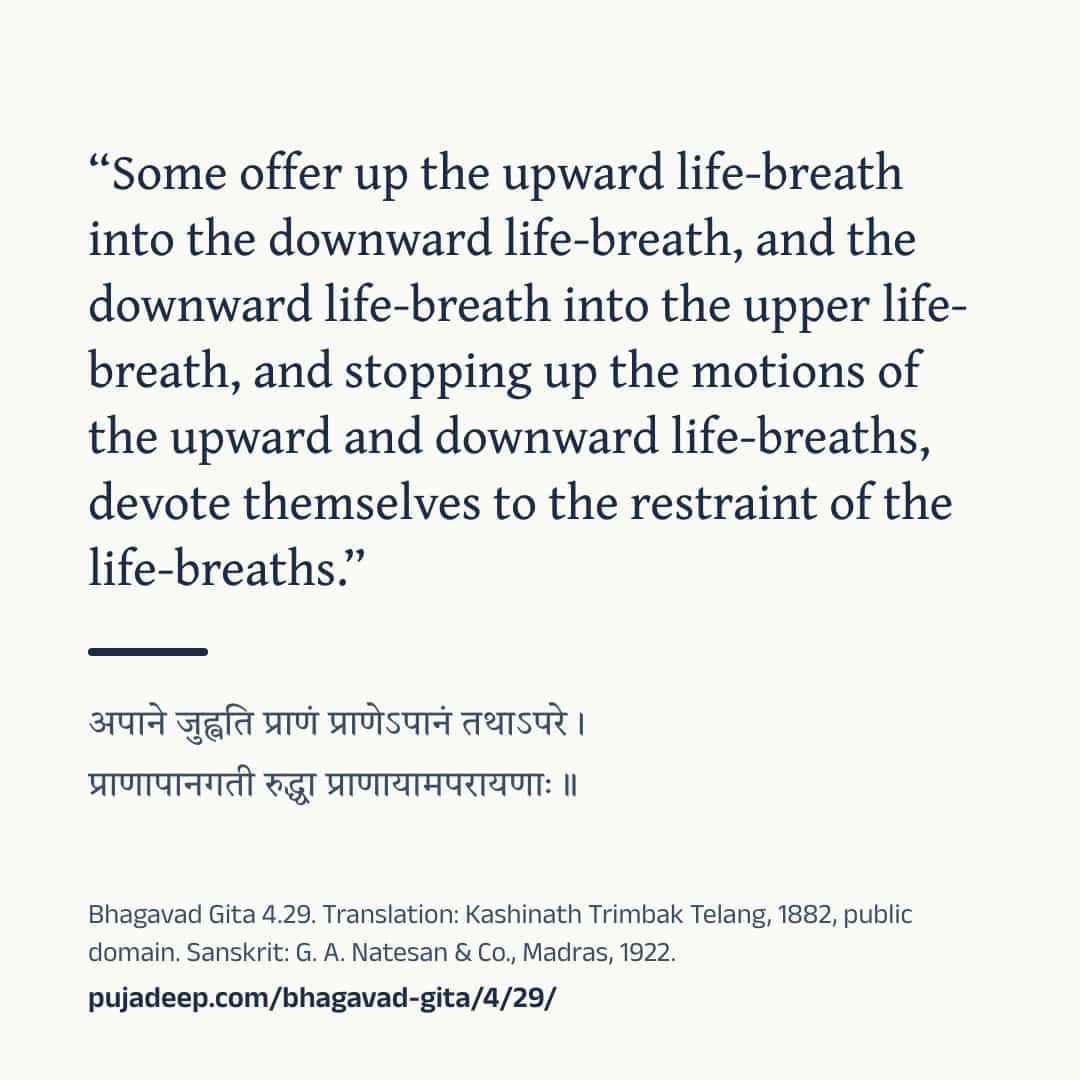
अपाने जुह्वति प्राणं प्राणेऽपानं तथाऽपरे ।प्राणापानगती रुद्ध्वा प्राणायामपरायणाः ॥
Apane juhvati pranam pranepanam tathaparePranapanagati ruddhva pranayamaparayanah
apāne juhvati prāṇaṃ prāṇe’pānaṃ tathā’pare |prāṇāpānagatī ruddhvā prāṇāyāmaparāyaṇāḥ ||
Our explanation Others, devoted to breath control (prāṇāyāma), offer prāṇa into apāna and apāna into prāṇa, and hold back the flow of both. Telang calls prāṇa the upward breath and apāna the downward one; Besant calls them the outgoing and the incoming breath.
हिंदी अर्थ दूसरे, जो प्राणायाम में लगे हैं, अपान में प्राण का और प्राण में अपान का होम करते हैं, और दोनों की गति को रोकते हैं। तेलंग प्राण को ऊपर जाने वाली और अपान को नीचे जाने वाली श्वास कहते हैं; बेसेंट इन्हें बाहर जाने वाली और भीतर आने वाली श्वास कहती हैं।
Word by word
Every word, with its dictionary page
Word by word
- अपाने apāne · into apāna (noun (masculine), locative singular) Dictionary: apāna, Monier-Williams 1899, p. 54, col. 2 “that of the five vital airs which goes downwards”
- जुह्वति juhvati · offer (present, 3rd person plural) Dictionary: 1. hu, Monier-Williams 1899, p. 1301, col. 1 “to sacrifice (esp. pour butter into the fire), offer or present an oblation”
- प्राणम् prāṇam · prāṇa (noun (masculine), accusative singular) Dictionary: prāṇa, Monier-Williams 1899, p. 705, col. 1 “the breath of life, breath, respiration, spirit, vitality”
- प्राणे prāṇe · into prāṇa (noun (masculine), locative singular) Dictionary: prāṇa, Monier-Williams 1899, p. 705, col. 1 “the breath of life, breath, respiration, spirit, vitality”
- अपानम् apānam · apāna (noun (masculine), accusative singular) Dictionary: apāna, Monier-Williams 1899, p. 54, col. 2 “that of the five vital airs which goes downwards”
- तथा tathā · likewise (indeclinable) Dictionary: tathā, Monier-Williams 1899, p. 433, col. 3 “in that manner, so, thus”
- अपरे apare · others (pronoun (masculine), nominative plural) Dictionary: 2. apara, Monier-Williams 1899, p. 50, col. 3 “other, another”
- प्राणापानगती prāṇāpānagatī · the flow of prāṇa and apāna (compound (feminine), accusative dual) Dictionary: prāṇa, Monier-Williams 1899, p. 705, col. 1 “the breath of life, breath, respiration, spirit, vitality”; apāna, Monier-Williams 1899, p. 54, col. 2 “that of the five vital airs which goes downwards”; gati, Monier-Williams 1899, p. 347, col. 3 “going, moving, gait, deportment, motion in general”
- रुद्ध्वा ruddhvā · having held back (absolutive (having done)) Dictionary: 2. rudh, Monier-Williams 1899, p. 884, col. 1 “to obstruct, check, arrest, stop, restrain”
- प्राणायामपरायणाः prāṇāyāmaparāyaṇāḥ · devoted to breath control (compound (masculine), nominative plural) Dictionary: prāṇāyāma, Monier-Williams 1899, p. 706, col. 1 “N. of the three ‘breath-exercises’ performed during Saṃdhyā”; parāyaṇa, Monier-Williams 1899, p. 587, col. 3 “final end or aim, last resort or refuge, principal object”
2 printings differ
Edition differences. Another printing or text reads this place differently.
- The printed edition reads: अपाने जुह्वति प्राणं प्राणेऽपानं तथाऽपरे ।
प्राणापानगती रुध्वा प्राणायामपरायणाः ॥ The print reads रुध्वा (leaf n79), with a single ध्; shown as रुद्ध्वा, the absolutive of rudh ('having restrained'), as both proofreading references read. - Spelling A digital text reads Same words. The 1922 edition marks the merged vowel with an avagraha (ऽ); this e-text does not. Edition: तथाऽपरे.
Old translations
Kashinath Trimbak Telang, 1882. Public domain. Page 61.
Some offer up the upward life-breath into the downward life-breath, and the downward life-breath into the upper life-breath, and stopping up the motions of the upward and downward life-breaths, devote themselves to the restraint of the life-breaths1.
Footnotes (the translator’s own) - Maitrî-upanishad, p. 129. ↩
Compare 3 translations
Kashinath Trimbak Telang, 1882. Public domain. Page 61.
Some offer up the upward life-breath into the downward life-breath, and the downward life-breath into the upper life-breath, and stopping up the motions of the upward and downward life-breaths, devote themselves to the restraint of the life-breaths1.
Footnotes (the translator’s own) - Maitrî-upanishad, p. 129. ↩
You are reading this one
Annie Besant, 1895. Public domain. Page 54–55.
Yet others pour as sacrifice the outgoing breath in the incoming, and the incoming in the outgoing, impeding the channels of the outgoing and incoming breaths, solely absorbed in Prânâyâma;1
This sentence begins in 4.25. This sentence goes on in 4.30.
Footnotes (the translator’s own) - Restraint of breath, a technical name for this practice. ↩
You are reading this one
Swami Swarupananda, 1909 (first printed 1907). Public domain. Page 98.
Yet some offer as sacrifice, the out-going into the in-coming breath, and the in-coming into the out-going, stopping the courses of the in-coming and out-going breaths, constantly practising the regulation of the vital energy; while others yet of regulated food, offer in the Pranas the functions thereof.
You are reading this one
Cite this verse
The translation: K. T. Telang, The Bhagavadgîtâ (The Sacred Books of the East, vol. VIII, Oxford: Clarendon Press, 1882), p. 61. Bhagavad Gita 4.29.
The translation: Annie Besant, The Bhagavad Gîtâ, or The Lord's Song (London: Theosophical Publishing Society, 1895), pp. 54–55. Bhagavad Gita 4.29.
The translation: Swami Swarupananda, Srimad-Bhagavad-Gita (Mayavati: Prabuddha Bharata Press, 1909; first printed in Prabuddha Bharata, 1907–1909), p. 98. Bhagavad Gita 4.29.
Our explanation: “Bhagavad Gita 4.29: meaning and translation.” Pujadeep. Updated October 27, 2026. https://pujadeep.com/bhagavad-gita/4/29/
Pujadeep’s explanations are free to quote with credit: name Pujadeep and link to the page. How to credit
Classical readings, by school
No readings by school on this verse yet.
Share
Show the ways to share
Send one picture or the text to one chat. The picture names its source and the address of this page.
Drawing the picture
See the words
Bhagavad Gita 4.29

अपाने जुह्वति प्राणं प्राणेऽपानं तथाऽपरे ।
प्राणापानगती रुद्ध्वा प्राणायामपरायणाः ॥

“Some offer up the upward life-breath into the downward life-breath, and the downward life-breath into the upper life-breath, and stopping up the motions of the upward and downward life-breaths, devote themselves to the restraint of the life-breaths.”
(K. T. Telang, The Bhagavadgîtâ (The Sacred Books of the East, vol. VIII, Oxford: Clarendon Press, 1882), p. 61, public domain)

“Yet others pour as sacrifice the outgoing breath in the incoming, and the incoming in the outgoing, impeding the channels of the outgoing and incoming breaths, solely absorbed in Prânâyâma;”
(Annie Besant, The Bhagavad Gîtâ, or The Lord's Song (London: Theosophical Publishing Society, 1895), pp. 54–55, public domain)
This sentence begins in 4.25. This sentence goes on in 4.30.

“Yet some offer as sacrifice, the out-going into the in-coming breath, and the in-coming into the out-going, stopping the courses of the in-coming and out-going breaths, constantly practising the regulation of the vital energy; while others yet of regulated food, offer in the Pranas the functions thereof.”
(Swami Swarupananda, Srimad-Bhagavad-Gita (Mayavati: Prabuddha Bharata Press, 1909; first printed in Prabuddha Bharata, 1907–1909), p. 98, public domain)

Sanskrit: G. A. Natesan & Co., Madras, 1922.
https://pujadeep.com/bhagavad-gita/4/29/ Nothing is sent from this site. Your own app sends it, to the chat you choose. The picture quotes the translation you chose on this page, with its name and year.
Sanskrit text: The Bhagavad-Gita, or The Lord's Song, with the text in Devanagari and an English translation, 1922. Meanings: written for Pujadeep and checked against the cited edition. Source and changes
Questions families ask
Who speaks Bhagavad Gita 4.29?
Krishna speaks this verse, in chapter 4 (Jnana Karma Sannyasa Yoga).
Where does the Sanskrit text come from?
Sanskrit text: The Bhagavad-Gita, or The Lord's Song, with the text in Devanagari and an English translation, 1922. Meanings: written for Pujadeep and checked against the cited edition. See the source
Is the meaning on this page a translation?
Explanation written for this site from the sources listed here, and checked against the cited edition. It is not a translation and not the only way to read the text. Free to quote with credit.
Source and licence
- Sanskrit text
- The Bhagavad-Gita, or The Lord's Song, with the text in Devanagari and an English translation (Annie Besant, G. A. Natesan & Co., Madras, 1922). Public domain. The Sanskrit on these pages was read from this printing’s page images.
- Translation
- The Bhagavadgîtâ with the Sanatsugâtîya and the Anugîtâ, translated by Kâshinâth Trimbak Telang (The Sacred Books of the East, vol. VIII, ed. F. Max Müller) (Kashinath Trimbak Telang, F. Max Müller, Clarendon Press, Oxford, 1882). Public domain. Shown verbatim, as printed.
- Translation
- The Bhagavad Gîtâ, or The Lord's Song, translated by Annie Besant (Annie Besant, Theosophical Publishing Society, London, 1895). Public domain. Shown verbatim, as printed.
- Translation
- Srimad-Bhagavad-Gita, with Sanskrit Text; Paraphrase with Word-by-word Literal Translation; English Rendering and Comments, Index, &c., by the Swami Swarupananda (Himalayan Series, No. XX) (Swami Swarupananda, The Editors and Publishers, Advaita Ashrama, Mayavati, Prabuddha Bharata Press, Mayavati, Almora, Himalayas, 1909). Public domain. Shown verbatim, as printed.
- Common wording
- In this text, 32 words follow today's common wording, checked against sanskritdocuments.org; Sanskrit Wikisource; Gita Press, Gorakhpur; GRETIL, Göttingen and Bhaktivedanta Book Trust.
- Our explanation
- Explanation written for this site from the sources listed here, and checked against the cited edition. It is not a translation and not the only way to read the text. Free to quote with credit.
- Checked
- Checked against the cited edition, October 15, 2026.
- Updated
- October 27, 2026