Bhagavad Gita 4.20: meaning and translation
Chapter 4: Jnana Karma Sannyasa Yoga. Krishna says
Krishna: Such a person has let go of attachment to the fruit of action, is always content and leans on nothing.
Click or tap a word for its meaning and its dictionary page.
Text and layers
Text and layers
These choices stay in this browser.
Bhagavad Gita 4.20
त्यक्त्वा कर्मफलासङ्गं नित्यतृप्तो निराश्रयः ।कर्मण्यभिप्रवृत्तोऽपि नैव किञ्चित्करोति सः ॥
Tyaktva karmaphalasangam nityatripto nirashrayahKarmanyabhipravrittopi naiva kinchitkaroti sah
tyaktvā karmaphalāsaṅgaṃ nityatṛpto nirāśrayaḥ |karmaṇyabhipravṛtto’pi naiva kiñcitkaroti saḥ ||
Our explanation Such a person has let go of attachment to the fruit of action, is always content and leans on nothing. Even while fully engaged in action, Krishna says, that person does nothing at all.
हिंदी अर्थ ऐसा व्यक्ति कर्म के फल की आसक्ति छोड़ चुका है, सदा तृप्त है और किसी पर आश्रित नहीं है। कृष्ण कहते हैं कि कर्म में पूरी तरह लगे रहकर भी वह कुछ नहीं करता।
Word by word
Every word, with its dictionary page
Word by word
- त्यक्त्वा tyaktvā · having given up (absolutive (having done)) Dictionary: 1. tyaj, Monier-Williams 1899, p. 456, col. 3 “to leave, abandon, quit”
- कर्मफलासङ्गम् karmaphalāsaṅgam · attachment to the fruit of action (compound (masculine), accusative singular) Dictionary: karma-phala, Monier-Williams 1899, p. 259, col. 1 “the fruit or recompense of actions”; ā-saṅga, Monier-Williams 1899, p. 160, col. 1 “attachment, devotedness”
- नित्यतृप्तः nityatṛptaḥ · always content (compound (masculine), nominative singular) Dictionary: nitya, Monier-Williams 1899, p. 547, col. 2 “continual, perpetual, eternal”; tṛpta, Monier-Williams 1899, p. 454, col. 1 “satiated, satisfied with”
- निराश्रयः nirāśrayaḥ · leaning on nothing (adjective (masculine), nominative singular) Dictionary: nir-āśraya, Monier-Williams 1899, p. 540, col. 2 “supportless, having or offering no prop or stay”
- कर्मणि karmaṇi · in action (noun (neuter), locative singular) Dictionary: karman, Monier-Williams 1899, p. 258, col. 2 “act, action, performance, business”
- अभिप्रवृत्तः abhipravṛttaḥ · fully engaged (past participle (masculine), nominative singular) Dictionary: abhi-pravṛtta, Monier-Williams 1899, p. 66, col. 1 “occupied or engaged in”
- अपि api · even (indeclinable) Dictionary: api, Monier-Williams 1899, p. 55, col. 1 “in the sense of even, also, very”
- न na · not (indeclinable) Dictionary: 2. na, Monier-Williams 1899, p. 523, col. 1 “ind. not, no, nor, neither”
- एव eva · at all (indeclinable) Dictionary: 1. eva, Monier-Williams 1899, p. 232, col. 2 “just, exactly, very, same, only, even, alone, merely”
- किञ्चित् kiñcit · anything (indeclinable) Dictionary: kiṃ-cid, Monier-Williams 1899, p. 283, col. 1 “‘something,’”
- करोति karoti · does (present, 3rd person singular) Dictionary: 1. kṛ, Monier-Williams 1899, p. 301, col. 1 “to do, make, perform, accomplish, cause, effect”
- सः saḥ · he (pronoun (masculine), nominative singular) Dictionary: tad, Monier-Williams 1899, p. 434, col. 1 “m. he, f. she, n. it, that, this”
Old translations
Kashinath Trimbak Telang, 1882. Public domain. Page 60.
Forsaking all attachment to the fruit of action, always contented, dependent on none, he does nothing at all, though he engages in action.
Compare 3 translations
Kashinath Trimbak Telang, 1882. Public domain. Page 60.
Forsaking all attachment to the fruit of action, always contented, dependent on none, he does nothing at all, though he engages in action.
You are reading this one
Annie Besant, 1895. Public domain. Page 53.
Having abandoned all attachment to the fruit of action, always content, seeking refuge in none, although doing actions he is not doing anything.
You are reading this one
Swami Swarupananda, 1909 (first printed 1907). Public domain. Page 94.
Forsaking the clinging to fruits of action, ever satisfied, depending on nothing, though engaged in action, he does not do anything.
You are reading this one
Cite this verse
The translation: K. T. Telang, The Bhagavadgîtâ (The Sacred Books of the East, vol. VIII, Oxford: Clarendon Press, 1882), p. 60. Bhagavad Gita 4.20.
The translation: Annie Besant, The Bhagavad Gîtâ, or The Lord's Song (London: Theosophical Publishing Society, 1895), p. 53. Bhagavad Gita 4.20.
The translation: Swami Swarupananda, Srimad-Bhagavad-Gita (Mayavati: Prabuddha Bharata Press, 1909; first printed in Prabuddha Bharata, 1907–1909), p. 94. Bhagavad Gita 4.20.
Our explanation: “Bhagavad Gita 4.20: meaning and translation.” Pujadeep. Updated October 27, 2026. https://pujadeep.com/bhagavad-gita/4/20/
Pujadeep’s explanations are free to quote with credit: name Pujadeep and link to the page. How to credit
Classical readings, by school
No readings by school on this verse yet.
Share
Show the ways to share
Send one picture or the text to one chat. The picture names its source and the address of this page.
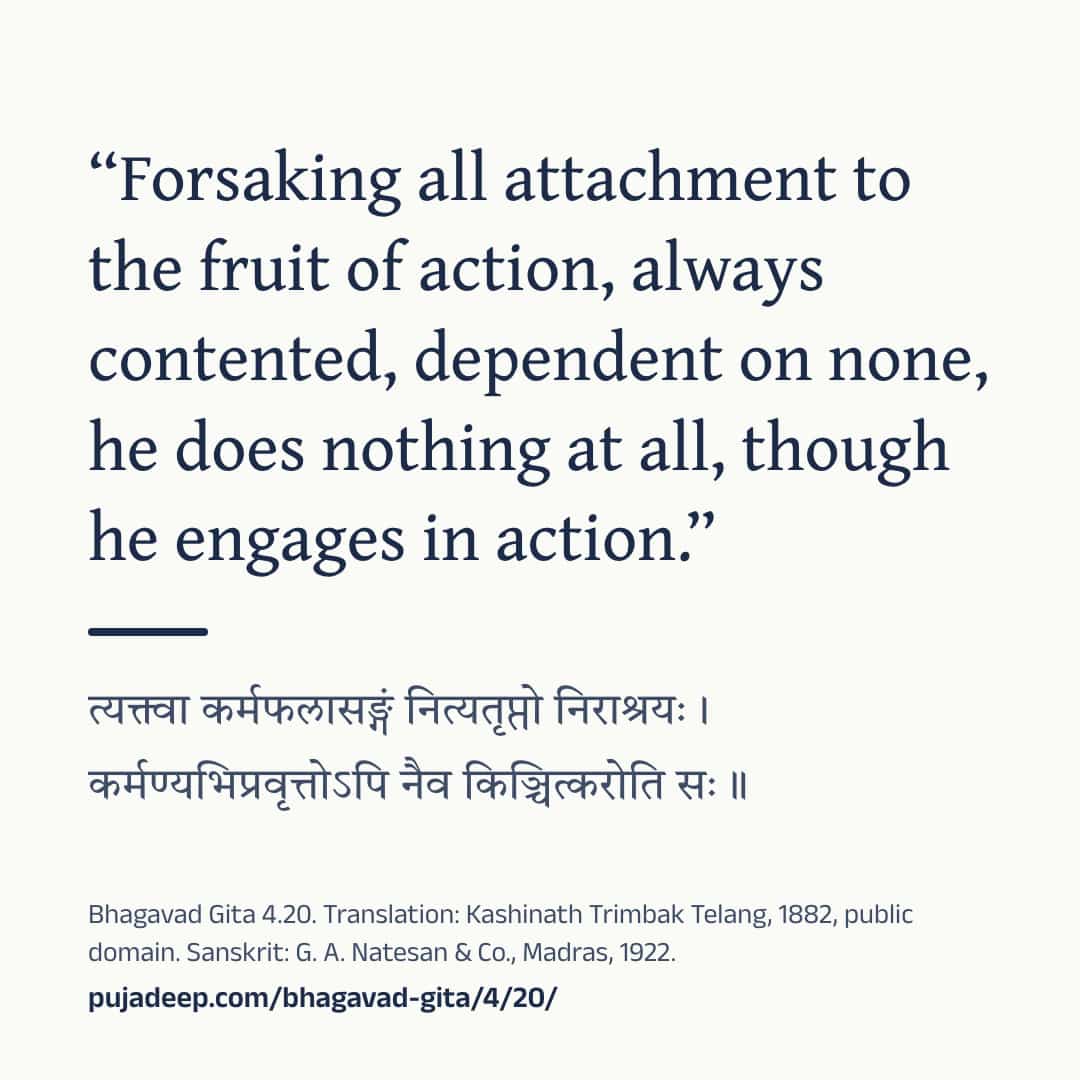
Drawing the picture
See the words
Bhagavad Gita 4.20

त्यक्त्वा कर्मफलासङ्गं नित्यतृप्तो निराश्रयः ।
कर्मण्यभिप्रवृत्तोऽपि नैव किञ्चित्करोति सः ॥

“Forsaking all attachment to the fruit of action, always contented, dependent on none, he does nothing at all, though he engages in action.”
(K. T. Telang, The Bhagavadgîtâ (The Sacred Books of the East, vol. VIII, Oxford: Clarendon Press, 1882), p. 60, public domain)

“Having abandoned all attachment to the fruit of action, always content, seeking refuge in none, although doing actions he is not doing anything.”
(Annie Besant, The Bhagavad Gîtâ, or The Lord's Song (London: Theosophical Publishing Society, 1895), p. 53, public domain)

“Forsaking the clinging to fruits of action, ever satisfied, depending on nothing, though engaged in action, he does not do anything.”
(Swami Swarupananda, Srimad-Bhagavad-Gita (Mayavati: Prabuddha Bharata Press, 1909; first printed in Prabuddha Bharata, 1907–1909), p. 94, public domain)

Sanskrit: G. A. Natesan & Co., Madras, 1922.
https://pujadeep.com/bhagavad-gita/4/20/ Nothing is sent from this site. Your own app sends it, to the chat you choose. The picture quotes the translation you chose on this page, with its name and year.
Sanskrit text: The Bhagavad-Gita, or The Lord's Song, with the text in Devanagari and an English translation, 1922. Meanings: written for Pujadeep and checked against the cited edition. Source and changes
Questions families ask
Who speaks Bhagavad Gita 4.20?
Krishna speaks this verse, in chapter 4 (Jnana Karma Sannyasa Yoga).
Where does the Sanskrit text come from?
Sanskrit text: The Bhagavad-Gita, or The Lord's Song, with the text in Devanagari and an English translation, 1922. Meanings: written for Pujadeep and checked against the cited edition. See the source
Is the meaning on this page a translation?
Explanation written for this site from the sources listed here, and checked against the cited edition. It is not a translation and not the only way to read the text. Free to quote with credit.
Source and licence
- Sanskrit text
- The Bhagavad-Gita, or The Lord's Song, with the text in Devanagari and an English translation (Annie Besant, G. A. Natesan & Co., Madras, 1922). Public domain. The Sanskrit on these pages was read from this printing’s page images.
- Translation
- The Bhagavadgîtâ with the Sanatsugâtîya and the Anugîtâ, translated by Kâshinâth Trimbak Telang (The Sacred Books of the East, vol. VIII, ed. F. Max Müller) (Kashinath Trimbak Telang, F. Max Müller, Clarendon Press, Oxford, 1882). Public domain. Shown verbatim, as printed.
- Translation
- The Bhagavad Gîtâ, or The Lord's Song, translated by Annie Besant (Annie Besant, Theosophical Publishing Society, London, 1895). Public domain. Shown verbatim, as printed.
- Translation
- Srimad-Bhagavad-Gita, with Sanskrit Text; Paraphrase with Word-by-word Literal Translation; English Rendering and Comments, Index, &c., by the Swami Swarupananda (Himalayan Series, No. XX) (Swami Swarupananda, The Editors and Publishers, Advaita Ashrama, Mayavati, Prabuddha Bharata Press, Mayavati, Almora, Himalayas, 1909). Public domain. Shown verbatim, as printed.
- Common wording
- In this text, 32 words follow today's common wording, checked against sanskritdocuments.org; Sanskrit Wikisource; Gita Press, Gorakhpur; GRETIL, Göttingen and Bhaktivedanta Book Trust.
- Our explanation
- Explanation written for this site from the sources listed here, and checked against the cited edition. It is not a translation and not the only way to read the text. Free to quote with credit.
- Checked
- Checked against the cited edition, October 15, 2026.
- Updated
- October 27, 2026