Bhagavad Gita 4.16: meaning and translation
Chapter 4: Jnana Karma Sannyasa Yoga. Krishna says
Krishna: What is action, and what is inaction?
Click or tap a word for its meaning and its dictionary page.
Text and layers
Text and layers
These choices stay in this browser.
Bhagavad Gita 4.16
किं कर्म किमकर्मेति कवयोऽप्यत्र मोहिताः ।तत्ते कर्म प्रवक्ष्यामि यज्ज्ञात्वा मोक्ष्यसेऽशुभात् ॥
Kim karma kimakarmeti kavayopyatra mohitahTatte karma pravakshyami yajjnatva mokshyaseshubhat
kiṃ karma kimakarmeti kavayo’pyatra mohitāḥ |tatte karma pravakṣyāmi yajjñātvā mokṣyase’śubhāt ||
Our explanation What is action, and what is inaction? Even the wise are confused about this, Krishna says. So he will explain action to Arjuna; knowing it, Arjuna will be freed from what is harmful (aśubha).
हिंदी अर्थ कृष्ण कहते हैं कि कर्म क्या है और अकर्म क्या है, इस पर बुद्धिमान लोग भी भ्रम में पड़ जाते हैं। इसलिए वे अर्जुन को कर्म का स्वरूप बताएँगे, जिसे जानकर अर्जुन अशुभ (बंधन) से छूट जाएँगे।
Word by word
Every word, with its dictionary page
Word by word
- किम् kim · what (pronoun (neuter), nominative singular) Dictionary: kim, Monier-Williams 1899, p. 282, col. 2 “what? how? whence? wherefore? why?”
- कर्म karma · action (noun (neuter), nominative singular) Dictionary: karman, Monier-Williams 1899, p. 258, col. 2 “act, action, performance, business”
- किम् kim · what (pronoun (neuter), nominative singular) Dictionary: kim, Monier-Williams 1899, p. 282, col. 2 “what? how? whence? wherefore? why?”
- अकर्म akarma · inaction (noun (neuter), nominative singular) Dictionary: a-karman, Monier-Williams 1899, p. 2, col. 1 “absence of work”
- इति iti · thus (ends the question) (indeclinable) Dictionary: 2. iti, Monier-Williams 1899, p. 165, col. 1 “in this manner, thus”
- कवयः kavayaḥ · the wise (noun (masculine), nominative plural) Dictionary: kavi, Monier-Williams 1899, p. 264, col. 2 “gifted with insight, intelligent, knowing, enlightened, wise”
- अपि api · even (indeclinable) Dictionary: api, Monier-Williams 1899, p. 55, col. 1 “in the sense of even, also, very”
- अत्र atra · here, in this (indeclinable) Dictionary: 1. a-tra, Monier-Williams 1899, p. 17, col. 2 “in this matter, in this respect; in this place, here”
- मोहिताः mohitāḥ · confused (past participle (masculine), nominative plural) Dictionary: mohita, Monier-Williams 1899, p. 836, col. 2 “stupefied, bewildered, infatuated, deluded”
- तत् tat · that (pronoun (neuter), accusative singular) Dictionary: tad, Monier-Williams 1899, p. 434, col. 1 “m. he, f. she, n. it, that, this”
- ते te · to you (pronoun, dative singular) Dictionary: 2. tva, Monier-Williams 1899, p. 463, col. 2 “base of the 2nd personal pron.”
- कर्म karma · action (noun (neuter), accusative singular) Dictionary: karman, Monier-Williams 1899, p. 258, col. 2 “act, action, performance, business”
- प्रवक्ष्यामि pravakṣyāmi · will explain (future, 1st person singular) Dictionary: pra-vac, Monier-Williams 1899, p. 690, col. 1 “to proclaim, announce, praise, commend, mention, teach, impart, explain”
- यत् yat · which (pronoun (neuter), accusative singular) Dictionary: yad, Monier-Williams 1899, p. 844, col. 2 “who, which, what, whichever, whatever, that”
- ज्ञात्वा jñātvā · having known (absolutive (having done)) Dictionary: 1. jñā, Monier-Williams 1899, p. 425, col. 3 “to know, have knowledge, become acquainted with”
- मोक्ष्यसे mokṣyase · you will be freed (future, 2nd person singular) Dictionary: 2. muc, Monier-Williams 1899, p. 820, col. 3 “to be loosed, to be set free or released”
- अशुभात् aśubhāt · from what is harmful (noun (neuter), ablative singular) Dictionary: a-śubha, Monier-Williams 1899, p. 113, col. 3 “a shameful deed, sin”
Old translations
Kashinath Trimbak Telang, 1882. Public domain. Page 59–60.
Even sages are confused as to what is action, what inaction. Therefore I will speak to you about action, and learning that, you will be freed from (this world of) evil.
Compare 3 translations
Kashinath Trimbak Telang, 1882. Public domain. Page 59–60.
Even sages are confused as to what is action, what inaction. Therefore I will speak to you about action, and learning that, you will be freed from (this world of) evil.
You are reading this one
Annie Besant, 1895. Public domain. Page 52.
"What is action, what inaction?" Even the wise are hereby perplexed. I will declare to thee the action by knowing which thou shalt be loosed from evil.
You are reading this one
Swami Swarupananda, 1909 (first printed 1907). Public domain. Page 92.
Even sages are bewildered, as to what is action and what is inaction. I shall therefore tell you what action is, by knowing which you will be freed from evil.
You are reading this one
Cite this verse
The translation: K. T. Telang, The Bhagavadgîtâ (The Sacred Books of the East, vol. VIII, Oxford: Clarendon Press, 1882), pp. 59–60. Bhagavad Gita 4.16.
The translation: Annie Besant, The Bhagavad Gîtâ, or The Lord's Song (London: Theosophical Publishing Society, 1895), p. 52. Bhagavad Gita 4.16.
The translation: Swami Swarupananda, Srimad-Bhagavad-Gita (Mayavati: Prabuddha Bharata Press, 1909; first printed in Prabuddha Bharata, 1907–1909), p. 92. Bhagavad Gita 4.16.
Our explanation: “Bhagavad Gita 4.16: meaning and translation.” Pujadeep. Updated October 27, 2026. https://pujadeep.com/bhagavad-gita/4/16/
Pujadeep’s explanations are free to quote with credit: name Pujadeep and link to the page. How to credit
Classical readings, by school
No readings by school on this verse yet.
Share
Show the ways to share
Send one picture or the text to one chat. The picture names its source and the address of this page.
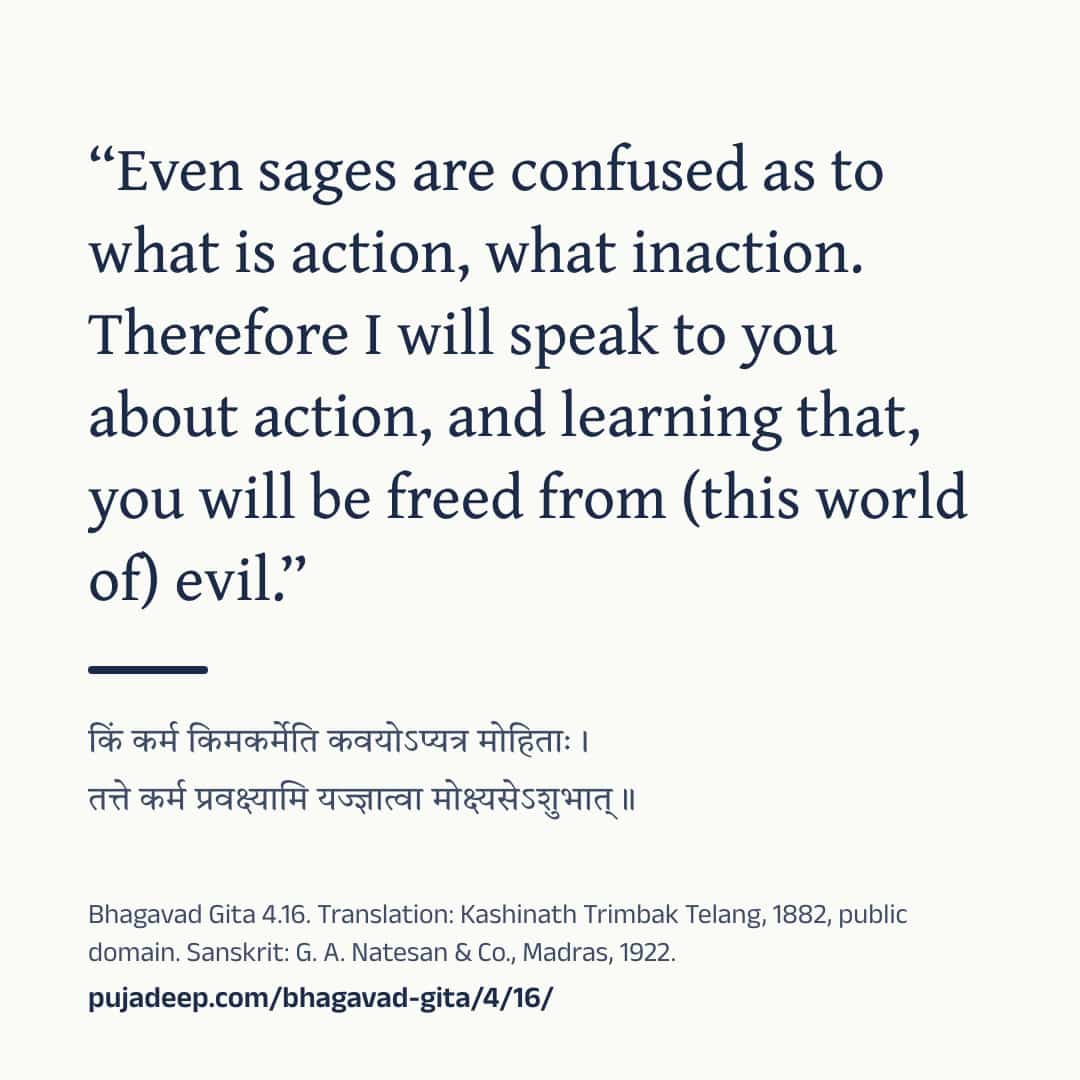
Drawing the picture
See the words
Bhagavad Gita 4.16

किं कर्म किमकर्मेति कवयोऽप्यत्र मोहिताः ।
तत्ते कर्म प्रवक्ष्यामि यज्ज्ञात्वा मोक्ष्यसेऽशुभात् ॥

“Even sages are confused as to what is action, what inaction. Therefore I will speak to you about action, and learning that, you will be freed from (this world of) evil.”
(K. T. Telang, The Bhagavadgîtâ (The Sacred Books of the East, vol. VIII, Oxford: Clarendon Press, 1882), pp. 59–60, public domain)

“"What is action, what inaction?" Even the wise are hereby perplexed. I will declare to thee the action by knowing which thou shalt be loosed from evil.”
(Annie Besant, The Bhagavad Gîtâ, or The Lord's Song (London: Theosophical Publishing Society, 1895), p. 52, public domain)

“Even sages are bewildered, as to what is action and what is inaction. I shall therefore tell you what action is, by knowing which you will be freed from evil.”
(Swami Swarupananda, Srimad-Bhagavad-Gita (Mayavati: Prabuddha Bharata Press, 1909; first printed in Prabuddha Bharata, 1907–1909), p. 92, public domain)

Sanskrit: G. A. Natesan & Co., Madras, 1922.
https://pujadeep.com/bhagavad-gita/4/16/ Nothing is sent from this site. Your own app sends it, to the chat you choose. The picture quotes the translation you chose on this page, with its name and year.
Sanskrit text: The Bhagavad-Gita, or The Lord's Song, with the text in Devanagari and an English translation, 1922. Meanings: written for Pujadeep and checked against the cited edition. Source and changes
Questions families ask
Who speaks Bhagavad Gita 4.16?
Krishna speaks this verse, in chapter 4 (Jnana Karma Sannyasa Yoga).
Where does the Sanskrit text come from?
Sanskrit text: The Bhagavad-Gita, or The Lord's Song, with the text in Devanagari and an English translation, 1922. Meanings: written for Pujadeep and checked against the cited edition. See the source
Is the meaning on this page a translation?
Explanation written for this site from the sources listed here, and checked against the cited edition. It is not a translation and not the only way to read the text. Free to quote with credit.
Source and licence
- Sanskrit text
- The Bhagavad-Gita, or The Lord's Song, with the text in Devanagari and an English translation (Annie Besant, G. A. Natesan & Co., Madras, 1922). Public domain. The Sanskrit on these pages was read from this printing’s page images.
- Translation
- The Bhagavadgîtâ with the Sanatsugâtîya and the Anugîtâ, translated by Kâshinâth Trimbak Telang (The Sacred Books of the East, vol. VIII, ed. F. Max Müller) (Kashinath Trimbak Telang, F. Max Müller, Clarendon Press, Oxford, 1882). Public domain. Shown verbatim, as printed.
- Translation
- The Bhagavad Gîtâ, or The Lord's Song, translated by Annie Besant (Annie Besant, Theosophical Publishing Society, London, 1895). Public domain. Shown verbatim, as printed.
- Translation
- Srimad-Bhagavad-Gita, with Sanskrit Text; Paraphrase with Word-by-word Literal Translation; English Rendering and Comments, Index, &c., by the Swami Swarupananda (Himalayan Series, No. XX) (Swami Swarupananda, The Editors and Publishers, Advaita Ashrama, Mayavati, Prabuddha Bharata Press, Mayavati, Almora, Himalayas, 1909). Public domain. Shown verbatim, as printed.
- Common wording
- In this text, 32 words follow today's common wording, checked against sanskritdocuments.org; Sanskrit Wikisource; Gita Press, Gorakhpur; GRETIL, Göttingen and Bhaktivedanta Book Trust.
- Our explanation
- Explanation written for this site from the sources listed here, and checked against the cited edition. It is not a translation and not the only way to read the text. Free to quote with credit.
- Checked
- Checked against the cited edition, October 15, 2026.
- Updated
- October 27, 2026