Bhagavad Gita 4.17: meaning and translation
Chapter 4: Jnana Karma Sannyasa Yoga. Krishna says
One must understand action (karma), wrong action (vikarma) and inaction (akarma), Krishna says, because the way of action is hard to understand.
Click or tap a word for its meaning and its dictionary page.
Text and layers
Text and layers
These choices stay in this browser.
Bhagavad Gita 4.17
कर्मणो ह्यपि बोद्धव्यं बोद्धव्यं च विकर्मणः ।अकर्मणश्च बोद्धव्यं गहना कर्मणो गतिः ॥
Karmano hyapi boddhavyam boddhavyam cha vikarmanahAkarmanashcha boddhavyam gahana karmano gatih
karmaṇo hyapi boddhavyaṃ boddhavyaṃ ca vikarmaṇaḥ |akarmaṇaśca boddhavyaṃ gahanā karmaṇo gatiḥ ||
Our explanation One must understand action (karma), wrong action (vikarma) and inaction (akarma), Krishna says, because the way of action is hard to understand.
हिंदी अर्थ कृष्ण कहते हैं कि कर्म को समझना चाहिए, विकर्म (निषिद्ध या उलटे कर्म) को भी, और अकर्म को भी, क्योंकि कर्म की गति गहन है।
Word by word
Every word, with its dictionary page
Word by word
- कर्मणः karmaṇaḥ · of action (noun (neuter), genitive singular) Dictionary: karman, Monier-Williams 1899, p. 258, col. 2 “act, action, performance, business”
- हि hi · for (indeclinable) Dictionary: 2. hi, Monier-Williams 1899, p. 1297, col. 3 “for, because, on account of”
- अपि api · also (indeclinable) Dictionary: api, Monier-Williams 1899, p. 55, col. 1 “in the sense of even, also, very”
- बोद्धव्यम् boddhavyam · is to be understood (gerundive (to be done) (neuter), nominative singular) Dictionary: boddhavya, Monier-Williams 1899, p. 734, col. 2 “to be known or perceived or observed or recognized”
- बोद्धव्यम् boddhavyam · is to be understood (gerundive (to be done) (neuter), nominative singular) Dictionary: boddhavya, Monier-Williams 1899, p. 734, col. 2 “to be known or perceived or observed or recognized”
- च ca · and (indeclinable) Dictionary: 2. ca, Monier-Williams 1899, p. 380, col. 1 “and, both, also, moreover, as well as”
- विकर्मणः vikarmaṇaḥ · of wrong action (noun (neuter), genitive singular) Dictionary: 1. vi-karman, Monier-Williams 1899, p. 950, col. 1 “prohibited or unlawful act”
- अकर्मणः akarmaṇaḥ · of inaction (noun (neuter), genitive singular) Dictionary: a-karman, Monier-Williams 1899, p. 2, col. 1 “absence of work”
- च ca · and (indeclinable) Dictionary: 2. ca, Monier-Williams 1899, p. 380, col. 1 “and, both, also, moreover, as well as”
- बोद्धव्यम् boddhavyam · is to be understood (gerundive (to be done) (neuter), nominative singular) Dictionary: boddhavya, Monier-Williams 1899, p. 734, col. 2 “to be known or perceived or observed or recognized”
- गहना gahanā · deep, hard to grasp (adjective (feminine), nominative singular) Dictionary: gahana, Monier-Williams 1899, p. 352, col. 1 “deep, dense, thick, impervious, impenetrable, inexplicable, hard to be understood”
- कर्मणः karmaṇaḥ · of action (noun (neuter), genitive singular) Dictionary: karman, Monier-Williams 1899, p. 258, col. 2 “act, action, performance, business”
- गतिः gatiḥ · way (noun (feminine), nominative singular) Dictionary: gati, Monier-Williams 1899, p. 347, col. 3 “going, moving, gait, deportment, motion in general”
Old translations
Kashinath Trimbak Telang, 1882. Public domain. Page 60.
One must possess knowledge about action; one must also possess knowledge about prohibited action; and again one must possess knowledge about inaction. The truth regarding action is abstruse.
Compare 3 translations
Kashinath Trimbak Telang, 1882. Public domain. Page 60.
One must possess knowledge about action; one must also possess knowledge about prohibited action; and again one must possess knowledge about inaction. The truth regarding action is abstruse.
You are reading this one
Annie Besant, 1895. Public domain. Page 52.
It is needful to discriminate action, to discriminate unlawful action, and to discriminate inaction; difficult to tread is the path of action.
You are reading this one
Swami Swarupananda, 1909 (first printed 1907). Public domain. Page 92.
For verily, (the true nature) even of action (enjoined by the Shastras) should be known, as also, (that) of forbidden action, and of inaction: the nature of Karma is impenetrable.
You are reading this one
Cite this verse
The translation: K. T. Telang, The Bhagavadgîtâ (The Sacred Books of the East, vol. VIII, Oxford: Clarendon Press, 1882), p. 60. Bhagavad Gita 4.17.
The translation: Annie Besant, The Bhagavad Gîtâ, or The Lord's Song (London: Theosophical Publishing Society, 1895), p. 52. Bhagavad Gita 4.17.
The translation: Swami Swarupananda, Srimad-Bhagavad-Gita (Mayavati: Prabuddha Bharata Press, 1909; first printed in Prabuddha Bharata, 1907–1909), p. 92. Bhagavad Gita 4.17.
Our explanation: “Bhagavad Gita 4.17: meaning and translation.” Pujadeep. Updated October 27, 2026. https://pujadeep.com/bhagavad-gita/4/17/
Pujadeep’s explanations are free to quote with credit: name Pujadeep and link to the page. How to credit
Classical readings, by school
No readings by school on this verse yet.
Share
Show the ways to share
Send one picture or the text to one chat. The picture names its source and the address of this page.
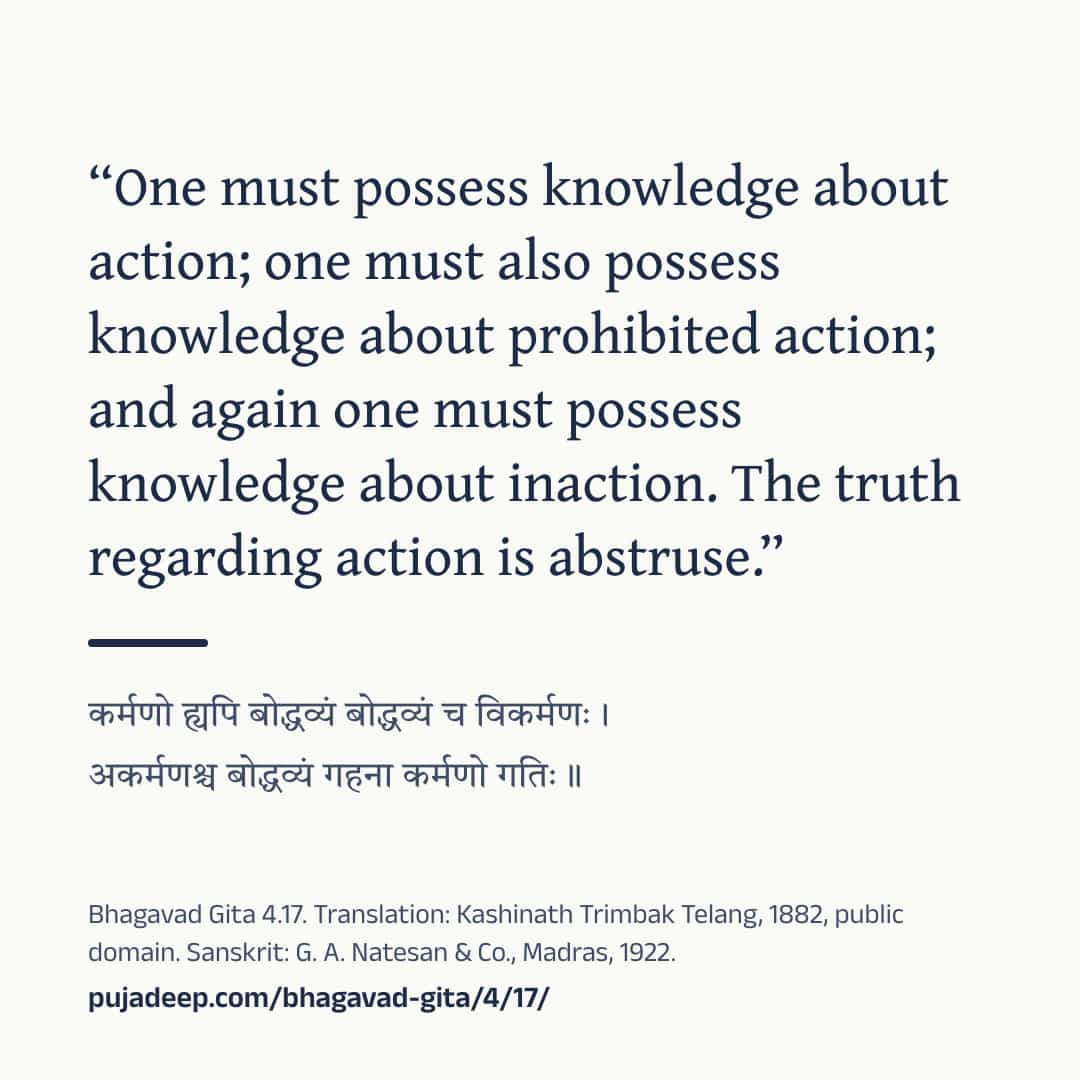
Drawing the picture
See the words
Bhagavad Gita 4.17

कर्मणो ह्यपि बोद्धव्यं बोद्धव्यं च विकर्मणः ।
अकर्मणश्च बोद्धव्यं गहना कर्मणो गतिः ॥

“One must possess knowledge about action; one must also possess knowledge about prohibited action; and again one must possess knowledge about inaction. The truth regarding action is abstruse.”
(K. T. Telang, The Bhagavadgîtâ (The Sacred Books of the East, vol. VIII, Oxford: Clarendon Press, 1882), p. 60, public domain)

“It is needful to discriminate action, to discriminate unlawful action, and to discriminate inaction; difficult to tread is the path of action.”
(Annie Besant, The Bhagavad Gîtâ, or The Lord's Song (London: Theosophical Publishing Society, 1895), p. 52, public domain)

“For verily, (the true nature) even of action (enjoined by the Shastras) should be known, as also, (that) of forbidden action, and of inaction: the nature of Karma is impenetrable.”
(Swami Swarupananda, Srimad-Bhagavad-Gita (Mayavati: Prabuddha Bharata Press, 1909; first printed in Prabuddha Bharata, 1907–1909), p. 92, public domain)

Sanskrit: G. A. Natesan & Co., Madras, 1922.
https://pujadeep.com/bhagavad-gita/4/17/ Nothing is sent from this site. Your own app sends it, to the chat you choose. The picture quotes the translation you chose on this page, with its name and year.
Sanskrit text: The Bhagavad-Gita, or The Lord's Song, with the text in Devanagari and an English translation, 1922. Meanings: written for Pujadeep and checked against the cited edition. Source and changes
Questions families ask
Who speaks Bhagavad Gita 4.17?
Krishna speaks this verse, in chapter 4 (Jnana Karma Sannyasa Yoga).
Where does the Sanskrit text come from?
Sanskrit text: The Bhagavad-Gita, or The Lord's Song, with the text in Devanagari and an English translation, 1922. Meanings: written for Pujadeep and checked against the cited edition. See the source
Is the meaning on this page a translation?
Explanation written for this site from the sources listed here, and checked against the cited edition. It is not a translation and not the only way to read the text. Free to quote with credit.
Source and licence
- Sanskrit text
- The Bhagavad-Gita, or The Lord's Song, with the text in Devanagari and an English translation (Annie Besant, G. A. Natesan & Co., Madras, 1922). Public domain. The Sanskrit on these pages was read from this printing’s page images.
- Translation
- The Bhagavadgîtâ with the Sanatsugâtîya and the Anugîtâ, translated by Kâshinâth Trimbak Telang (The Sacred Books of the East, vol. VIII, ed. F. Max Müller) (Kashinath Trimbak Telang, F. Max Müller, Clarendon Press, Oxford, 1882). Public domain. Shown verbatim, as printed.
- Translation
- The Bhagavad Gîtâ, or The Lord's Song, translated by Annie Besant (Annie Besant, Theosophical Publishing Society, London, 1895). Public domain. Shown verbatim, as printed.
- Translation
- Srimad-Bhagavad-Gita, with Sanskrit Text; Paraphrase with Word-by-word Literal Translation; English Rendering and Comments, Index, &c., by the Swami Swarupananda (Himalayan Series, No. XX) (Swami Swarupananda, The Editors and Publishers, Advaita Ashrama, Mayavati, Prabuddha Bharata Press, Mayavati, Almora, Himalayas, 1909). Public domain. Shown verbatim, as printed.
- Common wording
- In this text, 32 words follow today's common wording, checked against sanskritdocuments.org; Sanskrit Wikisource; Gita Press, Gorakhpur; GRETIL, Göttingen and Bhaktivedanta Book Trust.
- Our explanation
- Explanation written for this site from the sources listed here, and checked against the cited edition. It is not a translation and not the only way to read the text. Free to quote with credit.
- Checked
- Checked against the cited edition, October 15, 2026.
- Updated
- October 27, 2026