Bhagavad Gita 4.14: meaning and translation
Chapter 4: Jnana Karma Sannyasa Yoga. Krishna says
Actions do not stain him, Krishna says, and he has no desire for their fruit.
Click or tap a word for its meaning and its dictionary page.
Text and layers
Text and layers
These choices stay in this browser.
Bhagavad Gita 4.14
न मां कर्माणि लिम्पन्ति न मे कर्मफले स्पृहा ।इति मां योऽभिजानाति कर्मभिर्न स बध्यते ॥
Na mam karmani limpanti na me karmaphale sprihaIti mam yobhijanati karmabhirna sa badhyate
na māṃ karmāṇi limpanti na me karmaphale spṛhā |iti māṃ yo’bhijānāti karmabhirna sa badhyate ||
Our explanation Actions do not stain him, Krishna says, and he has no desire for their fruit. Whoever knows him in this way is not bound by actions.
हिंदी अर्थ कृष्ण कहते हैं कि कर्म उन्हें लिप्त नहीं करते, और उन्हें कर्म के फल की इच्छा नहीं है। जो उन्हें इस तरह जानता है, वह कर्मों से नहीं बँधता।
Word by word
Every word, with its dictionary page
Word by word
- न na · not (indeclinable) Dictionary: 2. na, Monier-Williams 1899, p. 523, col. 1 “ind. not, no, nor, neither”
- माम् mām · "me" (Krishna) (pronoun, accusative singular) Dictionary: 1. mad, Monier-Williams 1899, p. 777, col. 2 “base of the first pers. pron. in the sg. number (esp. in comp.)”
- कर्माणि karmāṇi · actions (noun (neuter), nominative plural) Dictionary: karman, Monier-Williams 1899, p. 258, col. 2 “act, action, performance, business”
- लिम्पन्ति limpanti · stain (present, 3rd person plural) Dictionary: lip, Monier-Williams 1899, p. 902, col. 2 “to be attached to (loc.), stick, adhere”
- न na · no (indeclinable) Dictionary: 2. na, Monier-Williams 1899, p. 523, col. 1 “ind. not, no, nor, neither”
- मे me · "my" (pronoun, genitive singular) Dictionary: 1. mad, Monier-Williams 1899, p. 777, col. 2 “base of the first pers. pron. in the sg. number (esp. in comp.)”
- कर्मफले karmaphale · for the fruit of action (compound (neuter), locative singular) Dictionary: karma-phala, Monier-Williams 1899, p. 259, col. 1 “the fruit or recompense of actions”
- स्पृहा spṛhā · desire (noun (feminine), nominative singular) Dictionary: spṛhā, Monier-Williams 1899, p. 1269, col. 3 “eager desire, desire, covetousness, envy, longing for”
- इति iti · thus (indeclinable) Dictionary: 2. iti, Monier-Williams 1899, p. 165, col. 1 “in this manner, thus”
- माम् mām · "me" (Krishna) (pronoun, accusative singular) Dictionary: 1. mad, Monier-Williams 1899, p. 777, col. 2 “base of the first pers. pron. in the sg. number (esp. in comp.)”
- यः yaḥ · who (pronoun (masculine), nominative singular) Dictionary: yad, Monier-Williams 1899, p. 844, col. 2 “who, which, what, whichever, whatever, that”
- अभिजानाति abhijānāti · knows (present, 3rd person singular) Dictionary: abhi-jñā, Monier-Williams 1899, p. 62, col. 2 “to recognize, perceive, know”
- कर्मभिः karmabhiḥ · by actions (noun (neuter), instrumental plural) Dictionary: karman, Monier-Williams 1899, p. 258, col. 2 “act, action, performance, business”
- न na · not (indeclinable) Dictionary: 2. na, Monier-Williams 1899, p. 523, col. 1 “ind. not, no, nor, neither”
- सः saḥ · he (pronoun (masculine), nominative singular) Dictionary: tad, Monier-Williams 1899, p. 434, col. 1 “m. he, f. she, n. it, that, this”
- बध्यते badhyate · is bound (present passive, 3rd person singular) Dictionary: bandh, Monier-Williams 1899, p. 720, col. 1 “to bind, tie, fix, fasten, chain”
1 printing differs
Edition differences. Another printing or text reads this place differently.
- The printed edition reads: न मां कर्माणि लिम्पन्ति न मे कर्मफले स्पृहा ।
इति मां योऽभिजानाति कर्मभिर्न स बद्ध्यते ॥ The print reads बद्ध्यते, with a stacked द्ध (leaf n74); read as a printing flaw and shown as बध्यते, the passive of bandh ('is bound'), which the same edition prints in 4.22 (निबध्यते) and both proofreading references read here.
Old translations
Kashinath Trimbak Telang, 1882. Public domain. Page 59.
Actions defile me not. I have no attachment to the fruit of actions. He who knows me thus is not tied down by actions.
Compare 3 translations
Kashinath Trimbak Telang, 1882. Public domain. Page 59.
Actions defile me not. I have no attachment to the fruit of actions. He who knows me thus is not tied down by actions.
You are reading this one
Annie Besant, 1895. Public domain. Page 51–52.
Nor do actions pollute Me, nor is the fruit of action desired by Me. He who thus knoweth Me is not bound by actions.
You are reading this one
Swami Swarupananda, 1909 (first printed 1907). Public domain. Page 91.
Actions do not taint Me, nor have I any thirst for the result of action. He who knows Me thus, is not fettered by action.
You are reading this one
Cite this verse
The translation: K. T. Telang, The Bhagavadgîtâ (The Sacred Books of the East, vol. VIII, Oxford: Clarendon Press, 1882), p. 59. Bhagavad Gita 4.14.
The translation: Annie Besant, The Bhagavad Gîtâ, or The Lord's Song (London: Theosophical Publishing Society, 1895), pp. 51–52. Bhagavad Gita 4.14.
The translation: Swami Swarupananda, Srimad-Bhagavad-Gita (Mayavati: Prabuddha Bharata Press, 1909; first printed in Prabuddha Bharata, 1907–1909), p. 91. Bhagavad Gita 4.14.
Our explanation: “Bhagavad Gita 4.14: meaning and translation.” Pujadeep. Updated October 27, 2026. https://pujadeep.com/bhagavad-gita/4/14/
Pujadeep’s explanations are free to quote with credit: name Pujadeep and link to the page. How to credit
Classical readings, by school
No readings by school on this verse yet.
Share
Show the ways to share
Send one picture or the text to one chat. The picture names its source and the address of this page.
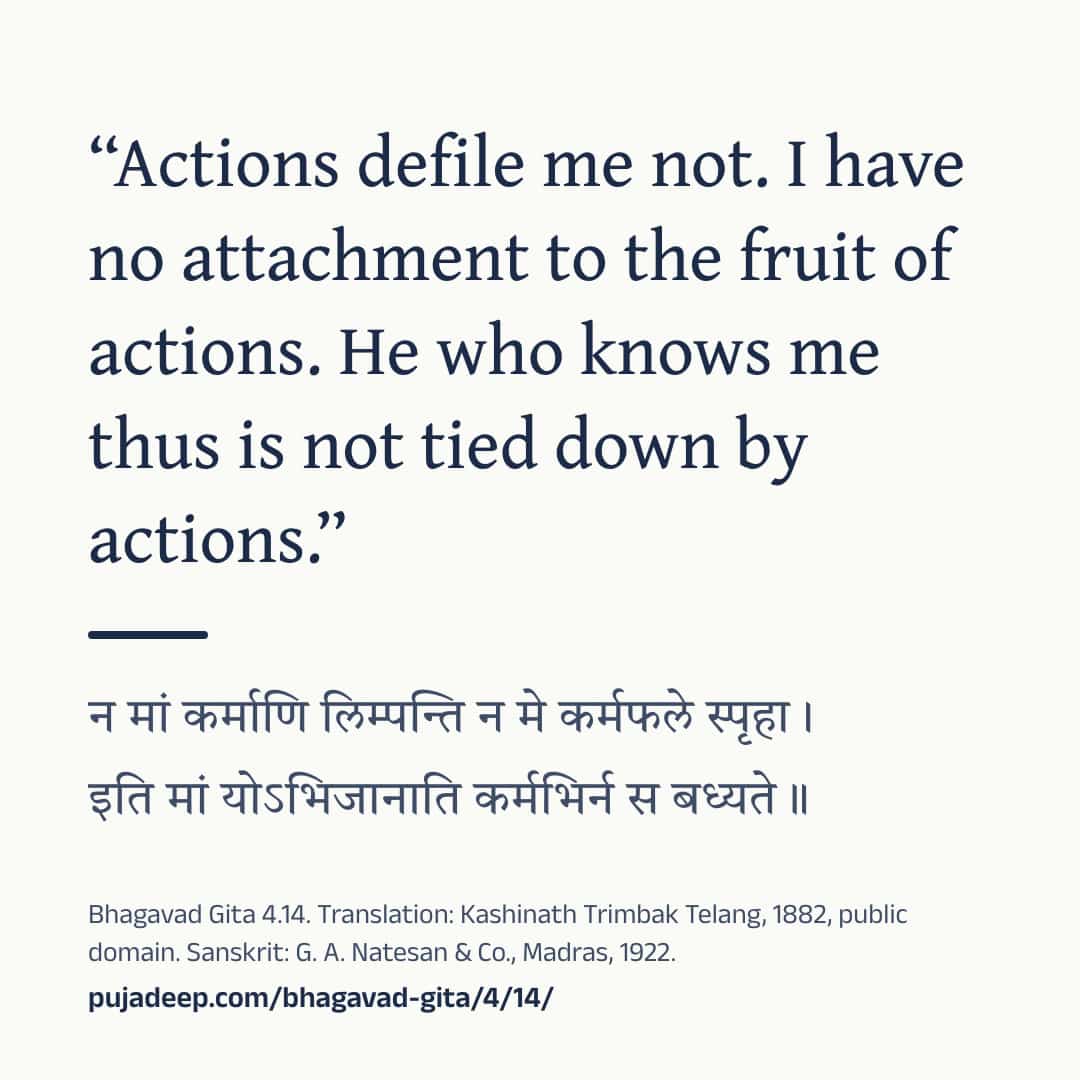
Drawing the picture
See the words
Bhagavad Gita 4.14

न मां कर्माणि लिम्पन्ति न मे कर्मफले स्पृहा ।
इति मां योऽभिजानाति कर्मभिर्न स बध्यते ॥

“Actions defile me not. I have no attachment to the fruit of actions. He who knows me thus is not tied down by actions.”
(K. T. Telang, The Bhagavadgîtâ (The Sacred Books of the East, vol. VIII, Oxford: Clarendon Press, 1882), p. 59, public domain)

“Nor do actions pollute Me, nor is the fruit of action desired by Me. He who thus knoweth Me is not bound by actions.”
(Annie Besant, The Bhagavad Gîtâ, or The Lord's Song (London: Theosophical Publishing Society, 1895), pp. 51–52, public domain)

“Actions do not taint Me, nor have I any thirst for the result of action. He who knows Me thus, is not fettered by action.”
(Swami Swarupananda, Srimad-Bhagavad-Gita (Mayavati: Prabuddha Bharata Press, 1909; first printed in Prabuddha Bharata, 1907–1909), p. 91, public domain)

Sanskrit: G. A. Natesan & Co., Madras, 1922.
https://pujadeep.com/bhagavad-gita/4/14/ Nothing is sent from this site. Your own app sends it, to the chat you choose. The picture quotes the translation you chose on this page, with its name and year.
Sanskrit text: The Bhagavad-Gita, or The Lord's Song, with the text in Devanagari and an English translation, 1922. Meanings: written for Pujadeep and checked against the cited edition. Source and changes
Questions families ask
Who speaks Bhagavad Gita 4.14?
Krishna speaks this verse, in chapter 4 (Jnana Karma Sannyasa Yoga).
Where does the Sanskrit text come from?
Sanskrit text: The Bhagavad-Gita, or The Lord's Song, with the text in Devanagari and an English translation, 1922. Meanings: written for Pujadeep and checked against the cited edition. See the source
Is the meaning on this page a translation?
Explanation written for this site from the sources listed here, and checked against the cited edition. It is not a translation and not the only way to read the text. Free to quote with credit.
Source and licence
- Sanskrit text
- The Bhagavad-Gita, or The Lord's Song, with the text in Devanagari and an English translation (Annie Besant, G. A. Natesan & Co., Madras, 1922). Public domain. The Sanskrit on these pages was read from this printing’s page images.
- Translation
- The Bhagavadgîtâ with the Sanatsugâtîya and the Anugîtâ, translated by Kâshinâth Trimbak Telang (The Sacred Books of the East, vol. VIII, ed. F. Max Müller) (Kashinath Trimbak Telang, F. Max Müller, Clarendon Press, Oxford, 1882). Public domain. Shown verbatim, as printed.
- Translation
- The Bhagavad Gîtâ, or The Lord's Song, translated by Annie Besant (Annie Besant, Theosophical Publishing Society, London, 1895). Public domain. Shown verbatim, as printed.
- Translation
- Srimad-Bhagavad-Gita, with Sanskrit Text; Paraphrase with Word-by-word Literal Translation; English Rendering and Comments, Index, &c., by the Swami Swarupananda (Himalayan Series, No. XX) (Swami Swarupananda, The Editors and Publishers, Advaita Ashrama, Mayavati, Prabuddha Bharata Press, Mayavati, Almora, Himalayas, 1909). Public domain. Shown verbatim, as printed.
- Common wording
- In this text, 32 words follow today's common wording, checked against sanskritdocuments.org; Sanskrit Wikisource; Gita Press, Gorakhpur; GRETIL, Göttingen and Bhaktivedanta Book Trust.
- Our explanation
- Explanation written for this site from the sources listed here, and checked against the cited edition. It is not a translation and not the only way to read the text. Free to quote with credit.
- Checked
- Checked against the cited edition, October 15, 2026.
- Updated
- October 27, 2026