Bhagavad Gita 4.10: meaning and translation
Chapter 4: Jnana Karma Sannyasa Yoga. Krishna says
Krishna says that many have done this before.
Click or tap a word for its meaning and its dictionary page.
Text and layers
Text and layers
These choices stay in this browser.
Bhagavad Gita 4.10
वीतरागभयक्रोधा मन्मया मामुपाश्रिताः ।बहवो ज्ञानतपसा पूता मद्भावमागताः ॥
Vitaragabhayakrodha manmaya mamupashritahBahavo jnanatapasa puta madbhavamagatah
vītarāgabhayakrodhā manmayā māmupāśritāḥ |bahavo jñānatapasā pūtā madbhāvamāgatāḥ ||
Our explanation Krishna says that many have done this before. Free from attachment, fear and anger, absorbed in him and taking refuge in him, and purified by the discipline (tapas) of knowledge, many have reached his state of being.
हिंदी अर्थ कृष्ण कहते हैं कि पहले भी बहुत लोग ऐसा कर चुके हैं। राग, भय और क्रोध से मुक्त, उन्हीं में लीन और उन्हीं की शरण में रहकर, ज्ञान रूपी तप से पवित्र हुए बहुत-से लोग उनके भाव (स्वरूप) को प्राप्त हुए हैं।
Word by word
Every word, with its dictionary page
Word by word
- वीतरागभयक्रोधाः vītarāgabhayakrodhāḥ · free of attachment, fear and anger (compound (masculine), nominative plural) Dictionary: 2. vīta, Monier-Williams 1899, p. 1004, col. 2 “gone away, departed, disappeared, vanished, lost”; rāga, Monier-Williams 1899, p. 872, col. 1 “any feeling or passion, (esp.) love, affection or sympathy for”; bhaya, Monier-Williams 1899, p. 747, col. 1 “fear, alarm, dread, apprehension”; krodha, Monier-Williams 1899, p. 322, col. 1 “anger, wrath, passion”
- मन्मयाः manmayāḥ · absorbed in "me" (compound (masculine), nominative plural) Dictionary: 1. mad, Monier-Williams 1899, p. 777, col. 2 “base of the first pers. pron. in the sg. number (esp. in comp.)”
- माम् mām · "me" (Krishna) (pronoun, accusative singular) Dictionary: 1. mad, Monier-Williams 1899, p. 777, col. 2 “base of the first pers. pron. in the sg. number (esp. in comp.)”
- उपाश्रिताः upāśritāḥ · taking refuge in (past participle (masculine), nominative plural) Dictionary: upā-śrita, Monier-Williams 1899, p. 214, col. 3 “having recourse to, relying upon, taking refuge with”
- बहवः bahavaḥ · many (adjective (masculine), nominative plural) Dictionary: bahu, Monier-Williams 1899, p. 724, col. 2 “much, many, frequent, abundant, numerous”
- ज्ञानतपसा jñānatapasā · by the tapas of knowledge (compound (neuter), instrumental singular) Dictionary: jñāna, Monier-Williams 1899, p. 426, col. 1 “knowing, becoming acquainted with, knowledge”; tapas, Monier-Williams 1899, p. 437, col. 1 “religious austerity, bodily mortification, penance, severe meditation”
- पूताः pūtāḥ · purified (past participle (masculine), nominative plural) Dictionary: 1. pūta, Monier-Williams 1899, p. 640, col. 3 “cleaned, purified, pure, clear, bright”
- मद्भावम् madbhāvam · "my" state of being (compound (masculine), accusative singular) Dictionary: 1. mad, Monier-Williams 1899, p. 777, col. 2 “base of the first pers. pron. in the sg. number (esp. in comp.)”; bhāva, Monier-Williams 1899, p. 754, col. 1 “becoming, being”
- आगताः āgatāḥ · have reached (past participle (masculine), nominative plural) Dictionary: ā-gata, Monier-Williams 1899, p. 129, col. 2 “come, arrived”
Old translations
Kashinath Trimbak Telang, 1882. Public domain. Page 59.
Many from whom affection, fear1, and wrath have departed, who are full of me, who depend on me, and who are purified by the penance of knowledge2, have come into my essence.
Footnotes (the translator’s own) Compare 3 translations
Kashinath Trimbak Telang, 1882. Public domain. Page 59.
Many from whom affection, fear1, and wrath have departed, who are full of me, who depend on me, and who are purified by the penance of knowledge2, have come into my essence.
Footnotes (the translator’s own) You are reading this one
Annie Besant, 1895. Public domain. Page 51.
Freed from passion, fear and anger, thinking on Me, taking refuge in Me, purified in the fire of wisdom,1 many have entered into My Being.
Footnotes (the translator’s own) - Tapas, from Tap, blazing like fire, ↩
You are reading this one
Swami Swarupananda, 1909 (first printed 1907). Public domain. Page 88.
Freed from attachment, fear, and anger, absorbed in Me, taking refuge in Me, purified by the fire of Knowledge, many have attained My Being.
You are reading this one
Cite this verse
The translation: K. T. Telang, The Bhagavadgîtâ (The Sacred Books of the East, vol. VIII, Oxford: Clarendon Press, 1882), p. 59. Bhagavad Gita 4.10.
The translation: Annie Besant, The Bhagavad Gîtâ, or The Lord's Song (London: Theosophical Publishing Society, 1895), p. 51. Bhagavad Gita 4.10.
The translation: Swami Swarupananda, Srimad-Bhagavad-Gita (Mayavati: Prabuddha Bharata Press, 1909; first printed in Prabuddha Bharata, 1907–1909), p. 88. Bhagavad Gita 4.10.
Our explanation: “Bhagavad Gita 4.10: meaning and translation.” Pujadeep. Updated October 27, 2026. https://pujadeep.com/bhagavad-gita/4/10/
Pujadeep’s explanations are free to quote with credit: name Pujadeep and link to the page. How to credit
Classical readings, by school
No readings by school on this verse yet.
Share
Show the ways to share
Send one picture or the text to one chat. The picture names its source and the address of this page.
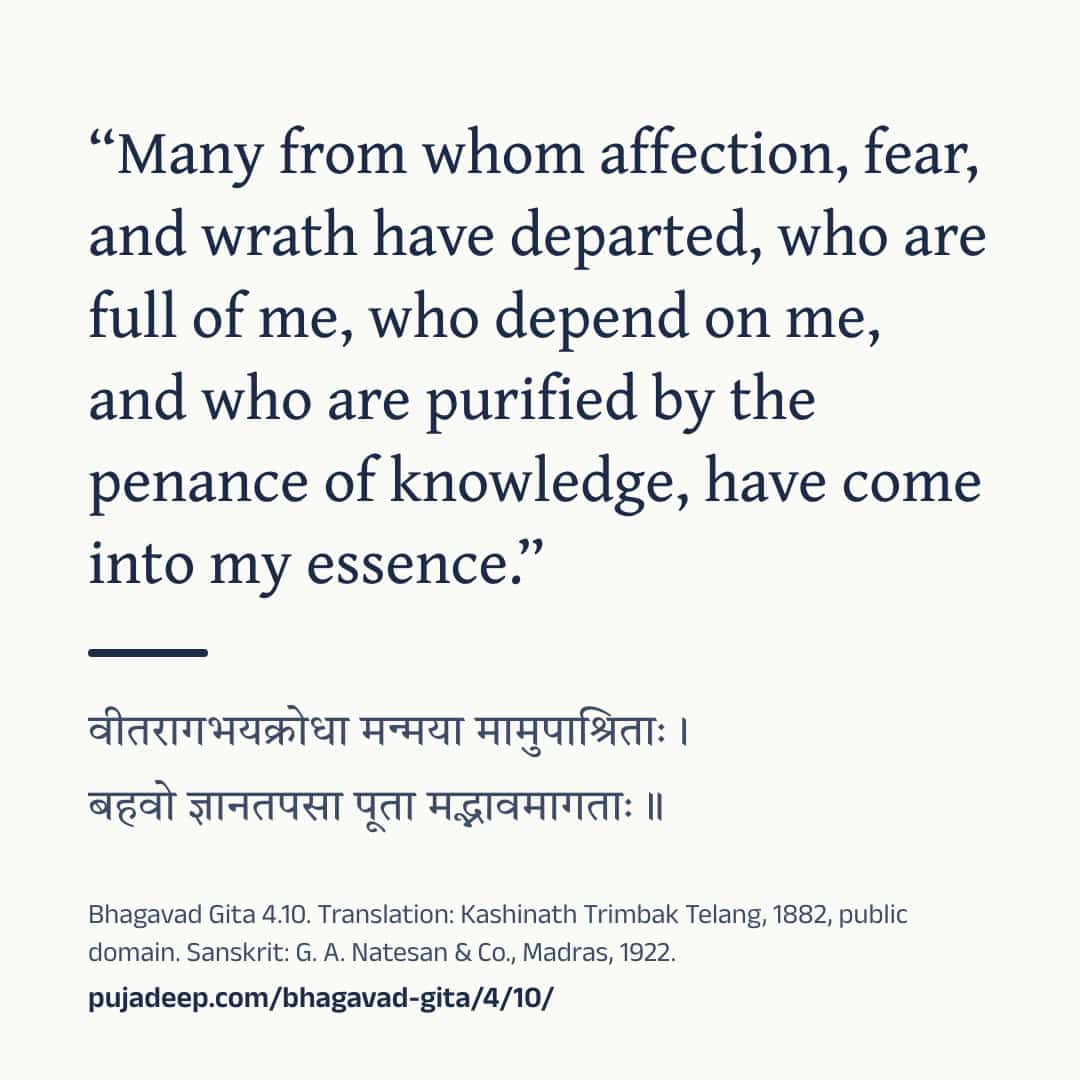
Drawing the picture
See the words
Bhagavad Gita 4.10

वीतरागभयक्रोधा मन्मया मामुपाश्रिताः ।
बहवो ज्ञानतपसा पूता मद्भावमागताः ॥

“Many from whom affection, fear, and wrath have departed, who are full of me, who depend on me, and who are purified by the penance of knowledge, have come into my essence.”
(K. T. Telang, The Bhagavadgîtâ (The Sacred Books of the East, vol. VIII, Oxford: Clarendon Press, 1882), p. 59, public domain)

“Freed from passion, fear and anger, thinking on Me, taking refuge in Me, purified in the fire of wisdom, many have entered into My Being.”
(Annie Besant, The Bhagavad Gîtâ, or The Lord's Song (London: Theosophical Publishing Society, 1895), p. 51, public domain)

“Freed from attachment, fear, and anger, absorbed in Me, taking refuge in Me, purified by the fire of Knowledge, many have attained My Being.”
(Swami Swarupananda, Srimad-Bhagavad-Gita (Mayavati: Prabuddha Bharata Press, 1909; first printed in Prabuddha Bharata, 1907–1909), p. 88, public domain)

Sanskrit: G. A. Natesan & Co., Madras, 1922.
https://pujadeep.com/bhagavad-gita/4/10/ Nothing is sent from this site. Your own app sends it, to the chat you choose. The picture quotes the translation you chose on this page, with its name and year.
Sanskrit text: The Bhagavad-Gita, or The Lord's Song, with the text in Devanagari and an English translation, 1922. Meanings: written for Pujadeep and checked against the cited edition. Source and changes
Questions families ask
Who speaks Bhagavad Gita 4.10?
Krishna speaks this verse, in chapter 4 (Jnana Karma Sannyasa Yoga).
Where does the Sanskrit text come from?
Sanskrit text: The Bhagavad-Gita, or The Lord's Song, with the text in Devanagari and an English translation, 1922. Meanings: written for Pujadeep and checked against the cited edition. See the source
Is the meaning on this page a translation?
Explanation written for this site from the sources listed here, and checked against the cited edition. It is not a translation and not the only way to read the text. Free to quote with credit.
Source and licence
- Sanskrit text
- The Bhagavad-Gita, or The Lord's Song, with the text in Devanagari and an English translation (Annie Besant, G. A. Natesan & Co., Madras, 1922). Public domain. The Sanskrit on these pages was read from this printing’s page images.
- Translation
- The Bhagavadgîtâ with the Sanatsugâtîya and the Anugîtâ, translated by Kâshinâth Trimbak Telang (The Sacred Books of the East, vol. VIII, ed. F. Max Müller) (Kashinath Trimbak Telang, F. Max Müller, Clarendon Press, Oxford, 1882). Public domain. Shown verbatim, as printed.
- Translation
- The Bhagavad Gîtâ, or The Lord's Song, translated by Annie Besant (Annie Besant, Theosophical Publishing Society, London, 1895). Public domain. Shown verbatim, as printed.
- Translation
- Srimad-Bhagavad-Gita, with Sanskrit Text; Paraphrase with Word-by-word Literal Translation; English Rendering and Comments, Index, &c., by the Swami Swarupananda (Himalayan Series, No. XX) (Swami Swarupananda, The Editors and Publishers, Advaita Ashrama, Mayavati, Prabuddha Bharata Press, Mayavati, Almora, Himalayas, 1909). Public domain. Shown verbatim, as printed.
- Common wording
- In this text, 32 words follow today's common wording, checked against sanskritdocuments.org; Sanskrit Wikisource; Gita Press, Gorakhpur; GRETIL, Göttingen and Bhaktivedanta Book Trust.
- Our explanation
- Explanation written for this site from the sources listed here, and checked against the cited edition. It is not a translation and not the only way to read the text. Free to quote with credit.
- Checked
- Checked against the cited edition, October 15, 2026.
- Updated
- October 27, 2026