Bhagavad Gita 4.6: meaning and translation
Chapter 4: Jnana Karma Sannyasa Yoga. Krishna says
Krishna says that he is unborn, that his nature never perishes, and that he is the Lord of all beings.
Click or tap a word for its meaning and its dictionary page.
Text and layers
Text and layers
These choices stay in this browser.
Bhagavad Gita 4.6
अजोऽपि सन्नव्ययात्मा भूतानामीश्वरोऽपि सन् ।प्रकृतिं स्वामधिष्ठाय सम्भवाम्यात्ममायया ॥
Ajopi sannavyayatma bhutanamishvaropi sanPrakritim svamadhishthaya sambhavamyatmamayaya
ajo’pi sannavyayātmā bhūtānāmīśvaro’pi san |prakṛtiṃ svāmadhiṣṭhāya sambhavāmyātmamāyayā ||
Our explanation Krishna says that he is unborn, that his nature never perishes, and that he is the Lord of all beings. Even so, governing his own nature (prakṛti), he comes into birth through his own power, his ātma-māyā. The classical commentators explain this birth in different ways (see the views).
हिंदी अर्थ कृष्ण कहते हैं कि वे अजन्मा हैं, उनका स्वरूप कभी नष्ट नहीं होता, और वे सब प्राणियों के ईश्वर हैं। फिर भी वे अपनी प्रकृति को अपने वश में रखकर, अपनी आत्ममाया (अपनी शक्ति) से जन्म लेते हैं। प्राचीन टीकाकार इस जन्म को अलग-अलग ढंग से समझाते हैं।
Word by word
Every word, with its dictionary page
Word by word
- अजः ajaḥ · unborn (adjective (masculine), nominative singular) Dictionary: 2. a-ja, Monier-Williams 1899, p. 9, col. 3 “not born, existing from all eternity”
- अपि api · though (indeclinable) Dictionary: api, Monier-Williams 1899, p. 55, col. 1 “in the sense of even, also, very”
- सन् san · being (present participle (masculine), nominative singular) Dictionary: 1. as, Monier-Williams 1899, p. 117, col. 2 “to be, live, exist, be present”
- अव्ययात्मा avyayātmā · whose nature is imperishable (compound (masculine), nominative singular) Dictionary: 2. a-vyaya, Monier-Williams 1899, p. 111, col. 3 “not liable to change, imperishable, undecaying”; ātman, Monier-Williams 1899, p. 135, col. 1 “the breath, RV.; the soul, principle of life and sensation”
- भूतानाम् bhūtānām · of beings (noun (neuter), genitive plural) Dictionary: bhūta, Monier-Williams 1899, p. 761, col. 3 “that which is or exists, any living being”
- ईश्वरः īśvaraḥ · Lord (noun (masculine), nominative singular) Dictionary: īśvara, Monier-Williams 1899, p. 171, col. 1 “master, lord, prince, king”
- अपि api · though (indeclinable) Dictionary: api, Monier-Williams 1899, p. 55, col. 1 “in the sense of even, also, very”
- सन् san · being (present participle (masculine), nominative singular) Dictionary: 1. as, Monier-Williams 1899, p. 117, col. 2 “to be, live, exist, be present”
- प्रकृतिम् prakṛtim · nature (prakṛti) (noun (feminine), accusative singular) Dictionary: pra-kṛti, Monier-Williams 1899, p. 654, col. 1 “the original or natural form or condition of anything, original or primary substance”
- स्वाम् svām · own (adjective (feminine), accusative singular) Dictionary: 1. sva, Monier-Williams 1899, p. 1275, col. 1 “own, one's own, my own, thy own, his own, her own, our own, their own &c.”
- अधिष्ठाय adhiṣṭhāya · governing (absolutive (having done)) Dictionary: adhi-ṣṭhā, Monier-Williams 1899, p. 22, col. 2 “to stand over; to superintend, govern”
- सम्भवामि sambhavāmi · come into being (present, 1st person singular) Dictionary: sam-bhū, Monier-Williams 1899, p. 1178, col. 3 “to be or come together, assemble, meet, be joined or united with”
- आत्ममायया ātmamāyayā · by his own māyā (power) (compound (feminine), instrumental singular) Dictionary: ātman, Monier-Williams 1899, p. 135, col. 1 “the breath, RV.; the soul, principle of life and sensation”; māyā, Monier-Williams 1899, p. 811, col. 1 “art, wisdom, extraordinary or supernatural power”
Old translations
Kashinath Trimbak Telang, 1882. Public domain. Page 58–59.
Even though I am unborn and inexhaustible in (my) essence, even though I am lord of all beings, still I take up the control of my own nature1, and am born by means of my delusive power.
Footnotes (the translator’s own) - Nature is what goes to the formation of the material form in which he is born; the 'power' includes knowledge, omnipotence, &c. It is delusive because he is still really 'unborn.' ↩
Compare 3 translations
Kashinath Trimbak Telang, 1882. Public domain. Page 58–59.
Even though I am unborn and inexhaustible in (my) essence, even though I am lord of all beings, still I take up the control of my own nature1, and am born by means of my delusive power.
Footnotes (the translator’s own) - Nature is what goes to the formation of the material form in which he is born; the 'power' includes knowledge, omnipotence, &c. It is delusive because he is still really 'unborn.' ↩
You are reading this one
Annie Besant, 1895. Public domain. Page 50.
Though unborn, the imperishable SELF, and also the Lord of all beings, ruling over Nature, which is Mine own, yet I am born through My own Mâyâ.1
Footnotes (the translator’s own) - The power of thought that produces form, which is transient and therefore unreal compared with the eternal Reality; hence Mâyâ comes to be taken as the power of producing illusion. ↩
You are reading this one
Swami Swarupananda, 1909 (first printed 1907). Public domain. Page 86–87.
Though I am unborn, of changeless nature, and Lord of beings, yet subjugating My Prakriti, I come into being by My own Maya.
You are reading this one
Cite this verse
The translation: K. T. Telang, The Bhagavadgîtâ (The Sacred Books of the East, vol. VIII, Oxford: Clarendon Press, 1882), pp. 58–59. Bhagavad Gita 4.6.
The translation: Annie Besant, The Bhagavad Gîtâ, or The Lord's Song (London: Theosophical Publishing Society, 1895), p. 50. Bhagavad Gita 4.6.
The translation: Swami Swarupananda, Srimad-Bhagavad-Gita (Mayavati: Prabuddha Bharata Press, 1909; first printed in Prabuddha Bharata, 1907–1909), pp. 86–87. Bhagavad Gita 4.6.
Our explanation: “Bhagavad Gita 4.6: meaning and translation.” Pujadeep. Updated October 27, 2026. https://pujadeep.com/bhagavad-gita/4/6/
Pujadeep’s explanations are free to quote with credit: name Pujadeep and link to the page. How to credit
Classical readings, by school
Each reading is named by its school. None is presented as the only meaning.
What Advaita, Vishishtadvaita and Dvaita teach, in short
Shankara Advaita
Shankara says the Lord, unborn and by nature the Lord of all, rules over his prakṛti, the māyā of Vishnu made of the three guṇas, and through this māyā appears to be born and to have a body. He is not born in reality, as other beings are.
Source: The Bhagavad-Gita, with the commentary of Sri Sankaracharya, translated by A. Mahadeva Sastri (2nd ed., Mysore: G. T. A. Printing Works, 1901), commentary on 4.6, p. 106. Summarised in our own words; none of its text is reproduced.
Ramanuja Vishishtadvaita
Ramanuja says the Lord's births are real, not an illusion. Here ātma-māyā means his own will or knowledge: he takes birth by his own free choice, without giving up any of his divine qualities, and takes forms like those of gods and of humans.
Source: Sri Bhagavad-Gita with Sri Ramanujacharya's Visishtadvaita commentary, translated by A. Govindacharya (Madras, 1898), commentary on 4.5–4.6, pp. 138–140. Summarised in our own words; none of its text is reproduced.
Share
Show the ways to share
Send one picture or the text to one chat. The picture names its source and the address of this page.
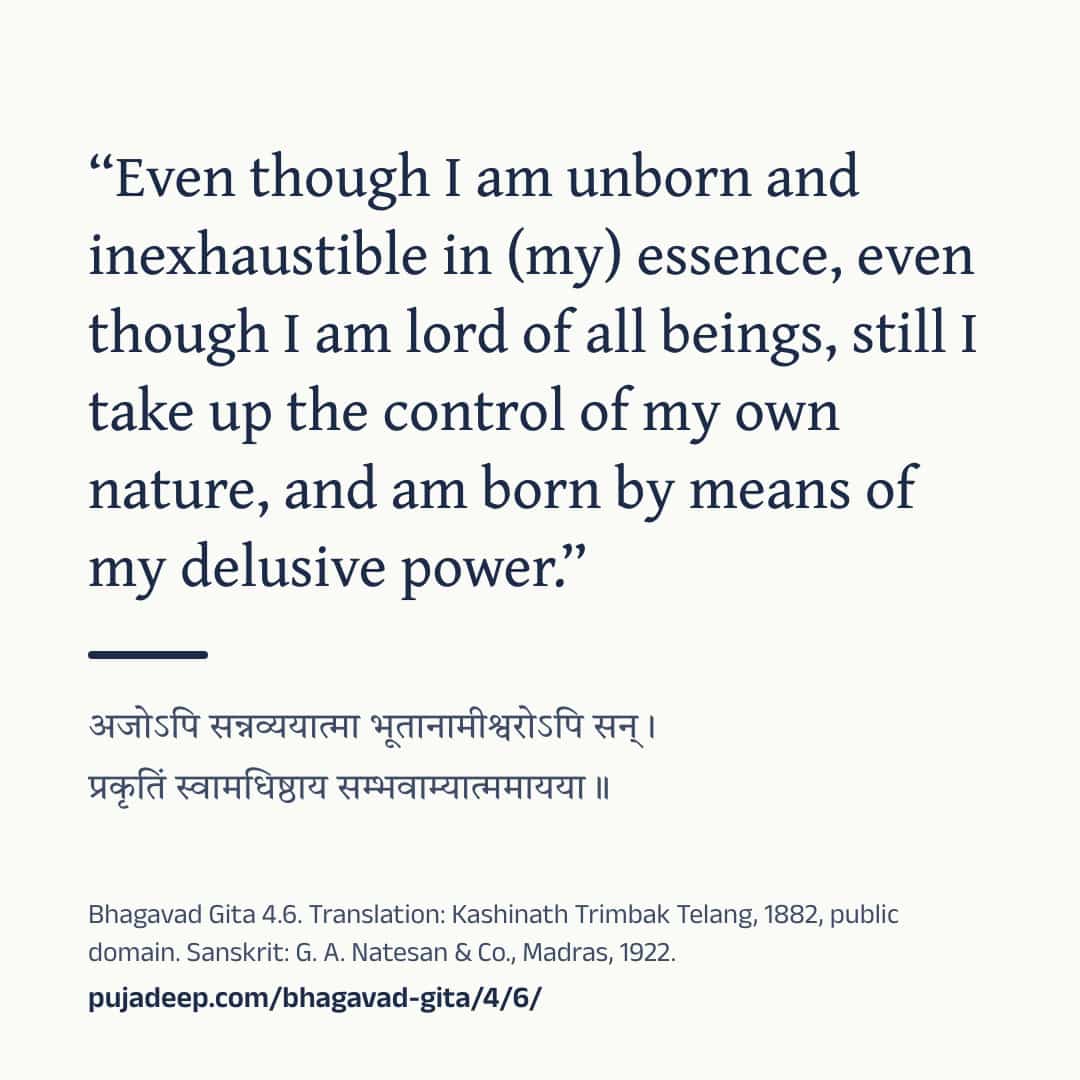
Drawing the picture
See the words
Bhagavad Gita 4.6

अजोऽपि सन्नव्ययात्मा भूतानामीश्वरोऽपि सन् ।
प्रकृतिं स्वामधिष्ठाय सम्भवाम्यात्ममायया ॥

“Even though I am unborn and inexhaustible in (my) essence, even though I am lord of all beings, still I take up the control of my own nature, and am born by means of my delusive power.”
(K. T. Telang, The Bhagavadgîtâ (The Sacred Books of the East, vol. VIII, Oxford: Clarendon Press, 1882), pp. 58–59, public domain)

“Though unborn, the imperishable SELF, and also the Lord of all beings, ruling over Nature, which is Mine own, yet I am born through My own Mâyâ.”
(Annie Besant, The Bhagavad Gîtâ, or The Lord's Song (London: Theosophical Publishing Society, 1895), p. 50, public domain)

“Though I am unborn, of changeless nature, and Lord of beings, yet subjugating My Prakriti, I come into being by My own Maya.”
(Swami Swarupananda, Srimad-Bhagavad-Gita (Mayavati: Prabuddha Bharata Press, 1909; first printed in Prabuddha Bharata, 1907–1909), pp. 86–87, public domain)

Sanskrit: G. A. Natesan & Co., Madras, 1922.
https://pujadeep.com/bhagavad-gita/4/6/ Nothing is sent from this site. Your own app sends it, to the chat you choose. The picture quotes the translation you chose on this page, with its name and year.
Sanskrit text: The Bhagavad-Gita, or The Lord's Song, with the text in Devanagari and an English translation, 1922. Meanings: written for Pujadeep and checked against the cited edition. Source and changes
Questions families ask
Who speaks Bhagavad Gita 4.6?
Krishna speaks this verse, in chapter 4 (Jnana Karma Sannyasa Yoga).
Where does the Sanskrit text come from?
Sanskrit text: The Bhagavad-Gita, or The Lord's Song, with the text in Devanagari and an English translation, 1922. Meanings: written for Pujadeep and checked against the cited edition. See the source
Is the meaning on this page a translation?
Explanation written for this site from the sources listed here, and checked against the cited edition. It is not a translation and not the only way to read the text. Free to quote with credit.
Source and licence
- Sanskrit text
- The Bhagavad-Gita, or The Lord's Song, with the text in Devanagari and an English translation (Annie Besant, G. A. Natesan & Co., Madras, 1922). Public domain. The Sanskrit on these pages was read from this printing’s page images.
- Translation
- The Bhagavadgîtâ with the Sanatsugâtîya and the Anugîtâ, translated by Kâshinâth Trimbak Telang (The Sacred Books of the East, vol. VIII, ed. F. Max Müller) (Kashinath Trimbak Telang, F. Max Müller, Clarendon Press, Oxford, 1882). Public domain. Shown verbatim, as printed.
- Translation
- The Bhagavad Gîtâ, or The Lord's Song, translated by Annie Besant (Annie Besant, Theosophical Publishing Society, London, 1895). Public domain. Shown verbatim, as printed.
- Translation
- Srimad-Bhagavad-Gita, with Sanskrit Text; Paraphrase with Word-by-word Literal Translation; English Rendering and Comments, Index, &c., by the Swami Swarupananda (Himalayan Series, No. XX) (Swami Swarupananda, The Editors and Publishers, Advaita Ashrama, Mayavati, Prabuddha Bharata Press, Mayavati, Almora, Himalayas, 1909). Public domain. Shown verbatim, as printed.
- Commentary
- The Bhagavad-Gita, with the commentary of Sri Sankaracharya, translated by A. Mahadeva Sastri (2nd ed., Mysore: G. T. A. Printing Works, 1901) (Public-domain scan, University of California Libraries). Summarised in our own words; none of its text is reproduced.
- Commentary
- Sri Bhagavad-Gita with Sri Ramanujacharya's Visishtadvaita commentary, translated by A. Govindacharya (Madras, 1898) (Scan uploaded to archive.org (folkscanomy collection)). Summarised in our own words; none of its text is reproduced.
- Common wording
- In this text, 32 words follow today's common wording, checked against sanskritdocuments.org; Sanskrit Wikisource; Gita Press, Gorakhpur; GRETIL, Göttingen and Bhaktivedanta Book Trust.
- Our explanation
- Explanation written for this site from the sources listed here, and checked against the cited edition. It is not a translation and not the only way to read the text. Free to quote with credit.
- Checked
- Checked against the cited edition, October 15, 2026.
- Updated
- October 27, 2026