Bhagavad Gita 4.2: meaning and translation
Chapter 4: Jnana Karma Sannyasa Yoga. Krishna says
Krishna: Handed down in this way, from one to the next, this yoga was known to the royal sages (rājarṣi), kings who were also sages.
Click or tap a word for its meaning and its dictionary page.
Text and layers
Text and layers
These choices stay in this browser.
Bhagavad Gita 4.2
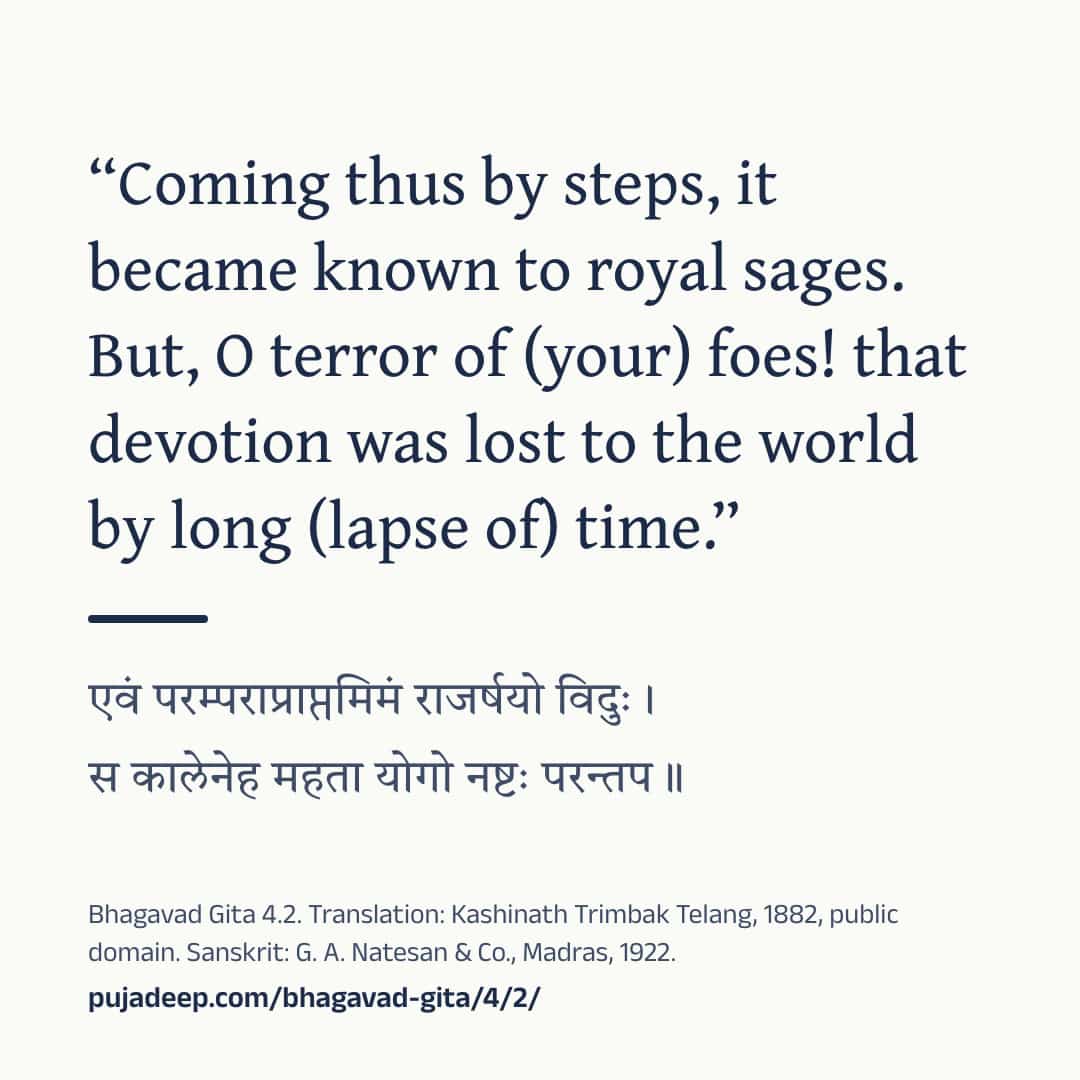
एवं परम्पराप्राप्तमिमं राजर्षयो विदुः ।स कालेनेह महता योगो नष्टः परन्तप ॥
Evam paramparapraptamimam rajarshayo viduhSa kaleneha mahata yogo nashtah parantapa
evaṃ paramparāprāptamimaṃ rājarṣayo viduḥ |sa kāleneha mahatā yogo naṣṭaḥ parantapa ||
Our explanation Handed down in this way, from one to the next, this yoga was known to the royal sages (rājarṣi), kings who were also sages. But over a long time, Krishna tells Arjuna, it was lost to the world. He calls Arjuna Parantapa, "scorcher of foes".
हिंदी अर्थ इस तरह परंपरा से चलते हुए यह योग राजर्षियों (जो राजा होकर भी ऋषि थे) ने जाना। पर कृष्ण अर्जुन से कहते हैं कि बहुत समय बीतने पर यह योग संसार से लुप्त हो गया। वे अर्जुन को परंतप (शत्रुओं को तपाने वाले) कहते हैं।
Word by word
Every word, with its dictionary page
Word by word
- एवम् evam · thus (indeclinable) Dictionary: evam, Monier-Williams 1899, p. 232, col. 2 “thus, in this way, in such a manner”
- परम्पराप्राप्तम् paramparāprāptam · received in succession (compound (masculine), accusative singular) Dictionary: param-parā, Monier-Williams 1899, p. 587, col. 1 “an uninterrupted row or series, order, succession”; prāpta, Monier-Williams 1899, p. 707, col. 2 “attained to, reached, arrived at, met with, found”
- इमम् imam · this (yoga) (pronoun (masculine), accusative singular) Dictionary: 1. idam, Monier-Williams 1899, p. 165, col. 2 “this, this here, referring to something near the speaker”
- राजर्षयः rājarṣayaḥ · royal sages (compound (masculine), nominative plural) Dictionary: rājarṣi, Monier-Williams 1899, p. 874, col. 1 “a royal Rishi or saint”
- विदुः viduḥ · knew (perfect, 3rd person plural) Dictionary: 1. vid, Monier-Williams 1899, p. 963, col. 2 “to know, understand, perceive, learn”
- सः saḥ · that (pronoun (masculine), nominative singular) Dictionary: tad, Monier-Williams 1899, p. 434, col. 1 “m. he, f. she, n. it, that, this”
- कालेन kālena · by time, over time (noun (masculine), instrumental singular) Dictionary: kāla, Monier-Williams 1899, p. 278, col. 1 “a fixed or right point of time, a space of time, time (in general)”
- इह iha · here, in this world (indeclinable) Dictionary: iha, Monier-Williams 1899, p. 169, col. 3 “in this place, here”
- महता mahatā · long (adjective (masculine), instrumental singular) Dictionary: mahat, Monier-Williams 1899, p. 794, col. 2 “great (in space, time, quantity or degree)”
- योगः yogaḥ · yoga (noun (masculine), nominative singular) Dictionary: yoga, Monier-Williams 1899, p. 856, col. 2 “the act of yoking, joining, attaching”
- नष्टः naṣṭaḥ · was lost (past participle (masculine), nominative singular) Dictionary: naṣṭa, Monier-Williams 1899, p. 532, col. 1 “lost, disappeared, perished, destroyed”
- परन्तप parantapa · O scorcher of foes (noun (masculine), vocative singular) Dictionary: param-tapa, Monier-Williams 1899, p. 586, col. 3 “destroying foes (said of heroes)”
Old translations
Kashinath Trimbak Telang, 1882. Public domain. Page 58.
Coming thus by steps, it became known to royal sages. But, O terror of (your) foes! that devotion was lost to the world by long (lapse of) time.
Compare 3 translations
Kashinath Trimbak Telang, 1882. Public domain. Page 58.
Coming thus by steps, it became known to royal sages. But, O terror of (your) foes! that devotion was lost to the world by long (lapse of) time.
You are reading this one
Annie Besant, 1895. Public domain. Page 49.
This, handed on down the line, the King-Sages knew. This Yoga by great efflux of time decayed in the world, O Parantapa.
This sentence begins in 4.1.
You are reading this one
Swami Swarupananda, 1909 (first printed 1907). Public domain. Page 85.
Thus handed down in regular succession, the royal sages knew it. This Yoga, by long lapse of time, declined in this world, O, burner of foes.
This sentence begins in 4.1.
You are reading this one
Cite this verse
The translation: K. T. Telang, The Bhagavadgîtâ (The Sacred Books of the East, vol. VIII, Oxford: Clarendon Press, 1882), p. 58. Bhagavad Gita 4.2.
The translation: Annie Besant, The Bhagavad Gîtâ, or The Lord's Song (London: Theosophical Publishing Society, 1895), p. 49. Bhagavad Gita 4.2.
The translation: Swami Swarupananda, Srimad-Bhagavad-Gita (Mayavati: Prabuddha Bharata Press, 1909; first printed in Prabuddha Bharata, 1907–1909), p. 85. Bhagavad Gita 4.2.
Our explanation: “Bhagavad Gita 4.2: meaning and translation.” Pujadeep. Updated October 27, 2026. https://pujadeep.com/bhagavad-gita/4/2/
Pujadeep’s explanations are free to quote with credit: name Pujadeep and link to the page. How to credit
Classical readings, by school
No readings by school on this verse yet.
Share
Show the ways to share
Send one picture or the text to one chat. The picture names its source and the address of this page.
Drawing the picture
See the words
Bhagavad Gita 4.2

एवं परम्पराप्राप्तमिमं राजर्षयो विदुः ।
स कालेनेह महता योगो नष्टः परन्तप ॥

“Coming thus by steps, it became known to royal sages. But, O terror of (your) foes! that devotion was lost to the world by long (lapse of) time.”
(K. T. Telang, The Bhagavadgîtâ (The Sacred Books of the East, vol. VIII, Oxford: Clarendon Press, 1882), p. 58, public domain)

“This, handed on down the line, the King-Sages knew. This Yoga by great efflux of time decayed in the world, O Parantapa.”
(Annie Besant, The Bhagavad Gîtâ, or The Lord's Song (London: Theosophical Publishing Society, 1895), p. 49, public domain)
This sentence begins in 4.1.

“Thus handed down in regular succession, the royal sages knew it. This Yoga, by long lapse of time, declined in this world, O, burner of foes.”
(Swami Swarupananda, Srimad-Bhagavad-Gita (Mayavati: Prabuddha Bharata Press, 1909; first printed in Prabuddha Bharata, 1907–1909), p. 85, public domain)
This sentence begins in 4.1.

Sanskrit: G. A. Natesan & Co., Madras, 1922.
https://pujadeep.com/bhagavad-gita/4/2/ Nothing is sent from this site. Your own app sends it, to the chat you choose. The picture quotes the translation you chose on this page, with its name and year.
Sanskrit text: The Bhagavad-Gita, or The Lord's Song, with the text in Devanagari and an English translation, 1922. Meanings: written for Pujadeep and checked against the cited edition. Source and changes
Questions families ask
Who speaks Bhagavad Gita 4.2?
Krishna speaks this verse, in chapter 4 (Jnana Karma Sannyasa Yoga).
Where does the Sanskrit text come from?
Sanskrit text: The Bhagavad-Gita, or The Lord's Song, with the text in Devanagari and an English translation, 1922. Meanings: written for Pujadeep and checked against the cited edition. See the source
Is the meaning on this page a translation?
Explanation written for this site from the sources listed here, and checked against the cited edition. It is not a translation and not the only way to read the text. Free to quote with credit.
Source and licence
- Sanskrit text
- The Bhagavad-Gita, or The Lord's Song, with the text in Devanagari and an English translation (Annie Besant, G. A. Natesan & Co., Madras, 1922). Public domain. The Sanskrit on these pages was read from this printing’s page images.
- Translation
- The Bhagavadgîtâ with the Sanatsugâtîya and the Anugîtâ, translated by Kâshinâth Trimbak Telang (The Sacred Books of the East, vol. VIII, ed. F. Max Müller) (Kashinath Trimbak Telang, F. Max Müller, Clarendon Press, Oxford, 1882). Public domain. Shown verbatim, as printed.
- Translation
- The Bhagavad Gîtâ, or The Lord's Song, translated by Annie Besant (Annie Besant, Theosophical Publishing Society, London, 1895). Public domain. Shown verbatim, as printed.
- Translation
- Srimad-Bhagavad-Gita, with Sanskrit Text; Paraphrase with Word-by-word Literal Translation; English Rendering and Comments, Index, &c., by the Swami Swarupananda (Himalayan Series, No. XX) (Swami Swarupananda, The Editors and Publishers, Advaita Ashrama, Mayavati, Prabuddha Bharata Press, Mayavati, Almora, Himalayas, 1909). Public domain. Shown verbatim, as printed.
- Common wording
- In this text, 32 words follow today's common wording, checked against sanskritdocuments.org; Sanskrit Wikisource; Gita Press, Gorakhpur; GRETIL, Göttingen and Bhaktivedanta Book Trust.
- Our explanation
- Explanation written for this site from the sources listed here, and checked against the cited edition. It is not a translation and not the only way to read the text. Free to quote with credit.
- Checked
- Checked against the cited edition, October 15, 2026.
- Updated
- October 27, 2026