Bhagavad Gita 4.3: meaning and translation
Chapter 4: Jnana Karma Sannyasa Yoga. Krishna says
Krishna says that this same ancient yoga is what he has taught Arjuna today, because Arjuna is his devotee and his friend.
Click or tap a word for its meaning and its dictionary page.
Text and layers
Text and layers
These choices stay in this browser.
Bhagavad Gita 4.3
स एवाऽयं मया तेऽद्य योगः प्रोक्तः पुरातनः ।भक्तोऽसि मे सखा चेति रहस्यं ह्येतदुत्तमम् ॥
Sa evayam maya tedya yogah proktah puratanahBhaktosi me sakha cheti rahasyam hyetaduttamam
sa evā’yaṃ mayā te’dya yogaḥ proktaḥ purātanaḥ |bhakto’si me sakhā ceti rahasyaṃ hyetaduttamam ||
Our explanation Krishna says that this same ancient yoga is what he has taught Arjuna today, because Arjuna is his devotee and his friend. It is, he says, the highest secret.
हिंदी अर्थ कृष्ण कहते हैं कि वही पुराना योग आज उन्होंने अर्जुन को बताया है, क्योंकि अर्जुन उनके भक्त और मित्र हैं। वे कहते हैं कि यह उत्तम रहस्य है।
Word by word
Every word, with its dictionary page
Word by word
- सः saḥ · that (pronoun (masculine), nominative singular) Dictionary: tad, Monier-Williams 1899, p. 434, col. 1 “m. he, f. she, n. it, that, this”
- एव eva · very, same (indeclinable) Dictionary: 1. eva, Monier-Williams 1899, p. 232, col. 2 “just, exactly, very, same, only, even, alone, merely”
- अयम् ayam · this (pronoun (masculine), nominative singular) Dictionary: 1. idam, Monier-Williams 1899, p. 165, col. 2 “this, this here, referring to something near the speaker”
- मया mayā · by "me" (Krishna) (pronoun, instrumental singular) Dictionary: 1. mad, Monier-Williams 1899, p. 777, col. 2 “base of the first pers. pron. in the sg. number (esp. in comp.)”
- ते te · to you (pronoun, dative singular) Dictionary: 2. tva, Monier-Williams 1899, p. 463, col. 2 “base of the 2nd personal pron.”
- अद्य adya · today (indeclinable) Dictionary: 2. a-dya, Monier-Williams 1899, p. 19, col. 1 “to-day”
- योगः yogaḥ · yoga (noun (masculine), nominative singular) Dictionary: yoga, Monier-Williams 1899, p. 856, col. 2 “the act of yoking, joining, attaching”
- प्रोक्तः proktaḥ · has been taught (past participle (masculine), nominative singular) Dictionary: pra-vac, Monier-Williams 1899, p. 690, col. 1 “to proclaim, announce, praise, commend, mention, teach, impart, explain”
- पुरातनः purātanaḥ · ancient (adjective (masculine), nominative singular) Dictionary: purātana, Monier-Williams 1899, p. 635, col. 1 “belonging to the past, former, old, ancient”
- भक्तः bhaktaḥ · devotee (noun (masculine), nominative singular) Dictionary: bhakta, Monier-Williams 1899, p. 743, col. 1 “attached or devoted to, loyal, faithful, honouring, worshipping, serving”
- असि asi · you are (present, 2nd person singular) Dictionary: 1. as, Monier-Williams 1899, p. 117, col. 2 “to be, live, exist, be present”
- मे me · "my" (pronoun, genitive singular) Dictionary: 1. mad, Monier-Williams 1899, p. 777, col. 2 “base of the first pers. pron. in the sg. number (esp. in comp.)”
- सखा sakhā · friend (noun (masculine), nominative singular) Dictionary: sakhi, Monier-Williams 1899, p. 1130, col. 2 “a friend, assistant”
- च ca · and (indeclinable) Dictionary: 2. ca, Monier-Williams 1899, p. 380, col. 1 “and, both, also, moreover, as well as”
- इति iti · so, for this reason (indeclinable) Dictionary: 2. iti, Monier-Williams 1899, p. 165, col. 1 “in this manner, thus”
- रहस्यम् rahasyam · secret (noun (neuter), nominative singular) Dictionary: rahasya, Monier-Williams 1899, p. 871, col. 2 “a secret, any secret doctrine or mystery”
- हि hi · for, indeed (indeclinable) Dictionary: 2. hi, Monier-Williams 1899, p. 1297, col. 3 “for, because, on account of”
- एतत् etat · this (pronoun (neuter), nominative singular) Dictionary: etad, Monier-Williams 1899, p. 231, col. 2 “this, this here, here”
- उत्तमम् uttamam · highest (adjective (neuter), nominative singular) Dictionary: ut-tama, Monier-Williams 1899, p. 177, col. 3 “uppermost, highest, chief; most elevated, principal; best, excellent”
1 printing differs
Edition differences. Another printing or text reads this place differently.
- Spelling A digital text reads Same words. The 1922 edition marks the merged vowel with an avagraha (ऽ); this e-text does not. Edition: स एवाऽयं.
Old translations
Kashinath Trimbak Telang, 1882. Public domain. Page 58.
That same primeval devotion I have declared to you to-day, seeing that you are my devotee and friend, for it is the highest mystery.
Compare 3 translations
Kashinath Trimbak Telang, 1882. Public domain. Page 58.
That same primeval devotion I have declared to you to-day, seeing that you are my devotee and friend, for it is the highest mystery.
You are reading this one
Annie Besant, 1895. Public domain. Page 49.
This same ancient Yoga hath been to-day declared to thee by Me, for thou art My devotee and My friend; it is the Supreme Secret.
You are reading this one
Swami Swarupananda, 1909 (first printed 1907). Public domain. Page 85.
I have this day told thee that same ancient Yoga, (for) thou art my devotee, and my friend, and this secret is profound indeed.
You are reading this one
Cite this verse
The translation: K. T. Telang, The Bhagavadgîtâ (The Sacred Books of the East, vol. VIII, Oxford: Clarendon Press, 1882), p. 58. Bhagavad Gita 4.3.
The translation: Annie Besant, The Bhagavad Gîtâ, or The Lord's Song (London: Theosophical Publishing Society, 1895), p. 49. Bhagavad Gita 4.3.
The translation: Swami Swarupananda, Srimad-Bhagavad-Gita (Mayavati: Prabuddha Bharata Press, 1909; first printed in Prabuddha Bharata, 1907–1909), p. 85. Bhagavad Gita 4.3.
Our explanation: “Bhagavad Gita 4.3: meaning and translation.” Pujadeep. Updated October 27, 2026. https://pujadeep.com/bhagavad-gita/4/3/
Pujadeep’s explanations are free to quote with credit: name Pujadeep and link to the page. How to credit
Classical readings, by school
No readings by school on this verse yet.
Share
Show the ways to share
Send one picture or the text to one chat. The picture names its source and the address of this page.
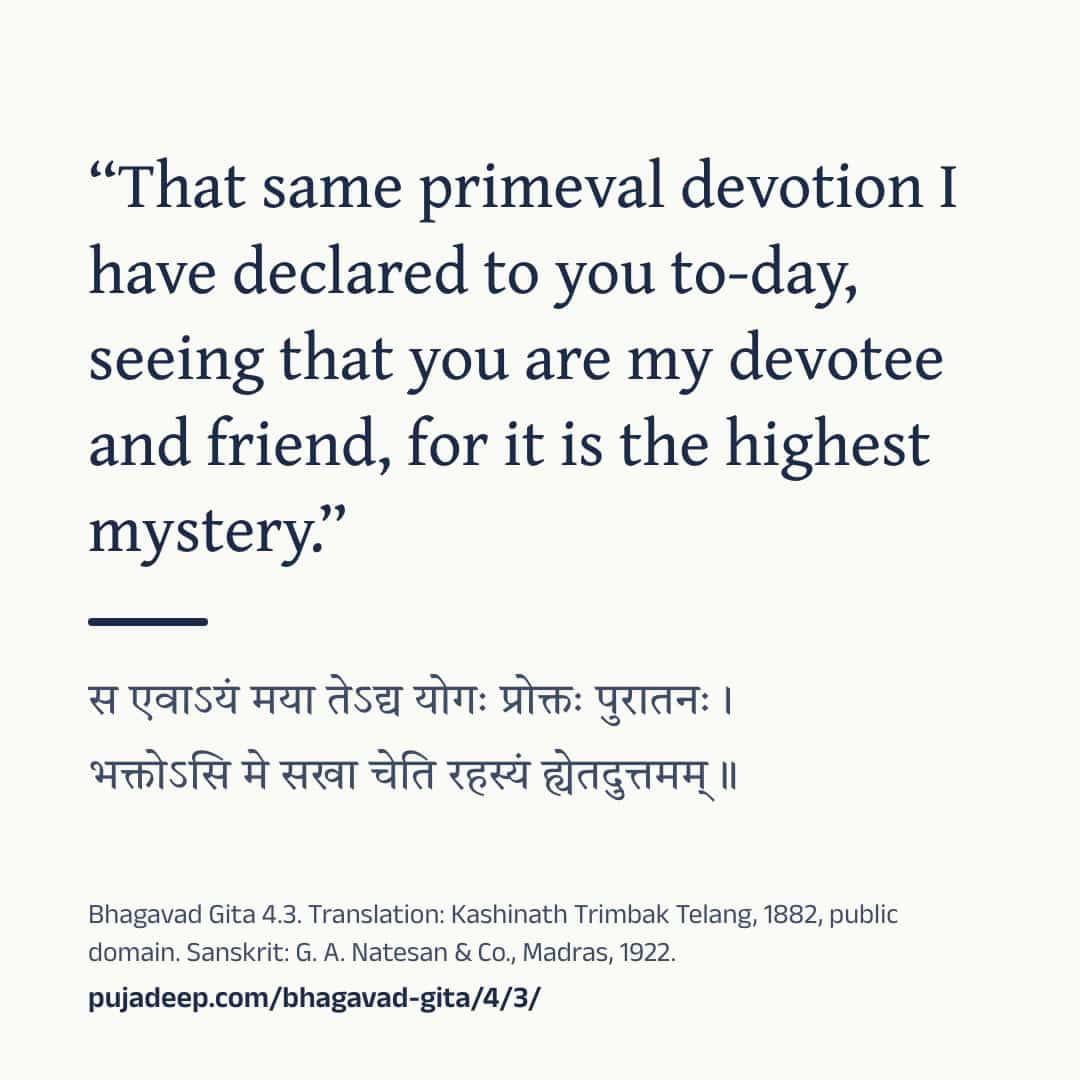
Drawing the picture
See the words
Bhagavad Gita 4.3

स एवाऽयं मया तेऽद्य योगः प्रोक्तः पुरातनः ।
भक्तोऽसि मे सखा चेति रहस्यं ह्येतदुत्तमम् ॥

“That same primeval devotion I have declared to you to-day, seeing that you are my devotee and friend, for it is the highest mystery.”
(K. T. Telang, The Bhagavadgîtâ (The Sacred Books of the East, vol. VIII, Oxford: Clarendon Press, 1882), p. 58, public domain)

“This same ancient Yoga hath been to-day declared to thee by Me, for thou art My devotee and My friend; it is the Supreme Secret.”
(Annie Besant, The Bhagavad Gîtâ, or The Lord's Song (London: Theosophical Publishing Society, 1895), p. 49, public domain)

“I have this day told thee that same ancient Yoga, (for) thou art my devotee, and my friend, and this secret is profound indeed.”
(Swami Swarupananda, Srimad-Bhagavad-Gita (Mayavati: Prabuddha Bharata Press, 1909; first printed in Prabuddha Bharata, 1907–1909), p. 85, public domain)

Sanskrit: G. A. Natesan & Co., Madras, 1922.
https://pujadeep.com/bhagavad-gita/4/3/ Nothing is sent from this site. Your own app sends it, to the chat you choose. The picture quotes the translation you chose on this page, with its name and year.
Sanskrit text: The Bhagavad-Gita, or The Lord's Song, with the text in Devanagari and an English translation, 1922. Meanings: written for Pujadeep and checked against the cited edition. Source and changes
Questions families ask
Who speaks Bhagavad Gita 4.3?
Krishna speaks this verse, in chapter 4 (Jnana Karma Sannyasa Yoga).
Where does the Sanskrit text come from?
Sanskrit text: The Bhagavad-Gita, or The Lord's Song, with the text in Devanagari and an English translation, 1922. Meanings: written for Pujadeep and checked against the cited edition. See the source
Is the meaning on this page a translation?
Explanation written for this site from the sources listed here, and checked against the cited edition. It is not a translation and not the only way to read the text. Free to quote with credit.
Source and licence
- Sanskrit text
- The Bhagavad-Gita, or The Lord's Song, with the text in Devanagari and an English translation (Annie Besant, G. A. Natesan & Co., Madras, 1922). Public domain. The Sanskrit on these pages was read from this printing’s page images.
- Translation
- The Bhagavadgîtâ with the Sanatsugâtîya and the Anugîtâ, translated by Kâshinâth Trimbak Telang (The Sacred Books of the East, vol. VIII, ed. F. Max Müller) (Kashinath Trimbak Telang, F. Max Müller, Clarendon Press, Oxford, 1882). Public domain. Shown verbatim, as printed.
- Translation
- The Bhagavad Gîtâ, or The Lord's Song, translated by Annie Besant (Annie Besant, Theosophical Publishing Society, London, 1895). Public domain. Shown verbatim, as printed.
- Translation
- Srimad-Bhagavad-Gita, with Sanskrit Text; Paraphrase with Word-by-word Literal Translation; English Rendering and Comments, Index, &c., by the Swami Swarupananda (Himalayan Series, No. XX) (Swami Swarupananda, The Editors and Publishers, Advaita Ashrama, Mayavati, Prabuddha Bharata Press, Mayavati, Almora, Himalayas, 1909). Public domain. Shown verbatim, as printed.
- Common wording
- In this text, 32 words follow today's common wording, checked against sanskritdocuments.org; Sanskrit Wikisource; Gita Press, Gorakhpur; GRETIL, Göttingen and Bhaktivedanta Book Trust.
- Our explanation
- Explanation written for this site from the sources listed here, and checked against the cited edition. It is not a translation and not the only way to read the text. Free to quote with credit.
- Checked
- Checked against the cited edition, October 15, 2026.
- Updated
- October 27, 2026