Bhagavad Gita 4.15: meaning and translation
Chapter 4: Jnana Karma Sannyasa Yoga. Krishna says
Knowing this, Krishna says, people of old who sought liberation (mokṣa) still did their work.
Click or tap a word for its meaning and its dictionary page.
Text and layers
Text and layers
These choices stay in this browser.
Bhagavad Gita 4.15
एवं ज्ञात्वा कृतं कर्म पूर्वैरपि मुमुक्षुभिः ।कुरु कर्मैव तस्मात्त्वं पूर्वैः पूर्वतरं कृतम् ॥
Evam jnatva kritam karma purvairapi mumukshubhihKuru karmaiva tasmattvam purvaih purvataram kritam
evaṃ jñātvā kṛtaṃ karma pūrvairapi mumukṣubhiḥ |kuru karmaiva tasmāttvaṃ pūrvaiḥ pūrvataraṃ kṛtam ||
Our explanation Knowing this, Krishna says, people of old who sought liberation (mokṣa) still did their work. So Arjuna too should act, as they did long ago.
हिंदी अर्थ कृष्ण कहते हैं कि यह जानकर पुराने समय के मोक्ष चाहने वाले लोगों ने भी कर्म किया। इसलिए अर्जुन भी वैसे ही कर्म करें, जैसे पूर्वजों ने बहुत पहले किया था।
Word by word
Every word, with its dictionary page
Word by word
- एवम् evam · thus (indeclinable) Dictionary: evam, Monier-Williams 1899, p. 232, col. 2 “thus, in this way, in such a manner”
- ज्ञात्वा jñātvā · having known (absolutive (having done)) Dictionary: 1. jñā, Monier-Williams 1899, p. 425, col. 3 “to know, have knowledge, become acquainted with”
- कृतम् kṛtam · was done (past participle (neuter), nominative singular) Dictionary: 1. kṛ, Monier-Williams 1899, p. 301, col. 1 “to do, make, perform, accomplish, cause, effect”
- कर्म karma · action (noun (neuter), nominative singular) Dictionary: karman, Monier-Williams 1899, p. 258, col. 2 “act, action, performance, business”
- पूर्वैः pūrvaiḥ · by people of old (adjective (masculine), instrumental plural) Dictionary: pūrva, Monier-Williams 1899, p. 643, col. 1 “eastern, to the east of”
- अपि api · also (indeclinable) Dictionary: api, Monier-Williams 1899, p. 55, col. 1 “in the sense of even, also, very”
- मुमुक्षुभिः mumukṣubhiḥ · by seekers of liberation (adjective (masculine), instrumental plural) Dictionary: mumukṣu, Monier-Williams 1899, p. 821, col. 2 “eager to be free”
- कुरु kuru · do (imperative, 2nd person singular) Dictionary: 1. kṛ, Monier-Williams 1899, p. 301, col. 1 “to do, make, perform, accomplish, cause, effect”
- कर्म karma · action (noun (neuter), accusative singular) Dictionary: karman, Monier-Williams 1899, p. 258, col. 2 “act, action, performance, business”
- एव eva · just (indeclinable) Dictionary: 1. eva, Monier-Williams 1899, p. 232, col. 2 “just, exactly, very, same, only, even, alone, merely”
- तस्मात् tasmāt · therefore (indeclinable) Dictionary: tasmāt, Monier-Williams 1899, p. 441, col. 2 “from that, on that account, therefore”
- त्वम् tvam · you (pronoun, nominative singular) Dictionary: 2. tva, Monier-Williams 1899, p. 463, col. 2 “base of the 2nd personal pron.”
- पूर्वैः pūrvaiḥ · by people of old (adjective (masculine), instrumental plural) Dictionary: pūrva, Monier-Williams 1899, p. 643, col. 1 “eastern, to the east of”
- पूर्वतरम् pūrvataram · long ago (indeclinable) Dictionary: pūrva-tara, Monier-Williams 1899, p. 643, col. 2 “earlier, previous, prior”
- कृतम् kṛtam · done (past participle (neuter), accusative singular) Dictionary: 1. kṛ, Monier-Williams 1899, p. 301, col. 1 “to do, make, perform, accomplish, cause, effect”
Old translations
Kashinath Trimbak Telang, 1882. Public domain. Page 59.
Knowing this, the men of old who wished for final emancipation, performed action. Therefore do you, too, perform action as was done by men of old in olden times.
Compare 3 translations
Kashinath Trimbak Telang, 1882. Public domain. Page 59.
Knowing this, the men of old who wished for final emancipation, performed action. Therefore do you, too, perform action as was done by men of old in olden times.
You are reading this one
Annie Besant, 1895. Public domain. Page 52.
Having thus known, our forefathers performed action for the sake of liberation; therefore do thou also perform action, as did our forefathers in the olden time.
You are reading this one
Swami Swarupananda, 1909 (first printed 1907). Public domain. Page 91.
Knowing this, the ancient seekers after freedom, also performed action. Do thou, therefore, perform action, as did the ancients in olden times.
You are reading this one
Cite this verse
The translation: K. T. Telang, The Bhagavadgîtâ (The Sacred Books of the East, vol. VIII, Oxford: Clarendon Press, 1882), p. 59. Bhagavad Gita 4.15.
The translation: Annie Besant, The Bhagavad Gîtâ, or The Lord's Song (London: Theosophical Publishing Society, 1895), p. 52. Bhagavad Gita 4.15.
The translation: Swami Swarupananda, Srimad-Bhagavad-Gita (Mayavati: Prabuddha Bharata Press, 1909; first printed in Prabuddha Bharata, 1907–1909), p. 91. Bhagavad Gita 4.15.
Our explanation: “Bhagavad Gita 4.15: meaning and translation.” Pujadeep. Updated October 27, 2026. https://pujadeep.com/bhagavad-gita/4/15/
Pujadeep’s explanations are free to quote with credit: name Pujadeep and link to the page. How to credit
Classical readings, by school
No readings by school on this verse yet.
Share
Show the ways to share
Send one picture or the text to one chat. The picture names its source and the address of this page.
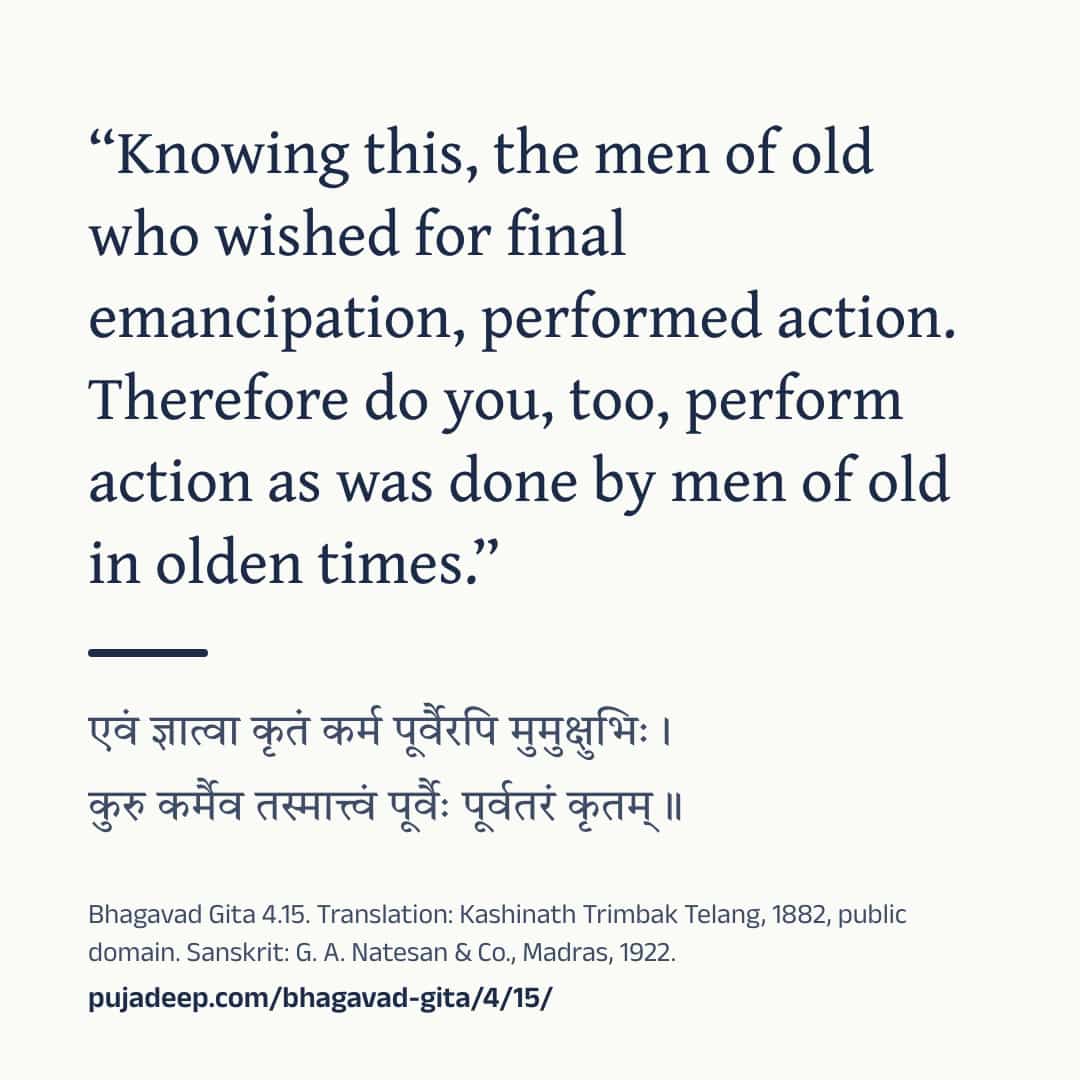
Drawing the picture
See the words
Bhagavad Gita 4.15

एवं ज्ञात्वा कृतं कर्म पूर्वैरपि मुमुक्षुभिः ।
कुरु कर्मैव तस्मात्त्वं पूर्वैः पूर्वतरं कृतम् ॥

“Knowing this, the men of old who wished for final emancipation, performed action. Therefore do you, too, perform action as was done by men of old in olden times.”
(K. T. Telang, The Bhagavadgîtâ (The Sacred Books of the East, vol. VIII, Oxford: Clarendon Press, 1882), p. 59, public domain)

“Having thus known, our forefathers performed action for the sake of liberation; therefore do thou also perform action, as did our forefathers in the olden time.”
(Annie Besant, The Bhagavad Gîtâ, or The Lord's Song (London: Theosophical Publishing Society, 1895), p. 52, public domain)

“Knowing this, the ancient seekers after freedom, also performed action. Do thou, therefore, perform action, as did the ancients in olden times.”
(Swami Swarupananda, Srimad-Bhagavad-Gita (Mayavati: Prabuddha Bharata Press, 1909; first printed in Prabuddha Bharata, 1907–1909), p. 91, public domain)

Sanskrit: G. A. Natesan & Co., Madras, 1922.
https://pujadeep.com/bhagavad-gita/4/15/ Nothing is sent from this site. Your own app sends it, to the chat you choose. The picture quotes the translation you chose on this page, with its name and year.
Sanskrit text: The Bhagavad-Gita, or The Lord's Song, with the text in Devanagari and an English translation, 1922. Meanings: written for Pujadeep and checked against the cited edition. Source and changes
Questions families ask
Who speaks Bhagavad Gita 4.15?
Krishna speaks this verse, in chapter 4 (Jnana Karma Sannyasa Yoga).
Where does the Sanskrit text come from?
Sanskrit text: The Bhagavad-Gita, or The Lord's Song, with the text in Devanagari and an English translation, 1922. Meanings: written for Pujadeep and checked against the cited edition. See the source
Is the meaning on this page a translation?
Explanation written for this site from the sources listed here, and checked against the cited edition. It is not a translation and not the only way to read the text. Free to quote with credit.
Source and licence
- Sanskrit text
- The Bhagavad-Gita, or The Lord's Song, with the text in Devanagari and an English translation (Annie Besant, G. A. Natesan & Co., Madras, 1922). Public domain. The Sanskrit on these pages was read from this printing’s page images.
- Translation
- The Bhagavadgîtâ with the Sanatsugâtîya and the Anugîtâ, translated by Kâshinâth Trimbak Telang (The Sacred Books of the East, vol. VIII, ed. F. Max Müller) (Kashinath Trimbak Telang, F. Max Müller, Clarendon Press, Oxford, 1882). Public domain. Shown verbatim, as printed.
- Translation
- The Bhagavad Gîtâ, or The Lord's Song, translated by Annie Besant (Annie Besant, Theosophical Publishing Society, London, 1895). Public domain. Shown verbatim, as printed.
- Translation
- Srimad-Bhagavad-Gita, with Sanskrit Text; Paraphrase with Word-by-word Literal Translation; English Rendering and Comments, Index, &c., by the Swami Swarupananda (Himalayan Series, No. XX) (Swami Swarupananda, The Editors and Publishers, Advaita Ashrama, Mayavati, Prabuddha Bharata Press, Mayavati, Almora, Himalayas, 1909). Public domain. Shown verbatim, as printed.
- Common wording
- In this text, 32 words follow today's common wording, checked against sanskritdocuments.org; Sanskrit Wikisource; Gita Press, Gorakhpur; GRETIL, Göttingen and Bhaktivedanta Book Trust.
- Our explanation
- Explanation written for this site from the sources listed here, and checked against the cited edition. It is not a translation and not the only way to read the text. Free to quote with credit.
- Checked
- Checked against the cited edition, October 15, 2026.
- Updated
- October 27, 2026