Bhagavad Gita 4.12: meaning and translation
Chapter 4: Jnana Karma Sannyasa Yoga. Krishna says
People who want their actions to succeed worship the gods (devatās) here, Krishna says, because in the human world the success that comes from action comes quickly.
Click or tap a word for its meaning and its dictionary page.
Text and layers
Text and layers
These choices stay in this browser.
Bhagavad Gita 4.12
काङ्क्षन्तः कर्मणां सिद्धिं यजन्त इह देवताः ।क्षिप्रं हि मानुषे लोके सिद्धिर्भवति कर्मजा ॥
Kankshantah karmanam siddhim yajanta iha devatahKshipram hi manushe loke siddhirbhavati karmaja
kāṅkṣantaḥ karmaṇāṃ siddhiṃ yajanta iha devatāḥ |kṣipraṃ hi mānuṣe loke siddhirbhavati karmajā ||
Our explanation People who want their actions to succeed worship the gods (devatās) here, Krishna says, because in the human world the success that comes from action comes quickly.
हिंदी अर्थ कृष्ण कहते हैं कि जो लोग अपने कर्मों की सफलता चाहते हैं, वे यहाँ देवताओं की पूजा करते हैं, क्योंकि मनुष्य-लोक में कर्म से मिलने वाली सफलता जल्दी मिलती है।
Word by word
Every word, with its dictionary page
Word by word
- काङ्क्षन्तः kāṅkṣantaḥ · desiring (present participle (masculine), nominative plural) Dictionary: kāṅkṣ, Monier-Williams 1899, p. 268, col. 1 “to wish, desire, long for, hope for”
- कर्मणाम् karmaṇām · of actions (noun (neuter), genitive plural) Dictionary: karman, Monier-Williams 1899, p. 258, col. 2 “act, action, performance, business”
- सिद्धिम् siddhim · success (noun (feminine), accusative singular) Dictionary: 2. siddhi, Monier-Williams 1899, p. 1216, col. 2 “accomplishment, performance, fulfilment, complete attainment (of any object), success”
- यजन्ते yajante · worship (present, 3rd person plural) Dictionary: 1. yaj, Monier-Williams 1899, p. 838, col. 3 “to worship, adore, honour (esp. with sacrifice or oblations)”
- इह iha · here (indeclinable) Dictionary: iha, Monier-Williams 1899, p. 169, col. 3 “in this place, here”
- देवताः devatāḥ · the gods (noun (feminine), accusative plural) Dictionary: devatā, Monier-Williams 1899, p. 495, col. 3 “godhead, divinity (abstr. & concr.)”
- क्षिप्रम् kṣipram · quickly (indeclinable) Dictionary: kṣipra, Monier-Williams 1899, p. 329, col. 1 “quick, speedy, swift”
- हि hi · for (indeclinable) Dictionary: 2. hi, Monier-Williams 1899, p. 1297, col. 3 “for, because, on account of”
- मानुषे mānuṣe · human (adjective (masculine), locative singular) Dictionary: mānuṣa, Monier-Williams 1899, p. 810, col. 2 “belonging to mankind, human”
- लोके loke · in the world (noun (masculine), locative singular) Dictionary: loka, Monier-Williams 1899, p. 906, col. 1 “the wide space or world”
- सिद्धिः siddhiḥ · success (noun (feminine), nominative singular) Dictionary: 2. siddhi, Monier-Williams 1899, p. 1216, col. 2 “accomplishment, performance, fulfilment, complete attainment (of any object), success”
- भवति bhavati · comes (present, 3rd person singular) Dictionary: 1. bhū, Monier-Williams 1899, p. 760, col. 2 “to become, be”
- कर्मजा karmajā · born of action (compound (feminine), nominative singular) Dictionary: karma-ja, Monier-Williams 1899, p. 258, col. 3 “resulting or produced from any act (good or bad)”
Old translations
Kashinath Trimbak Telang, 1882. Public domain. Page 59.
Desiring the success of actions1, men in this world worship the divinities, for in this world of mortals, the success produced by action is soon obtained.
Footnotes (the translator’s own) - Such as acquisition of sons, cattle, &c. ↩
Compare 3 translations
Kashinath Trimbak Telang, 1882. Public domain. Page 59.
Desiring the success of actions1, men in this world worship the divinities, for in this world of mortals, the success produced by action is soon obtained.
Footnotes (the translator’s own) - Such as acquisition of sons, cattle, &c. ↩
You are reading this one
Annie Besant, 1895. Public domain. Page 51.
They who long after success in action sacrifice on earth to the Gods; for in brief space verily, in this world of men, success is born of action.
You are reading this one
Swami Swarupananda, 1909 (first printed 1907). Public domain. Page 89–90.
Longing for success in action, in this world, (men) worship the gods. Because success, resulting from action, is quickly attained in the human world.
You are reading this one
Cite this verse
The translation: K. T. Telang, The Bhagavadgîtâ (The Sacred Books of the East, vol. VIII, Oxford: Clarendon Press, 1882), p. 59. Bhagavad Gita 4.12.
The translation: Annie Besant, The Bhagavad Gîtâ, or The Lord's Song (London: Theosophical Publishing Society, 1895), p. 51. Bhagavad Gita 4.12.
The translation: Swami Swarupananda, Srimad-Bhagavad-Gita (Mayavati: Prabuddha Bharata Press, 1909; first printed in Prabuddha Bharata, 1907–1909), pp. 89–90. Bhagavad Gita 4.12.
Our explanation: “Bhagavad Gita 4.12: meaning and translation.” Pujadeep. Updated October 27, 2026. https://pujadeep.com/bhagavad-gita/4/12/
Pujadeep’s explanations are free to quote with credit: name Pujadeep and link to the page. How to credit
Classical readings, by school
No readings by school on this verse yet.
Share
Show the ways to share
Send one picture or the text to one chat. The picture names its source and the address of this page.
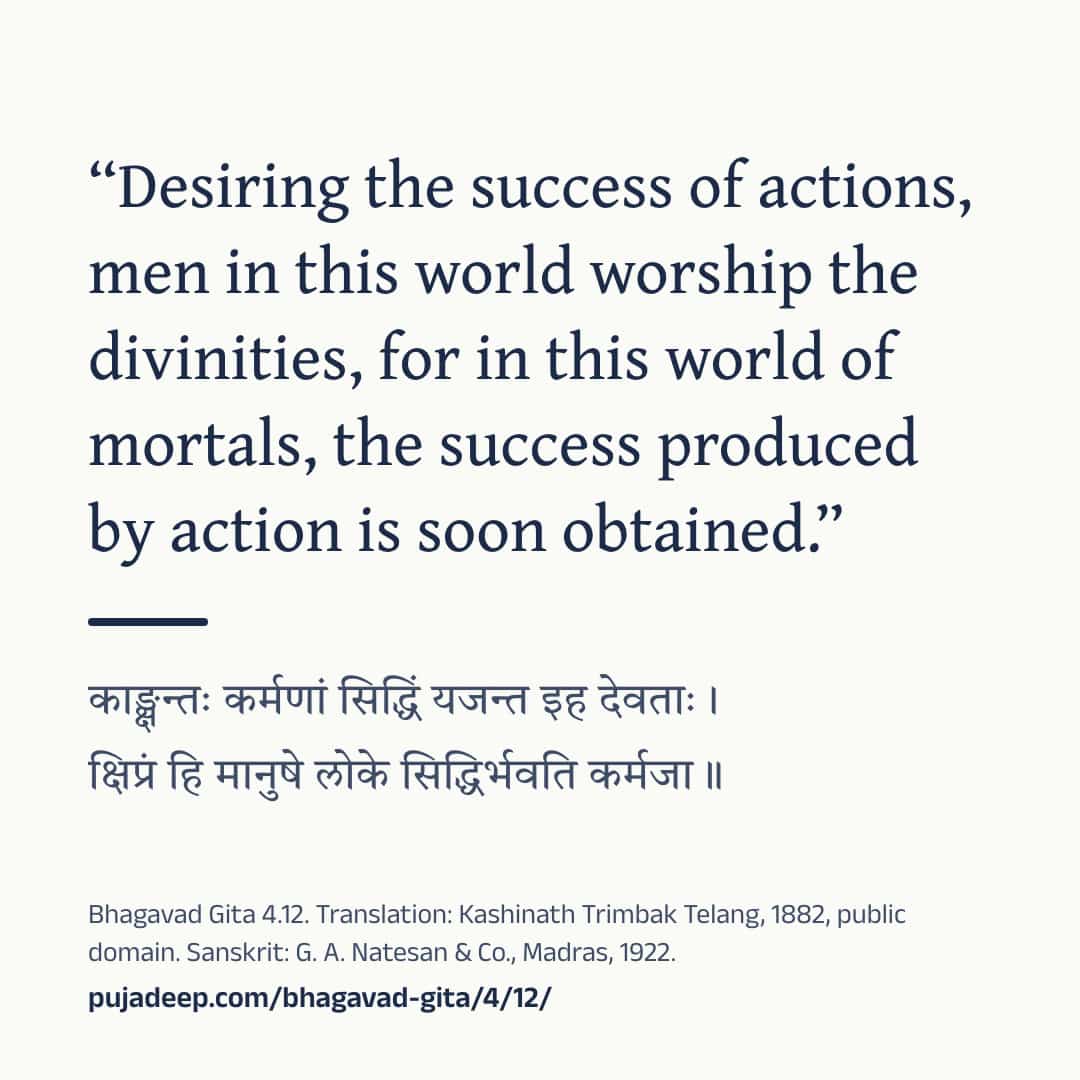
Drawing the picture
See the words
Bhagavad Gita 4.12

काङ्क्षन्तः कर्मणां सिद्धिं यजन्त इह देवताः ।
क्षिप्रं हि मानुषे लोके सिद्धिर्भवति कर्मजा ॥

“Desiring the success of actions, men in this world worship the divinities, for in this world of mortals, the success produced by action is soon obtained.”
(K. T. Telang, The Bhagavadgîtâ (The Sacred Books of the East, vol. VIII, Oxford: Clarendon Press, 1882), p. 59, public domain)

“They who long after success in action sacrifice on earth to the Gods; for in brief space verily, in this world of men, success is born of action.”
(Annie Besant, The Bhagavad Gîtâ, or The Lord's Song (London: Theosophical Publishing Society, 1895), p. 51, public domain)

“Longing for success in action, in this world, (men) worship the gods. Because success, resulting from action, is quickly attained in the human world.”
(Swami Swarupananda, Srimad-Bhagavad-Gita (Mayavati: Prabuddha Bharata Press, 1909; first printed in Prabuddha Bharata, 1907–1909), pp. 89–90, public domain)

Sanskrit: G. A. Natesan & Co., Madras, 1922.
https://pujadeep.com/bhagavad-gita/4/12/ Nothing is sent from this site. Your own app sends it, to the chat you choose. The picture quotes the translation you chose on this page, with its name and year.
Sanskrit text: The Bhagavad-Gita, or The Lord's Song, with the text in Devanagari and an English translation, 1922. Meanings: written for Pujadeep and checked against the cited edition. Source and changes
Questions families ask
Who speaks Bhagavad Gita 4.12?
Krishna speaks this verse, in chapter 4 (Jnana Karma Sannyasa Yoga).
Where does the Sanskrit text come from?
Sanskrit text: The Bhagavad-Gita, or The Lord's Song, with the text in Devanagari and an English translation, 1922. Meanings: written for Pujadeep and checked against the cited edition. See the source
Is the meaning on this page a translation?
Explanation written for this site from the sources listed here, and checked against the cited edition. It is not a translation and not the only way to read the text. Free to quote with credit.
Source and licence
- Sanskrit text
- The Bhagavad-Gita, or The Lord's Song, with the text in Devanagari and an English translation (Annie Besant, G. A. Natesan & Co., Madras, 1922). Public domain. The Sanskrit on these pages was read from this printing’s page images.
- Translation
- The Bhagavadgîtâ with the Sanatsugâtîya and the Anugîtâ, translated by Kâshinâth Trimbak Telang (The Sacred Books of the East, vol. VIII, ed. F. Max Müller) (Kashinath Trimbak Telang, F. Max Müller, Clarendon Press, Oxford, 1882). Public domain. Shown verbatim, as printed.
- Translation
- The Bhagavad Gîtâ, or The Lord's Song, translated by Annie Besant (Annie Besant, Theosophical Publishing Society, London, 1895). Public domain. Shown verbatim, as printed.
- Translation
- Srimad-Bhagavad-Gita, with Sanskrit Text; Paraphrase with Word-by-word Literal Translation; English Rendering and Comments, Index, &c., by the Swami Swarupananda (Himalayan Series, No. XX) (Swami Swarupananda, The Editors and Publishers, Advaita Ashrama, Mayavati, Prabuddha Bharata Press, Mayavati, Almora, Himalayas, 1909). Public domain. Shown verbatim, as printed.
- Common wording
- In this text, 32 words follow today's common wording, checked against sanskritdocuments.org; Sanskrit Wikisource; Gita Press, Gorakhpur; GRETIL, Göttingen and Bhaktivedanta Book Trust.
- Our explanation
- Explanation written for this site from the sources listed here, and checked against the cited edition. It is not a translation and not the only way to read the text. Free to quote with credit.
- Checked
- Checked against the cited edition, October 15, 2026.
- Updated
- October 27, 2026