Bhagavad Gita 4.21: meaning and translation
Chapter 4: Jnana Karma Sannyasa Yoga. Krishna says
Without craving, with mind and body under control, and having given up all possessiveness, a person who acts only for the body's needs, Krishna says, incurs no sin (kilbiṣa).
Click or tap a word for its meaning and its dictionary page.
Text and layers
Text and layers
These choices stay in this browser.
Bhagavad Gita 4.21
निराशीर्यतचित्तात्मा त्यक्तसर्वपरिग्रहः ।शारीरं केवलं कर्म कुर्वन्नाप्नोति किल्बिषम् ॥
Nirashiryatachittatma tyaktasarvaparigrahahShariram kevalam karma kurvannapnoti kilbisham
nirāśīryatacittātmā tyaktasarvaparigrahaḥ |śārīraṃ kevalaṃ karma kurvannāpnoti kilbiṣam ||
Our explanation Without craving, with mind and body under control, and having given up all possessiveness, a person who acts only for the body's needs, Krishna says, incurs no sin (kilbiṣa). The two translations read śārīraṃ kevalaṃ karma differently: Telang 'for the sake of the body', Besant 'by the body alone'.
हिंदी अर्थ कृष्ण कहते हैं कि जो आशा (लालसा) से रहित है, जिसका मन और शरीर वश में है, और जिसने सब संग्रह (परिग्रह) छोड़ दिया है, वह केवल शरीर के लिए कर्म करते हुए पाप (किल्बिष) को प्राप्त नहीं होता। दोनों अनुवाद 'शारीरं केवलं कर्म' को अलग ढंग से लेते हैं: तेलंग 'शरीर के लिए', बेसेंट 'केवल शरीर से'।
Word by word
Every word, with its dictionary page
Word by word
- निराशीः nirāśīḥ · without craving (adjective (masculine), nominative singular) Dictionary: nir-āśis, Monier-Williams 1899, p. 540, col. 2 “free from desire, indifferent”
- यतचित्तात्मा yatacittātmā · with mind and self controlled (compound (masculine), nominative singular) Dictionary: yata, Monier-Williams 1899, p. 845, col. 2 “restrained, held in, held forth, kept down or limited, subdued, governed, controlled &c.”; citta, Monier-Williams 1899, p. 395, col. 3 “the heart, mind”; ātman, Monier-Williams 1899, p. 135, col. 1 “the breath, RV.; the soul, principle of life and sensation”
- त्यक्तसर्वपरिग्रहः tyaktasarvaparigrahaḥ · having given up all possessions (compound (masculine), nominative singular) Dictionary: tyakta, Monier-Williams 1899, p. 456, col. 3 “left, abandoned”; sarva, Monier-Williams 1899, p. 1184, col. 3 “whole, entire, all, every”; pari-graha, Monier-Williams 1899, p. 593, col. 1 “laying hold of on all sides, surrounding, enclosing, fencing round”
- शारीरम् śārīram · bodily (adjective (neuter), accusative singular) Dictionary: śārīra, Monier-Williams 1899, p. 1066, col. 2 “bodily, corporeal”
- केवलम् kevalam · only (adjective (neuter), accusative singular) Dictionary: kevala, Monier-Williams 1899, p. 309, col. 3 “alone, only, mere”
- कर्म karma · action (noun (neuter), accusative singular) Dictionary: karman, Monier-Williams 1899, p. 258, col. 2 “act, action, performance, business”
- कुर्वन् kurvan · doing (present participle (masculine), nominative singular) Dictionary: 1. kṛ, Monier-Williams 1899, p. 301, col. 1 “to do, make, perform, accomplish, cause, effect”
- न na · not (indeclinable) Dictionary: 2. na, Monier-Williams 1899, p. 523, col. 1 “ind. not, no, nor, neither”
- आप्नोति āpnoti · incurs (present, 3rd person singular) Dictionary: 1. āp, Monier-Williams 1899, p. 142, col. 1 “to reach, overtake, meet with, fall upon”
- किल्बिषम् kilbiṣam · sin, fault (noun (neuter), accusative singular) Dictionary: kilbiṣa, Monier-Williams 1899, p. 284, col. 2 “fault, offence, sin, guilt”
Old translations
Kashinath Trimbak Telang, 1882. Public domain. Page 60.
Devoid of expectations, restraining the mind and the self, and casting off all belongings1, he incurs no sin, performing actions merely for the sake of the body2.
Footnotes (the translator’s own) Compare 3 translations
Kashinath Trimbak Telang, 1882. Public domain. Page 60.
Devoid of expectations, restraining the mind and the self, and casting off all belongings1, he incurs no sin, performing actions merely for the sake of the body2.
Footnotes (the translator’s own) You are reading this one
Annie Besant, 1895. Public domain. Page 53.
Free from desire, his thoughts controlled by the SELF, having abandoned all attachment, performing action by the body alone, he doth not commit sin.
You are reading this one
Swami Swarupananda, 1909 (first printed 1907). Public domain. Page 94.
Without hope, the body and mind controlled, and all possessions relinquished, he does not suffer any evil consequences, by doing mere bodily action.
You are reading this one
Cite this verse
The translation: K. T. Telang, The Bhagavadgîtâ (The Sacred Books of the East, vol. VIII, Oxford: Clarendon Press, 1882), p. 60. Bhagavad Gita 4.21.
The translation: Annie Besant, The Bhagavad Gîtâ, or The Lord's Song (London: Theosophical Publishing Society, 1895), p. 53. Bhagavad Gita 4.21.
The translation: Swami Swarupananda, Srimad-Bhagavad-Gita (Mayavati: Prabuddha Bharata Press, 1909; first printed in Prabuddha Bharata, 1907–1909), p. 94. Bhagavad Gita 4.21.
Our explanation: “Bhagavad Gita 4.21: meaning and translation.” Pujadeep. Updated October 27, 2026. https://pujadeep.com/bhagavad-gita/4/21/
Pujadeep’s explanations are free to quote with credit: name Pujadeep and link to the page. How to credit
Classical readings, by school
No readings by school on this verse yet.
Share
Show the ways to share
Send one picture or the text to one chat. The picture names its source and the address of this page.
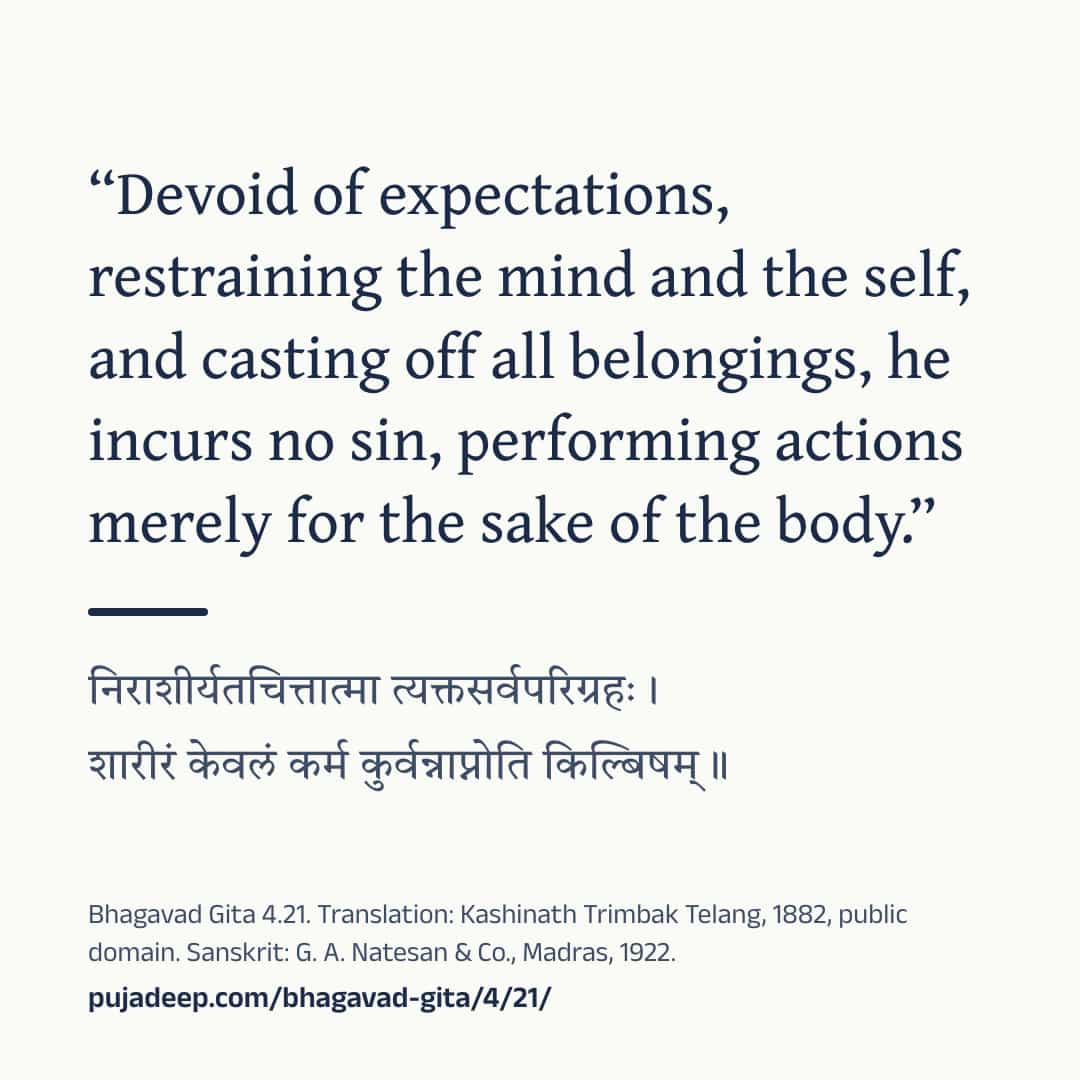
Drawing the picture
See the words
Bhagavad Gita 4.21

निराशीर्यतचित्तात्मा त्यक्तसर्वपरिग्रहः ।
शारीरं केवलं कर्म कुर्वन्नाप्नोति किल्बिषम् ॥

“Devoid of expectations, restraining the mind and the self, and casting off all belongings, he incurs no sin, performing actions merely for the sake of the body.”
(K. T. Telang, The Bhagavadgîtâ (The Sacred Books of the East, vol. VIII, Oxford: Clarendon Press, 1882), p. 60, public domain)

“Free from desire, his thoughts controlled by the SELF, having abandoned all attachment, performing action by the body alone, he doth not commit sin.”
(Annie Besant, The Bhagavad Gîtâ, or The Lord's Song (London: Theosophical Publishing Society, 1895), p. 53, public domain)

“Without hope, the body and mind controlled, and all possessions relinquished, he does not suffer any evil consequences, by doing mere bodily action.”
(Swami Swarupananda, Srimad-Bhagavad-Gita (Mayavati: Prabuddha Bharata Press, 1909; first printed in Prabuddha Bharata, 1907–1909), p. 94, public domain)

Sanskrit: G. A. Natesan & Co., Madras, 1922.
https://pujadeep.com/bhagavad-gita/4/21/ Nothing is sent from this site. Your own app sends it, to the chat you choose. The picture quotes the translation you chose on this page, with its name and year.
Sanskrit text: The Bhagavad-Gita, or The Lord's Song, with the text in Devanagari and an English translation, 1922. Meanings: written for Pujadeep and checked against the cited edition. Source and changes
Questions families ask
Who speaks Bhagavad Gita 4.21?
Krishna speaks this verse, in chapter 4 (Jnana Karma Sannyasa Yoga).
Where does the Sanskrit text come from?
Sanskrit text: The Bhagavad-Gita, or The Lord's Song, with the text in Devanagari and an English translation, 1922. Meanings: written for Pujadeep and checked against the cited edition. See the source
Is the meaning on this page a translation?
Explanation written for this site from the sources listed here, and checked against the cited edition. It is not a translation and not the only way to read the text. Free to quote with credit.
Source and licence
- Sanskrit text
- The Bhagavad-Gita, or The Lord's Song, with the text in Devanagari and an English translation (Annie Besant, G. A. Natesan & Co., Madras, 1922). Public domain. The Sanskrit on these pages was read from this printing’s page images.
- Translation
- The Bhagavadgîtâ with the Sanatsugâtîya and the Anugîtâ, translated by Kâshinâth Trimbak Telang (The Sacred Books of the East, vol. VIII, ed. F. Max Müller) (Kashinath Trimbak Telang, F. Max Müller, Clarendon Press, Oxford, 1882). Public domain. Shown verbatim, as printed.
- Translation
- The Bhagavad Gîtâ, or The Lord's Song, translated by Annie Besant (Annie Besant, Theosophical Publishing Society, London, 1895). Public domain. Shown verbatim, as printed.
- Translation
- Srimad-Bhagavad-Gita, with Sanskrit Text; Paraphrase with Word-by-word Literal Translation; English Rendering and Comments, Index, &c., by the Swami Swarupananda (Himalayan Series, No. XX) (Swami Swarupananda, The Editors and Publishers, Advaita Ashrama, Mayavati, Prabuddha Bharata Press, Mayavati, Almora, Himalayas, 1909). Public domain. Shown verbatim, as printed.
- Common wording
- In this text, 32 words follow today's common wording, checked against sanskritdocuments.org; Sanskrit Wikisource; Gita Press, Gorakhpur; GRETIL, Göttingen and Bhaktivedanta Book Trust.
- Our explanation
- Explanation written for this site from the sources listed here, and checked against the cited edition. It is not a translation and not the only way to read the text. Free to quote with credit.
- Checked
- Checked against the cited edition, October 15, 2026.
- Updated
- October 27, 2026