Bhagavad Gita 4.28: meaning and translation
Chapter 4: Jnana Karma Sannyasa Yoga. Krishna says
Krishna: Some make offerings of wealth, some of austerity (tapas), some of yoga practice.
Click or tap a word for its meaning and its dictionary page.
Text and layers
Text and layers
These choices stay in this browser.
Bhagavad Gita 4.28
द्रव्ययज्ञास्तपोयज्ञा योगयज्ञास्तथाऽपरे ।स्वाध्यायज्ञानयज्ञाश्च यतयः संशितव्रताः ॥
Dravyayajnastapoyajna yogayajnastathapareSvadhyayajnanayajnashcha yatayah sanshitavratah
dravyayajñāstapoyajñā yogayajñāstathā’pare |svādhyāyajñānayajñāśca yatayaḥ saṃśitavratāḥ ||
Our explanation Some make offerings of wealth, some of austerity (tapas), some of yoga practice. Others, disciplined and firm in their vows, make the offering of studying scripture (svādhyāya) and of knowledge.
हिंदी अर्थ कुछ लोग द्रव्य (धन-सामग्री) का यज्ञ करते हैं, कुछ तप का, कुछ योग का। कठोर व्रत वाले दूसरे यत्नशील लोग स्वाध्याय (शास्त्रों का अध्ययन) और ज्ञान का यज्ञ करते हैं।
Word by word
Every word, with its dictionary page
Word by word
- द्रव्ययज्ञाः dravyayajñāḥ · offering wealth (compound (masculine), nominative plural) Dictionary: dravya, Monier-Williams 1899, p. 501, col. 1 “a substance, thing, object”; yajña, Monier-Williams 1899, p. 839, col. 2 “worship, devotion, prayer, praise; act of worship or devotion, offering, oblation, sacrifice”
- तपोयज्ञाः tapoyajñāḥ · offering austerity (compound (masculine), nominative plural) Dictionary: tapas, Monier-Williams 1899, p. 437, col. 1 “religious austerity, bodily mortification, penance, severe meditation”; yajña, Monier-Williams 1899, p. 839, col. 2 “worship, devotion, prayer, praise; act of worship or devotion, offering, oblation, sacrifice”
- योगयज्ञाः yogayajñāḥ · offering yoga practice (compound (masculine), nominative plural) Dictionary: yoga, Monier-Williams 1899, p. 856, col. 2 “the act of yoking, joining, attaching”; yajña, Monier-Williams 1899, p. 839, col. 2 “worship, devotion, prayer, praise; act of worship or devotion, offering, oblation, sacrifice”
- तथा tathā · likewise (indeclinable) Dictionary: tathā, Monier-Williams 1899, p. 433, col. 3 “in that manner, so, thus”
- अपरे apare · others (pronoun (masculine), nominative plural) Dictionary: 2. apara, Monier-Williams 1899, p. 50, col. 3 “other, another”
- स्वाध्यायज्ञानयज्ञाः svādhyāyajñānayajñāḥ · offering study and knowledge (compound (masculine), nominative plural) Dictionary: 1. svādhyāya, Monier-Williams 1899, p. 1277, col. 2 “repetition or recitation of the Veda in a low voice”; jñāna, Monier-Williams 1899, p. 426, col. 1 “knowing, becoming acquainted with, knowledge”; yajña, Monier-Williams 1899, p. 839, col. 2 “worship, devotion, prayer, praise; act of worship or devotion, offering, oblation, sacrifice”
- च ca · and (indeclinable) Dictionary: 2. ca, Monier-Williams 1899, p. 380, col. 1 “and, both, also, moreover, as well as”
- यतयः yatayaḥ · striving ascetics (noun (masculine), nominative plural) Dictionary: 1. yati, Monier-Williams 1899, p. 841, col. 1 “an ascetic, devotee, one who has restrained his passions and abandoned the world”
- संशितव्रताः saṃśitavratāḥ · firm in their vows (compound (masculine), nominative plural) Dictionary: saṃ-śita, Monier-Williams 1899, p. 1118, col. 1 “whetted, sharpened”; vrata, Monier-Williams 1899, p. 1042, col. 2 “a religious vow or practice, any pious observance, meritorious act of devotion or austerity, solemn vow”
1 printing differs
Edition differences. Another printing or text reads this place differently.
- Spelling A digital text reads Same words. The 1922 edition marks the merged vowel with an avagraha (ऽ); this e-text does not. Edition: तथाऽपरे.
Old translations
Kashinath Trimbak Telang, 1882. Public domain. Page 61.
Others perform the sacrifice of wealth, the sacrifice of penance, the sacrifice of concentration of mind, the sacrifice of Vedic study1, and of knowledge, and others are ascetics of rigid vows.
Footnotes (the translator’s own) - This is called Brahmayagña, Âsvalâyana Grihya-sûtra III, 1, 3. ↩
Compare 3 translations
Kashinath Trimbak Telang, 1882. Public domain. Page 61.
Others perform the sacrifice of wealth, the sacrifice of penance, the sacrifice of concentration of mind, the sacrifice of Vedic study1, and of knowledge, and others are ascetics of rigid vows.
Footnotes (the translator’s own) - This is called Brahmayagña, Âsvalâyana Grihya-sûtra III, 1, 3. ↩
You are reading this one
Annie Besant, 1895. Public domain. Page 54.
Yet others the sacrifice of wealth, the sacrifice of austerity, the sacrifice of Yoga, the sacrifice of silent reading and wisdom, men concentrated and of effectual vows;
This sentence begins in 4.25. This sentence goes on in 4.29.
You are reading this one
Swami Swarupananda, 1909 (first printed 1907). Public domain. Page 97.
Others again offer wealth, austerity, and Yoga, as sacrifice, while still others, of self-restraint and rigid vows, offer study of the scriptures and knowledge, as sacrifice.
You are reading this one
Cite this verse
The translation: K. T. Telang, The Bhagavadgîtâ (The Sacred Books of the East, vol. VIII, Oxford: Clarendon Press, 1882), p. 61. Bhagavad Gita 4.28.
The translation: Annie Besant, The Bhagavad Gîtâ, or The Lord's Song (London: Theosophical Publishing Society, 1895), p. 54. Bhagavad Gita 4.28.
The translation: Swami Swarupananda, Srimad-Bhagavad-Gita (Mayavati: Prabuddha Bharata Press, 1909; first printed in Prabuddha Bharata, 1907–1909), p. 97. Bhagavad Gita 4.28.
Our explanation: “Bhagavad Gita 4.28: meaning and translation.” Pujadeep. Updated October 27, 2026. https://pujadeep.com/bhagavad-gita/4/28/
Pujadeep’s explanations are free to quote with credit: name Pujadeep and link to the page. How to credit
Classical readings, by school
No readings by school on this verse yet.
Share
Show the ways to share
Send one picture or the text to one chat. The picture names its source and the address of this page.
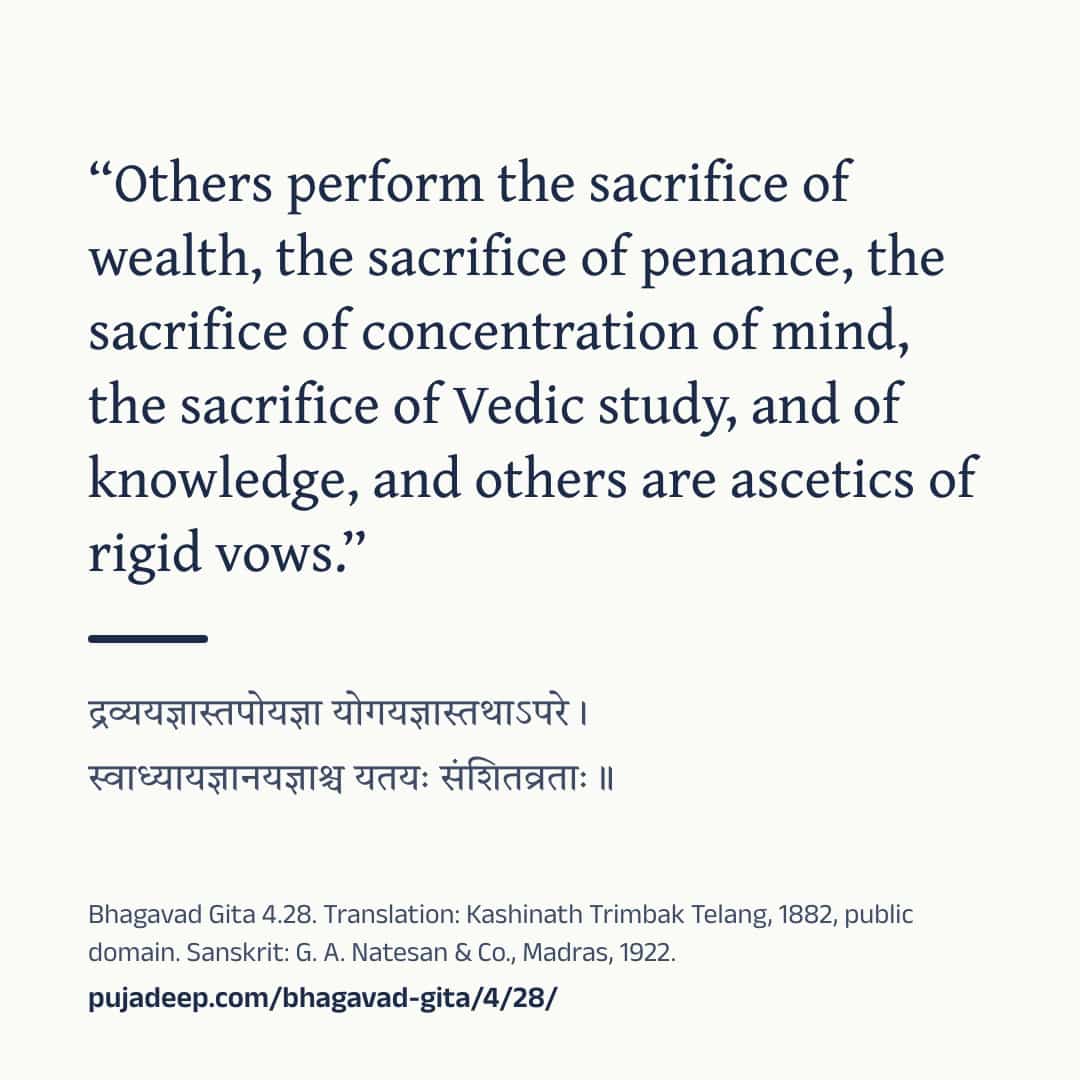
Drawing the picture
See the words
Bhagavad Gita 4.28

द्रव्ययज्ञास्तपोयज्ञा योगयज्ञास्तथाऽपरे ।
स्वाध्यायज्ञानयज्ञाश्च यतयः संशितव्रताः ॥

“Others perform the sacrifice of wealth, the sacrifice of penance, the sacrifice of concentration of mind, the sacrifice of Vedic study, and of knowledge, and others are ascetics of rigid vows.”
(K. T. Telang, The Bhagavadgîtâ (The Sacred Books of the East, vol. VIII, Oxford: Clarendon Press, 1882), p. 61, public domain)

“Yet others the sacrifice of wealth, the sacrifice of austerity, the sacrifice of Yoga, the sacrifice of silent reading and wisdom, men concentrated and of effectual vows;”
(Annie Besant, The Bhagavad Gîtâ, or The Lord's Song (London: Theosophical Publishing Society, 1895), p. 54, public domain)
This sentence begins in 4.25. This sentence goes on in 4.29.

“Others again offer wealth, austerity, and Yoga, as sacrifice, while still others, of self-restraint and rigid vows, offer study of the scriptures and knowledge, as sacrifice.”
(Swami Swarupananda, Srimad-Bhagavad-Gita (Mayavati: Prabuddha Bharata Press, 1909; first printed in Prabuddha Bharata, 1907–1909), p. 97, public domain)

Sanskrit: G. A. Natesan & Co., Madras, 1922.
https://pujadeep.com/bhagavad-gita/4/28/ Nothing is sent from this site. Your own app sends it, to the chat you choose. The picture quotes the translation you chose on this page, with its name and year.
Sanskrit text: The Bhagavad-Gita, or The Lord's Song, with the text in Devanagari and an English translation, 1922. Meanings: written for Pujadeep and checked against the cited edition. Source and changes
Questions families ask
Who speaks Bhagavad Gita 4.28?
Krishna speaks this verse, in chapter 4 (Jnana Karma Sannyasa Yoga).
Where does the Sanskrit text come from?
Sanskrit text: The Bhagavad-Gita, or The Lord's Song, with the text in Devanagari and an English translation, 1922. Meanings: written for Pujadeep and checked against the cited edition. See the source
Is the meaning on this page a translation?
Explanation written for this site from the sources listed here, and checked against the cited edition. It is not a translation and not the only way to read the text. Free to quote with credit.
Source and licence
- Sanskrit text
- The Bhagavad-Gita, or The Lord's Song, with the text in Devanagari and an English translation (Annie Besant, G. A. Natesan & Co., Madras, 1922). Public domain. The Sanskrit on these pages was read from this printing’s page images.
- Translation
- The Bhagavadgîtâ with the Sanatsugâtîya and the Anugîtâ, translated by Kâshinâth Trimbak Telang (The Sacred Books of the East, vol. VIII, ed. F. Max Müller) (Kashinath Trimbak Telang, F. Max Müller, Clarendon Press, Oxford, 1882). Public domain. Shown verbatim, as printed.
- Translation
- The Bhagavad Gîtâ, or The Lord's Song, translated by Annie Besant (Annie Besant, Theosophical Publishing Society, London, 1895). Public domain. Shown verbatim, as printed.
- Translation
- Srimad-Bhagavad-Gita, with Sanskrit Text; Paraphrase with Word-by-word Literal Translation; English Rendering and Comments, Index, &c., by the Swami Swarupananda (Himalayan Series, No. XX) (Swami Swarupananda, The Editors and Publishers, Advaita Ashrama, Mayavati, Prabuddha Bharata Press, Mayavati, Almora, Himalayas, 1909). Public domain. Shown verbatim, as printed.
- Common wording
- In this text, 32 words follow today's common wording, checked against sanskritdocuments.org; Sanskrit Wikisource; Gita Press, Gorakhpur; GRETIL, Göttingen and Bhaktivedanta Book Trust.
- Our explanation
- Explanation written for this site from the sources listed here, and checked against the cited edition. It is not a translation and not the only way to read the text. Free to quote with credit.
- Checked
- Checked against the cited edition, October 15, 2026.
- Updated
- October 27, 2026