Bhagavad Gita 4.35: meaning and translation
Chapter 4: Jnana Karma Sannyasa Yoga. Krishna says
Having known this, Krishna says, Arjuna will not fall into such confusion again.
Click or tap a word for its meaning and its dictionary page.
Text and layers
Text and layers
These choices stay in this browser.
Bhagavad Gita 4.35
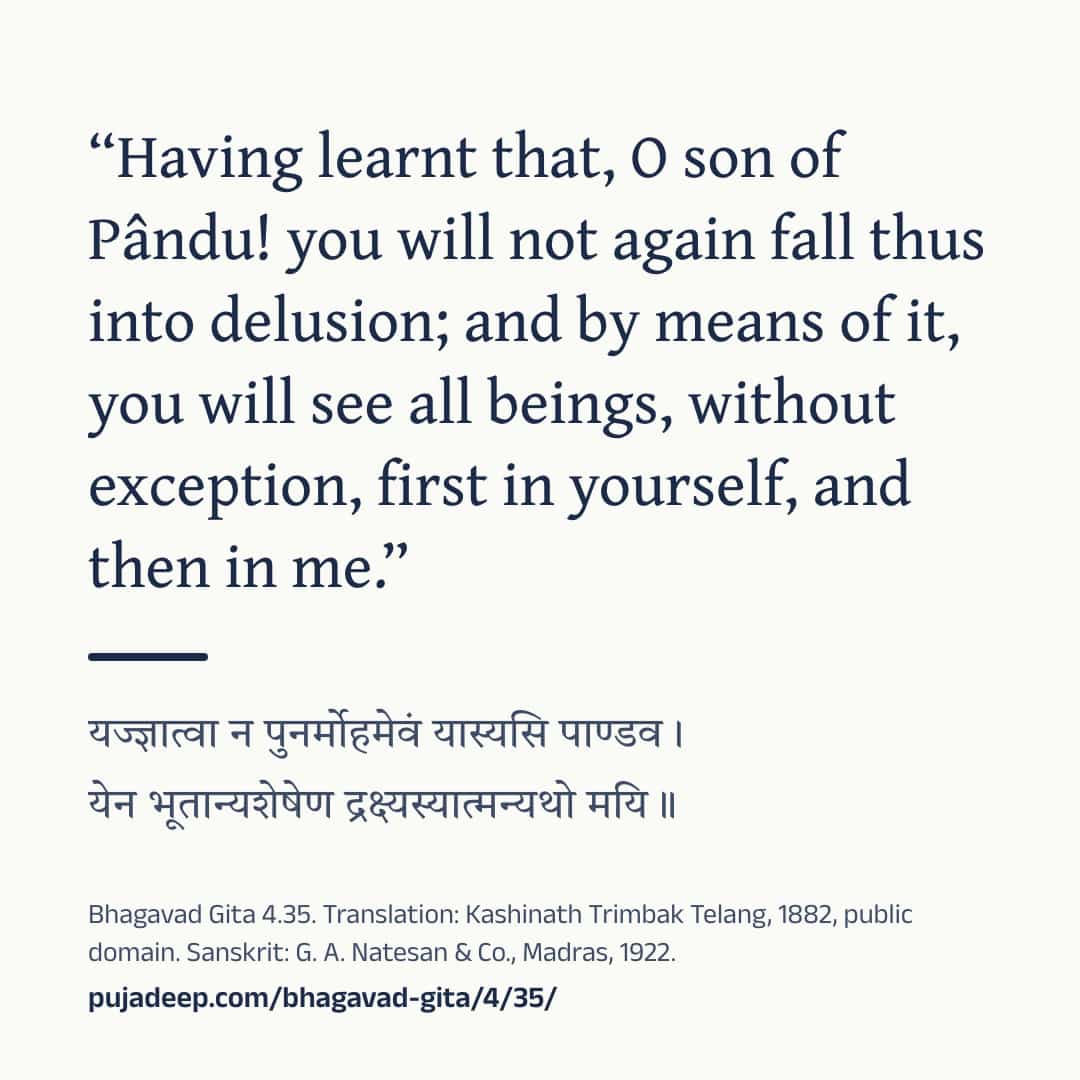
यज्ज्ञात्वा न पुनर्मोहमेवं यास्यसि पाण्डव ।येन भूतान्यशेषेण द्रक्ष्यस्यात्मन्यथो मयि ॥
Yajjnatva na punarmohamevam yasyasi pandavaYena bhutanyasheshena drakshyasyatmanyatho mayi
yajjñātvā na punarmohamevaṃ yāsyasi pāṇḍava |yena bhūtānyaśeṣeṇa drakṣyasyātmanyatho mayi ||
Our explanation Having known this, Krishna says, Arjuna will not fall into such confusion again. Through it he will see all beings, without exception, in the self (ātman), and then in Krishna.
हिंदी अर्थ कृष्ण कहते हैं कि यह जानकर अर्जुन फिर ऐसे मोह में नहीं पड़ेंगे। इसके द्वारा वे सब प्राणियों को, बिना किसी अपवाद के, अपने आत्मा में और फिर कृष्ण में देखेंगे।
Word by word
Every word, with its dictionary page
Word by word
- यत् yat · which (pronoun (neuter), accusative singular) Dictionary: yad, Monier-Williams 1899, p. 844, col. 2 “who, which, what, whichever, whatever, that”
- ज्ञात्वा jñātvā · having known (absolutive (having done)) Dictionary: 1. jñā, Monier-Williams 1899, p. 425, col. 3 “to know, have knowledge, become acquainted with”
- न na · not (indeclinable) Dictionary: 2. na, Monier-Williams 1899, p. 523, col. 1 “ind. not, no, nor, neither”
- पुनः punaḥ · again (indeclinable) Dictionary: punar, Monier-Williams 1899, p. 633, col. 2 “again, once more”
- मोहम् moham · confusion (noun (masculine), accusative singular) Dictionary: moha, Monier-Williams 1899, p. 836, col. 1 “loss of consciousness, bewilderment, perplexity, distraction, infatuation, delusion”
- एवम् evam · like this (indeclinable) Dictionary: evam, Monier-Williams 1899, p. 232, col. 2 “thus, in this way, in such a manner”
- यास्यसि yāsyasi · you will fall into (future, 2nd person singular) Dictionary: 1. yā, Monier-Williams 1899, p. 849, col. 1 “to go, proceed, move, walk, set out”
- पाण्डव pāṇḍava · O son of Pandu (noun (masculine), vocative singular) Dictionary: pāṇḍava, Monier-Williams 1899, p. 616, col. 2 “a son or descendant of Pāṇḍu”
- येन yena · by which (pronoun (neuter), instrumental singular) Dictionary: yad, Monier-Williams 1899, p. 844, col. 2 “who, which, what, whichever, whatever, that”
- भूतानि bhūtāni · beings (noun (neuter), accusative plural) Dictionary: bhūta, Monier-Williams 1899, p. 761, col. 3 “that which is or exists, any living being”
- अशेषेण aśeṣeṇa · without exception (noun (masculine), instrumental singular) Dictionary: a-śeṣa, Monier-Williams 1899, p. 113, col. 3 “without remainder, entire, perfect, all”
- द्रक्ष्यसि drakṣyasi · you will see (future, 2nd person singular) Dictionary: 1. dṛś, Monier-Williams 1899, p. 491, col. 2 “to see, behold, look at, regard, consider”
- आत्मनि ātmani · in the self (noun (masculine), locative singular) Dictionary: ātman, Monier-Williams 1899, p. 135, col. 1 “the breath, RV.; the soul, principle of life and sensation”
- अथो atho · and then (indeclinable) Dictionary: atho, Monier-Williams 1899, p. 17, col. 3 “now; likewise; next; therefore”
- मयि mayi · in "me" (Krishna) (pronoun, locative singular) Dictionary: 1. mad, Monier-Williams 1899, p. 777, col. 2 “base of the first pers. pron. in the sg. number (esp. in comp.)”
1 printing differs
Edition differences. Another printing or text reads this place differently.
- Word A digital text reads Reads like the edition (भूतान्यशेषेण, 'all beings without remainder') and gives भूतान्यशेषाणि ('all beings, every one') in brackets as an alternative. The sense is the same. Another digital text agrees with the edition.
Old translations
Kashinath Trimbak Telang, 1882. Public domain. Page 62.
Having learnt that, O son of Pându! you will not again fall thus into delusion; and by means of it, you will see all beings, without exception, first in yourself, and then in me1.
Footnotes (the translator’s own) - The essential unity of the supreme and individual soul and the whole universe. Cf. Îsopanishad, pp. 13, 14. ↩
Compare 3 translations
Kashinath Trimbak Telang, 1882. Public domain. Page 62.
Having learnt that, O son of Pându! you will not again fall thus into delusion; and by means of it, you will see all beings, without exception, first in yourself, and then in me1.
Footnotes (the translator’s own) - The essential unity of the supreme and individual soul and the whole universe. Cf. Îsopanishad, pp. 13, 14. ↩
You are reading this one
Annie Besant, 1895. Public domain. Page 56.
And having known this, thou shalt not again fall into this confusion, O Pândava; for by this thou wilt see all beings without exception in the SELF and all in Me.
This sentence begins in 4.34.
You are reading this one
Swami Swarupananda, 1909 (first printed 1907). Public domain. Page 101.
Knowing which, thou shalt not, O Pândava, again get deluded like this, and by which thou shalt see the whole of creation in (thy) Self and in Me.
You are reading this one
Cite this verse
The translation: K. T. Telang, The Bhagavadgîtâ (The Sacred Books of the East, vol. VIII, Oxford: Clarendon Press, 1882), p. 62. Bhagavad Gita 4.35.
The translation: Annie Besant, The Bhagavad Gîtâ, or The Lord's Song (London: Theosophical Publishing Society, 1895), p. 56. Bhagavad Gita 4.35.
The translation: Swami Swarupananda, Srimad-Bhagavad-Gita (Mayavati: Prabuddha Bharata Press, 1909; first printed in Prabuddha Bharata, 1907–1909), p. 101. Bhagavad Gita 4.35.
Our explanation: “Bhagavad Gita 4.35: meaning and translation.” Pujadeep. Updated October 27, 2026. https://pujadeep.com/bhagavad-gita/4/35/
Pujadeep’s explanations are free to quote with credit: name Pujadeep and link to the page. How to credit
Classical readings, by school
No readings by school on this verse yet.
Share
Show the ways to share
Send one picture or the text to one chat. The picture names its source and the address of this page.
Drawing the picture
See the words
Bhagavad Gita 4.35

यज्ज्ञात्वा न पुनर्मोहमेवं यास्यसि पाण्डव ।
येन भूतान्यशेषेण द्रक्ष्यस्यात्मन्यथो मयि ॥

“Having learnt that, O son of Pându! you will not again fall thus into delusion; and by means of it, you will see all beings, without exception, first in yourself, and then in me.”
(K. T. Telang, The Bhagavadgîtâ (The Sacred Books of the East, vol. VIII, Oxford: Clarendon Press, 1882), p. 62, public domain)

“And having known this, thou shalt not again fall into this confusion, O Pândava; for by this thou wilt see all beings without exception in the SELF and all in Me.”
(Annie Besant, The Bhagavad Gîtâ, or The Lord's Song (London: Theosophical Publishing Society, 1895), p. 56, public domain)
This sentence begins in 4.34.

“Knowing which, thou shalt not, O Pândava, again get deluded like this, and by which thou shalt see the whole of creation in (thy) Self and in Me.”
(Swami Swarupananda, Srimad-Bhagavad-Gita (Mayavati: Prabuddha Bharata Press, 1909; first printed in Prabuddha Bharata, 1907–1909), p. 101, public domain)

Sanskrit: G. A. Natesan & Co., Madras, 1922.
https://pujadeep.com/bhagavad-gita/4/35/ Nothing is sent from this site. Your own app sends it, to the chat you choose. The picture quotes the translation you chose on this page, with its name and year.
Sanskrit text: The Bhagavad-Gita, or The Lord's Song, with the text in Devanagari and an English translation, 1922. Meanings: written for Pujadeep and checked against the cited edition. Source and changes
Questions families ask
Who speaks Bhagavad Gita 4.35?
Krishna speaks this verse, in chapter 4 (Jnana Karma Sannyasa Yoga).
Where does the Sanskrit text come from?
Sanskrit text: The Bhagavad-Gita, or The Lord's Song, with the text in Devanagari and an English translation, 1922. Meanings: written for Pujadeep and checked against the cited edition. See the source
Is the meaning on this page a translation?
Explanation written for this site from the sources listed here, and checked against the cited edition. It is not a translation and not the only way to read the text. Free to quote with credit.
Source and licence
- Sanskrit text
- The Bhagavad-Gita, or The Lord's Song, with the text in Devanagari and an English translation (Annie Besant, G. A. Natesan & Co., Madras, 1922). Public domain. The Sanskrit on these pages was read from this printing’s page images.
- Translation
- The Bhagavadgîtâ with the Sanatsugâtîya and the Anugîtâ, translated by Kâshinâth Trimbak Telang (The Sacred Books of the East, vol. VIII, ed. F. Max Müller) (Kashinath Trimbak Telang, F. Max Müller, Clarendon Press, Oxford, 1882). Public domain. Shown verbatim, as printed.
- Translation
- The Bhagavad Gîtâ, or The Lord's Song, translated by Annie Besant (Annie Besant, Theosophical Publishing Society, London, 1895). Public domain. Shown verbatim, as printed.
- Translation
- Srimad-Bhagavad-Gita, with Sanskrit Text; Paraphrase with Word-by-word Literal Translation; English Rendering and Comments, Index, &c., by the Swami Swarupananda (Himalayan Series, No. XX) (Swami Swarupananda, The Editors and Publishers, Advaita Ashrama, Mayavati, Prabuddha Bharata Press, Mayavati, Almora, Himalayas, 1909). Public domain. Shown verbatim, as printed.
- Common wording
- In this text, 32 words follow today's common wording, checked against sanskritdocuments.org; Sanskrit Wikisource; Gita Press, Gorakhpur; GRETIL, Göttingen and Bhaktivedanta Book Trust.
- Our explanation
- Explanation written for this site from the sources listed here, and checked against the cited edition. It is not a translation and not the only way to read the text. Free to quote with credit.
- Checked
- Checked against the cited edition, October 15, 2026.
- Updated
- October 27, 2026