Bhagavad Gita 4.38: meaning and translation
Chapter 4: Jnana Karma Sannyasa Yoga. Krishna says
Nothing in this world purifies like knowledge, Krishna says.
Click or tap a word for its meaning and its dictionary page.
Text and layers
Text and layers
These choices stay in this browser.
Bhagavad Gita 4.38
न हि ज्ञानेन सदृशं पवित्रमिह विद्यते ।तत्स्वयं योगसंसिद्धः कालेनात्मनि विन्दति ॥
Na hi jnanena sadrisham pavitramiha vidyateTatsvayam yogasansiddhah kalenatmani vindati
na hi jñānena sadṛśaṃ pavitramiha vidyate |tatsvayaṃ yogasaṃsiddhaḥ kālenātmani vindati ||
Our explanation Nothing in this world purifies like knowledge, Krishna says. In time, the one who has become perfect in yoga finds it within, in the self.
हिंदी अर्थ कृष्ण कहते हैं कि इस संसार में ज्ञान के समान पवित्र करने वाला कुछ नहीं है। योग में सिद्ध हुआ व्यक्ति समय आने पर उसे अपने भीतर, अपने आत्मा में, पा लेता है।
Word by word
Every word, with its dictionary page
Word by word
- न na · not (indeclinable) Dictionary: 2. na, Monier-Williams 1899, p. 523, col. 1 “ind. not, no, nor, neither”
- हि hi · indeed (indeclinable) Dictionary: 2. hi, Monier-Williams 1899, p. 1297, col. 3 “for, because, on account of”
- ज्ञानेन jñānena · to knowledge (noun (neuter), instrumental singular) Dictionary: jñāna, Monier-Williams 1899, p. 426, col. 1 “knowing, becoming acquainted with, knowledge”
- सदृशम् sadṛśam · equal (adjective (neuter), nominative singular) Dictionary: sadṛśa, Monier-Williams 1899, p. 1140, col. 1 “like, resembling”
- पवित्रम् pavitram · purifier (noun (neuter), nominative singular) Dictionary: pavitra, Monier-Williams 1899, p. 611, col. 1 “purifying, averting evil, pure, holy, sacred, sinless, beneficent”
- इह iha · here, in this world (indeclinable) Dictionary: iha, Monier-Williams 1899, p. 169, col. 3 “in this place, here”
- विद्यते vidyate · is found (present passive, 3rd person singular) Dictionary: 3. vid, Monier-Williams 1899, p. 964, col. 3 “to find, discover, meet or fall in with, obtain, get, acquire”
- तत् tat · that (pronoun (neuter), accusative singular) Dictionary: tad, Monier-Williams 1899, p. 434, col. 1 “m. he, f. she, n. it, that, this”
- स्वयम् svayam · oneself (indeclinable) Dictionary: svayam, Monier-Williams 1899, p. 1278, col. 2 “self, one's self”
- योगसंसिद्धः yogasaṃsiddhaḥ · perfected in yoga (compound (masculine), nominative singular) Dictionary: yoga, Monier-Williams 1899, p. 856, col. 2 “the act of yoking, joining, attaching”; saṃ-siddha, Monier-Williams 1899, p. 1119, col. 2 “fully or thoroughly performed or accomplished”
- कालेन kālena · in time (noun (masculine), instrumental singular) Dictionary: kāla, Monier-Williams 1899, p. 278, col. 1 “a fixed or right point of time, a space of time, time (in general)”
- आत्मनि ātmani · in the self, within (noun (masculine), locative singular) Dictionary: ātman, Monier-Williams 1899, p. 135, col. 1 “the breath, RV.; the soul, principle of life and sensation”
- विन्दति vindati · finds (present, 3rd person singular) Dictionary: 3. vid, Monier-Williams 1899, p. 964, col. 3 “to find, discover, meet or fall in with, obtain, get, acquire”
Old translations
Kashinath Trimbak Telang, 1882. Public domain. Page 62.
For there is in this world no means of sanctification like knowledge1, and that one perfected by devotion finds within one's self in time.
Footnotes (the translator’s own) - Sutta Nipâta, p. 48. ↩
Compare 3 translations
Kashinath Trimbak Telang, 1882. Public domain. Page 62.
For there is in this world no means of sanctification like knowledge1, and that one perfected by devotion finds within one's self in time.
Footnotes (the translator’s own) - Sutta Nipâta, p. 48. ↩
You are reading this one
Annie Besant, 1895. Public domain. Page 56.
Verily there is no purifier in this world of the same worth as wisdom; he that is perfected in Yoga finds it in the SELF with the efflux of time.
You are reading this one
Swami Swarupananda, 1909 (first printed 1907). Public domain. Page 102.
Verily there exists nothing in this world purifying like knowledge. In good time, having reached perfection in Yoga, one realises that oneself in one's own heart.
You are reading this one
Cite this verse
The translation: K. T. Telang, The Bhagavadgîtâ (The Sacred Books of the East, vol. VIII, Oxford: Clarendon Press, 1882), p. 62. Bhagavad Gita 4.38.
The translation: Annie Besant, The Bhagavad Gîtâ, or The Lord's Song (London: Theosophical Publishing Society, 1895), p. 56. Bhagavad Gita 4.38.
The translation: Swami Swarupananda, Srimad-Bhagavad-Gita (Mayavati: Prabuddha Bharata Press, 1909; first printed in Prabuddha Bharata, 1907–1909), p. 102. Bhagavad Gita 4.38.
Our explanation: “Bhagavad Gita 4.38: meaning and translation.” Pujadeep. Updated October 27, 2026. https://pujadeep.com/bhagavad-gita/4/38/
Pujadeep’s explanations are free to quote with credit: name Pujadeep and link to the page. How to credit
Classical readings, by school
No readings by school on this verse yet.
Share
Show the ways to share
Send one picture or the text to one chat. The picture names its source and the address of this page.
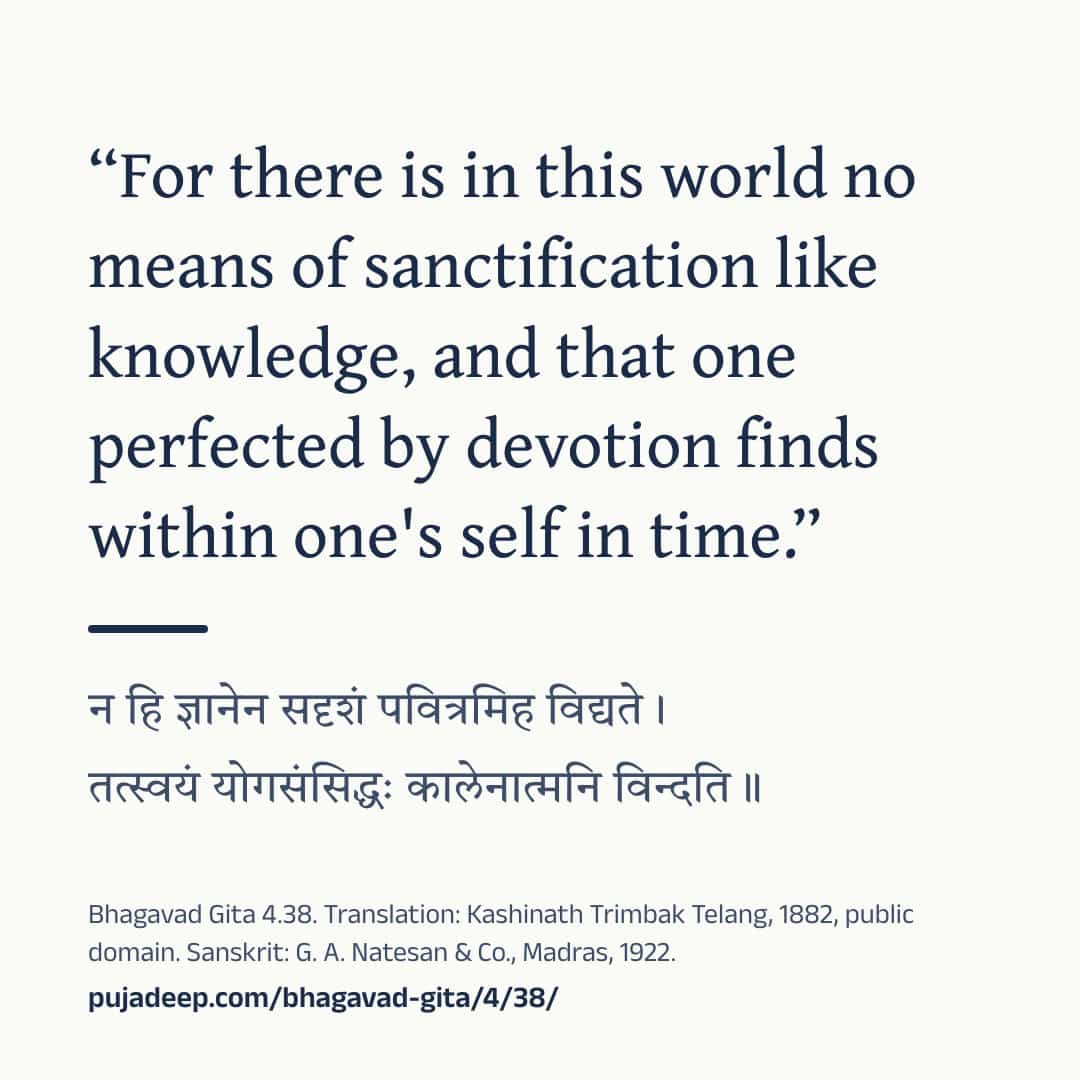
Drawing the picture
See the words
Bhagavad Gita 4.38

न हि ज्ञानेन सदृशं पवित्रमिह विद्यते ।
तत्स्वयं योगसंसिद्धः कालेनात्मनि विन्दति ॥

“For there is in this world no means of sanctification like knowledge, and that one perfected by devotion finds within one's self in time.”
(K. T. Telang, The Bhagavadgîtâ (The Sacred Books of the East, vol. VIII, Oxford: Clarendon Press, 1882), p. 62, public domain)

“Verily there is no purifier in this world of the same worth as wisdom; he that is perfected in Yoga finds it in the SELF with the efflux of time.”
(Annie Besant, The Bhagavad Gîtâ, or The Lord's Song (London: Theosophical Publishing Society, 1895), p. 56, public domain)

“Verily there exists nothing in this world purifying like knowledge. In good time, having reached perfection in Yoga, one realises that oneself in one's own heart.”
(Swami Swarupananda, Srimad-Bhagavad-Gita (Mayavati: Prabuddha Bharata Press, 1909; first printed in Prabuddha Bharata, 1907–1909), p. 102, public domain)

Sanskrit: G. A. Natesan & Co., Madras, 1922.
https://pujadeep.com/bhagavad-gita/4/38/ Nothing is sent from this site. Your own app sends it, to the chat you choose. The picture quotes the translation you chose on this page, with its name and year.
Sanskrit text: The Bhagavad-Gita, or The Lord's Song, with the text in Devanagari and an English translation, 1922. Meanings: written for Pujadeep and checked against the cited edition. Source and changes
Questions families ask
Who speaks Bhagavad Gita 4.38?
Krishna speaks this verse, in chapter 4 (Jnana Karma Sannyasa Yoga).
Where does the Sanskrit text come from?
Sanskrit text: The Bhagavad-Gita, or The Lord's Song, with the text in Devanagari and an English translation, 1922. Meanings: written for Pujadeep and checked against the cited edition. See the source
Is the meaning on this page a translation?
Explanation written for this site from the sources listed here, and checked against the cited edition. It is not a translation and not the only way to read the text. Free to quote with credit.
Source and licence
- Sanskrit text
- The Bhagavad-Gita, or The Lord's Song, with the text in Devanagari and an English translation (Annie Besant, G. A. Natesan & Co., Madras, 1922). Public domain. The Sanskrit on these pages was read from this printing’s page images.
- Translation
- The Bhagavadgîtâ with the Sanatsugâtîya and the Anugîtâ, translated by Kâshinâth Trimbak Telang (The Sacred Books of the East, vol. VIII, ed. F. Max Müller) (Kashinath Trimbak Telang, F. Max Müller, Clarendon Press, Oxford, 1882). Public domain. Shown verbatim, as printed.
- Translation
- The Bhagavad Gîtâ, or The Lord's Song, translated by Annie Besant (Annie Besant, Theosophical Publishing Society, London, 1895). Public domain. Shown verbatim, as printed.
- Translation
- Srimad-Bhagavad-Gita, with Sanskrit Text; Paraphrase with Word-by-word Literal Translation; English Rendering and Comments, Index, &c., by the Swami Swarupananda (Himalayan Series, No. XX) (Swami Swarupananda, The Editors and Publishers, Advaita Ashrama, Mayavati, Prabuddha Bharata Press, Mayavati, Almora, Himalayas, 1909). Public domain. Shown verbatim, as printed.
- Common wording
- In this text, 32 words follow today's common wording, checked against sanskritdocuments.org; Sanskrit Wikisource; Gita Press, Gorakhpur; GRETIL, Göttingen and Bhaktivedanta Book Trust.
- Our explanation
- Explanation written for this site from the sources listed here, and checked against the cited edition. It is not a translation and not the only way to read the text. Free to quote with credit.
- Checked
- Checked against the cited edition, October 15, 2026.
- Updated
- October 27, 2026