Bhagavad Gita 4.32: meaning and translation
Chapter 4: Jnana Karma Sannyasa Yoga. Krishna says
Krishna: Many kinds of offering are laid out in this way "in the mouth of Brahman": Telang reads this as "in the Vedas", Besant as "before Brahman".
Click or tap a word for its meaning and its dictionary page.
Text and layers
Text and layers
These choices stay in this browser.
Bhagavad Gita 4.32
एवं बहुविधा यज्ञा वितता ब्रह्मणो मुखे ।कर्मजान्विद्धि तान्सर्वानेवं ज्ञात्वा विमोक्ष्यसे ॥
Evam bahuvidha yajna vitata brahmano mukheKarmajanviddhi tansarvanevam jnatva vimokshyase
evaṃ bahuvidhā yajñā vitatā brahmaṇo mukhe |karmajānviddhi tānsarvānevaṃ jñātvā vimokṣyase ||
Our explanation Many kinds of offering are laid out in this way "in the mouth of Brahman": Telang reads this as "in the Vedas", Besant as "before Brahman". Krishna tells Arjuna to know that all of them are born of action; knowing this, he will be set free.
हिंदी अर्थ इस तरह बहुत-से यज्ञ 'ब्रह्म के मुख में' फैले हुए हैं: तेलंग इसका अर्थ 'वेदों में' लेते हैं, बेसेंट 'ब्रह्म के सामने'। कृष्ण कहते हैं कि अर्जुन जानें कि ये सब कर्म से उत्पन्न होते हैं, और यह जानकर वे मुक्त हो जाएँगे।
Word by word
Every word, with its dictionary page
Word by word
- एवम् evam · thus (indeclinable) Dictionary: evam, Monier-Williams 1899, p. 232, col. 2 “thus, in this way, in such a manner”
- बहुविधाः bahuvidhāḥ · of many kinds (compound (masculine), nominative plural) Dictionary: bahu-vidha, Monier-Williams 1899, p. 725, col. 3 “of many sorts or kinds, manifold, various”
- यज्ञाः yajñāḥ · offerings (noun (masculine), nominative plural) Dictionary: yajña, Monier-Williams 1899, p. 839, col. 2 “worship, devotion, prayer, praise; act of worship or devotion, offering, oblation, sacrifice”
- वितताः vitatāḥ · laid out (past participle (masculine), nominative plural) Dictionary: vi-tata, Monier-Williams 1899, p. 962, col. 2 “spread out, extended &c.; diffused”
- ब्रह्मणः brahmaṇaḥ · of Brahman (or of the Veda) (noun (neuter), genitive singular) Dictionary: brahman, Monier-Williams 1899, p. 738, col. 1 “one self-existent impersonal Spirit, the one universal Soul”
- मुखे mukhe · in the mouth (noun (neuter), locative singular) Dictionary: mukha, Monier-Williams 1899, p. 819, col. 3 “the mouth, face, countenance”
- कर्मजान् karmajān · born of action (compound (masculine), accusative plural) Dictionary: karma-ja, Monier-Williams 1899, p. 258, col. 3 “resulting or produced from any act (good or bad)”
- विद्धि viddhi · know (imperative, 2nd person singular) Dictionary: 1. vid, Monier-Williams 1899, p. 963, col. 2 “to know, understand, perceive, learn”
- तान् tān · them (pronoun (masculine), accusative plural) Dictionary: tad, Monier-Williams 1899, p. 434, col. 1 “m. he, f. she, n. it, that, this”
- सर्वान् sarvān · all (pronoun (masculine), accusative plural) Dictionary: sarva, Monier-Williams 1899, p. 1184, col. 3 “whole, entire, all, every”
- एवम् evam · thus (indeclinable) Dictionary: evam, Monier-Williams 1899, p. 232, col. 2 “thus, in this way, in such a manner”
- ज्ञात्वा jñātvā · having known (absolutive (having done)) Dictionary: 1. jñā, Monier-Williams 1899, p. 425, col. 3 “to know, have knowledge, become acquainted with”
- विमोक्ष्यसे vimokṣyase · you will be set free (future, 2nd person singular) Dictionary: 1. vi-muc, Monier-Williams 1899, p. 980, col. 2 “to be freed or delivered or released (esp. from the bonds of existence)”
Old translations
Kashinath Trimbak Telang, 1882. Public domain. Page 62.
Thus sacrifices of various sorts are laid down in the Vedas. Know them all to be produced from action1, and knowing this you will be released (from the fetters of this world).
Footnotes (the translator’s own) - Operations of mind, senses, &c.; cf. supra, p. 54. ↩
Compare 3 translations
Kashinath Trimbak Telang, 1882. Public domain. Page 62.
Thus sacrifices of various sorts are laid down in the Vedas. Know them all to be produced from action1, and knowing this you will be released (from the fetters of this world).
Footnotes (the translator’s own) - Operations of mind, senses, &c.; cf. supra, p. 54. ↩
You are reading this one
Annie Besant, 1895. Public domain. Page 55.
Many and various sacrifices are thus spread out before Brahman. Know thou that all these are born of action, and thus knowing thou shalt be free.
You are reading this one
Swami Swarupananda, 1909 (first printed 1907). Public domain. Page 99.
Various Yajnas like the above, are strewn in the store-house of the Veda. Know them all to be born of action, and thus knowing, thou shalt be free.
You are reading this one
Cite this verse
The translation: K. T. Telang, The Bhagavadgîtâ (The Sacred Books of the East, vol. VIII, Oxford: Clarendon Press, 1882), p. 62. Bhagavad Gita 4.32.
The translation: Annie Besant, The Bhagavad Gîtâ, or The Lord's Song (London: Theosophical Publishing Society, 1895), p. 55. Bhagavad Gita 4.32.
The translation: Swami Swarupananda, Srimad-Bhagavad-Gita (Mayavati: Prabuddha Bharata Press, 1909; first printed in Prabuddha Bharata, 1907–1909), p. 99. Bhagavad Gita 4.32.
Our explanation: “Bhagavad Gita 4.32: meaning and translation.” Pujadeep. Updated October 27, 2026. https://pujadeep.com/bhagavad-gita/4/32/
Pujadeep’s explanations are free to quote with credit: name Pujadeep and link to the page. How to credit
Classical readings, by school
No readings by school on this verse yet.
Share
Show the ways to share
Send one picture or the text to one chat. The picture names its source and the address of this page.
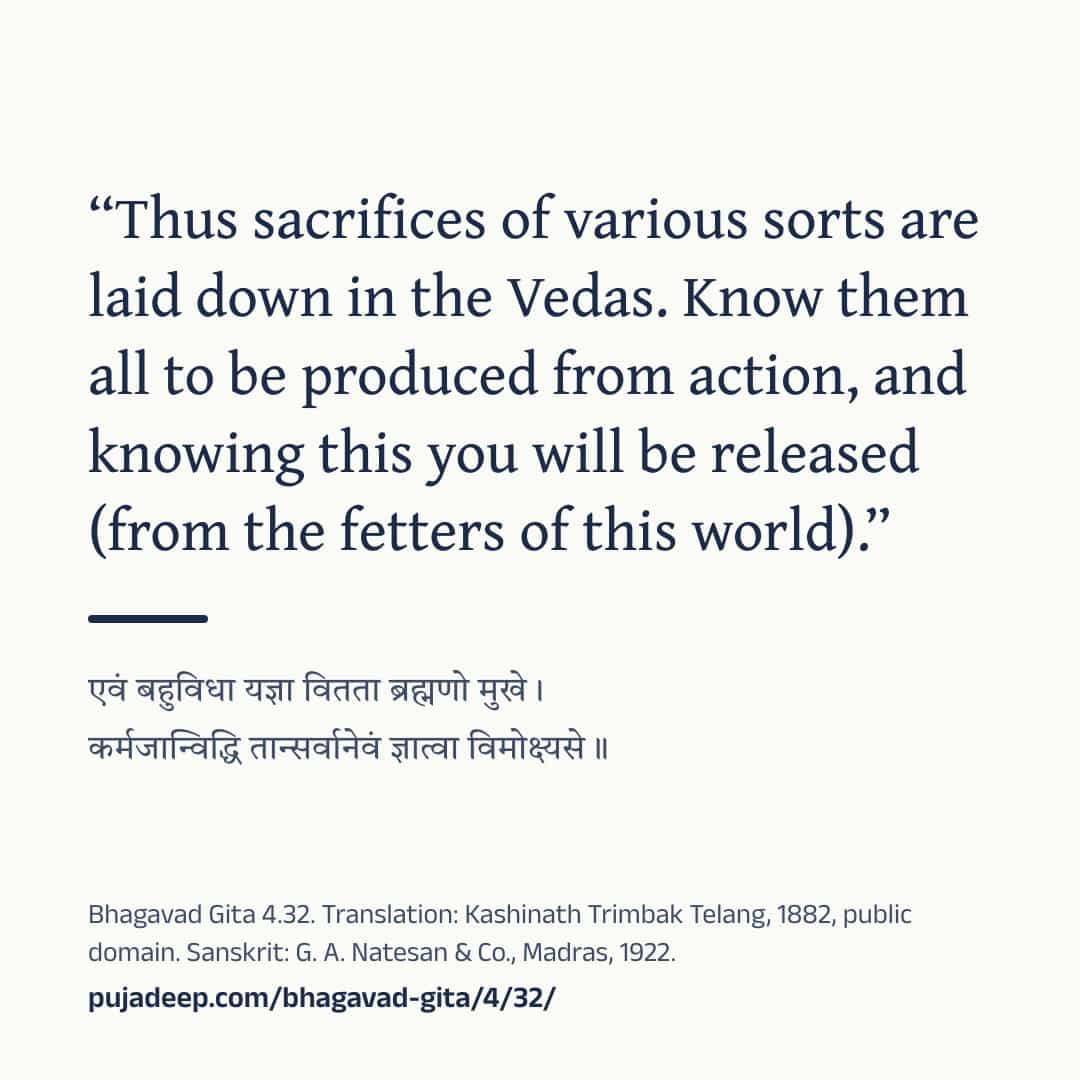
Drawing the picture
See the words
Bhagavad Gita 4.32

एवं बहुविधा यज्ञा वितता ब्रह्मणो मुखे ।
कर्मजान्विद्धि तान्सर्वानेवं ज्ञात्वा विमोक्ष्यसे ॥

“Thus sacrifices of various sorts are laid down in the Vedas. Know them all to be produced from action, and knowing this you will be released (from the fetters of this world).”
(K. T. Telang, The Bhagavadgîtâ (The Sacred Books of the East, vol. VIII, Oxford: Clarendon Press, 1882), p. 62, public domain)

“Many and various sacrifices are thus spread out before Brahman. Know thou that all these are born of action, and thus knowing thou shalt be free.”
(Annie Besant, The Bhagavad Gîtâ, or The Lord's Song (London: Theosophical Publishing Society, 1895), p. 55, public domain)

“Various Yajnas like the above, are strewn in the store-house of the Veda. Know them all to be born of action, and thus knowing, thou shalt be free.”
(Swami Swarupananda, Srimad-Bhagavad-Gita (Mayavati: Prabuddha Bharata Press, 1909; first printed in Prabuddha Bharata, 1907–1909), p. 99, public domain)

Sanskrit: G. A. Natesan & Co., Madras, 1922.
https://pujadeep.com/bhagavad-gita/4/32/ Nothing is sent from this site. Your own app sends it, to the chat you choose. The picture quotes the translation you chose on this page, with its name and year.
Sanskrit text: The Bhagavad-Gita, or The Lord's Song, with the text in Devanagari and an English translation, 1922. Meanings: written for Pujadeep and checked against the cited edition. Source and changes
Questions families ask
Who speaks Bhagavad Gita 4.32?
Krishna speaks this verse, in chapter 4 (Jnana Karma Sannyasa Yoga).
Where does the Sanskrit text come from?
Sanskrit text: The Bhagavad-Gita, or The Lord's Song, with the text in Devanagari and an English translation, 1922. Meanings: written for Pujadeep and checked against the cited edition. See the source
Is the meaning on this page a translation?
Explanation written for this site from the sources listed here, and checked against the cited edition. It is not a translation and not the only way to read the text. Free to quote with credit.
Source and licence
- Sanskrit text
- The Bhagavad-Gita, or The Lord's Song, with the text in Devanagari and an English translation (Annie Besant, G. A. Natesan & Co., Madras, 1922). Public domain. The Sanskrit on these pages was read from this printing’s page images.
- Translation
- The Bhagavadgîtâ with the Sanatsugâtîya and the Anugîtâ, translated by Kâshinâth Trimbak Telang (The Sacred Books of the East, vol. VIII, ed. F. Max Müller) (Kashinath Trimbak Telang, F. Max Müller, Clarendon Press, Oxford, 1882). Public domain. Shown verbatim, as printed.
- Translation
- The Bhagavad Gîtâ, or The Lord's Song, translated by Annie Besant (Annie Besant, Theosophical Publishing Society, London, 1895). Public domain. Shown verbatim, as printed.
- Translation
- Srimad-Bhagavad-Gita, with Sanskrit Text; Paraphrase with Word-by-word Literal Translation; English Rendering and Comments, Index, &c., by the Swami Swarupananda (Himalayan Series, No. XX) (Swami Swarupananda, The Editors and Publishers, Advaita Ashrama, Mayavati, Prabuddha Bharata Press, Mayavati, Almora, Himalayas, 1909). Public domain. Shown verbatim, as printed.
- Common wording
- In this text, 32 words follow today's common wording, checked against sanskritdocuments.org; Sanskrit Wikisource; Gita Press, Gorakhpur; GRETIL, Göttingen and Bhaktivedanta Book Trust.
- Our explanation
- Explanation written for this site from the sources listed here, and checked against the cited edition. It is not a translation and not the only way to read the text. Free to quote with credit.
- Checked
- Checked against the cited edition, October 15, 2026.
- Updated
- October 27, 2026