Bhagavad Gita 4.23: meaning and translation
Chapter 4: Jnana Karma Sannyasa Yoga. Krishna says
Krishna says that when a person's attachment is gone, who is free, whose mind is settled in knowledge, and who acts as an offering (yajña), all that person's action melts away.
Click or tap a word for its meaning and its dictionary page.
Text and layers
Text and layers
These choices stay in this browser.
Bhagavad Gita 4.23
गतसङ्गस्य मुक्तस्य ज्ञानावस्थितचेतसः ।यज्ञायाचरतः कर्म समग्रं प्रविलीयते ॥
Gatasangasya muktasya jnanavasthitachetasahYajnayacharatah karma samagram praviliyate
gatasaṅgasya muktasya jñānāvasthitacetasaḥ |yajñāyācarataḥ karma samagraṃ pravilīyate ||
Our explanation Krishna says that when a person's attachment is gone, who is free, whose mind is settled in knowledge, and who acts as an offering (yajña), all that person's action melts away.
हिंदी अर्थ कृष्ण कहते हैं कि जिसकी आसक्ति मिट गई है, जो मुक्त है, जिसका चित्त ज्ञान में स्थित है, और जो यज्ञ के भाव से कर्म करता है, उसका सारा कर्म विलीन हो जाता है।
Word by word
Every word, with its dictionary page
Word by word
- गतसङ्गस्य gatasaṅgasya · whose attachment is gone (compound (masculine), genitive singular) Dictionary: gata, Monier-Williams 1899, p. 347, col. 1 “gone, gone away, departed”; saṅga, Monier-Williams 1899, p. 1132, col. 3 “addiction or devotion to, propensity for”
- मुक्तस्य muktasya · of one who is free (past participle (masculine), genitive singular) Dictionary: mukta, Monier-Williams 1899, p. 820, col. 3 “liberated, delivered, emancipated”
- ज्ञानावस्थितचेतसः jñānāvasthitacetasaḥ · whose mind is settled in knowledge (compound (masculine), genitive singular) Dictionary: jñāna, Monier-Williams 1899, p. 426, col. 1 “knowing, becoming acquainted with, knowledge”; ava-sthita, Monier-Williams 1899, p. 106, col. 1 “placed, having its place or abode”; cetas, Monier-Williams 1899, p. 398, col. 1 “consciousness, intelligence, thinking soul, heart, mind”
- यज्ञाय yajñāya · as an offering (yajña) (noun (masculine), dative singular) Dictionary: yajña, Monier-Williams 1899, p. 839, col. 2 “worship, devotion, prayer, praise; act of worship or devotion, offering, oblation, sacrifice”
- आचरतः ācarataḥ · of one who acts (present participle (masculine), genitive singular) Dictionary: ā-car, Monier-Williams 1899, p. 131, col. 3 “to act, undertake, do, exercise, practise, perform”
- कर्म karma · action (noun (neuter), nominative singular) Dictionary: karman, Monier-Williams 1899, p. 258, col. 2 “act, action, performance, business”
- समग्रम् samagram · whole, entire (adjective (neuter), nominative singular) Dictionary: sam-agra, Monier-Williams 1899, p. 1153, col. 3 “all, entire, whole, complete”
- प्रविलीयते pravilīyate · melts away (present passive, 3rd person singular) Dictionary: pra-vi-lī, Monier-Williams 1899, p. 692, col. 2 “to become dissolved, melt or vanish away”
Old translations
Kashinath Trimbak Telang, 1882. Public domain. Page 60–61.
The acts of one who is devoid of attachment, who is free1, whose mind is fixed on knowledge, and who performs action for (the purpose of) the sacrifice2 are all destroyed.
Footnotes (the translator’s own) - The commentators vary in their interpretations of this word (mukta), but the common point appears to be 'free from attachment to worldly concerns.' Cf. Sutta Nipâta, p. 8. ↩
- Sacrifice here apparently means every act for the attainment of the supreme; cf. supra, p. 53. In Âsvalâyana Grihya-sûtra I, 1, 5, a text is cited meaning 'salutation verily is a sacrifice.' ↩
Compare 3 translations
Kashinath Trimbak Telang, 1882. Public domain. Page 60–61.
The acts of one who is devoid of attachment, who is free1, whose mind is fixed on knowledge, and who performs action for (the purpose of) the sacrifice2 are all destroyed.
Footnotes (the translator’s own) - The commentators vary in their interpretations of this word (mukta), but the common point appears to be 'free from attachment to worldly concerns.' Cf. Sutta Nipâta, p. 8. ↩
- Sacrifice here apparently means every act for the attainment of the supreme; cf. supra, p. 53. In Âsvalâyana Grihya-sûtra I, 1, 5, a text is cited meaning 'salutation verily is a sacrifice.' ↩
You are reading this one
Annie Besant, 1895. Public domain. Page 53.
For, with attachment dead, harmonious, his thoughts established in wisdom, his works sacrifices, all his action melts away.
This sentence begins in 4.22.
You are reading this one
Swami Swarupananda, 1909 (first printed 1907). Public domain. Page 95.
Devoid of attachment, liberated, with mind centred in knowledge, performing work for Yajna alone, his whole Karma dissolves away.
You are reading this one
Cite this verse
The translation: K. T. Telang, The Bhagavadgîtâ (The Sacred Books of the East, vol. VIII, Oxford: Clarendon Press, 1882), pp. 60–61. Bhagavad Gita 4.23.
The translation: Annie Besant, The Bhagavad Gîtâ, or The Lord's Song (London: Theosophical Publishing Society, 1895), p. 53. Bhagavad Gita 4.23.
The translation: Swami Swarupananda, Srimad-Bhagavad-Gita (Mayavati: Prabuddha Bharata Press, 1909; first printed in Prabuddha Bharata, 1907–1909), p. 95. Bhagavad Gita 4.23.
Our explanation: “Bhagavad Gita 4.23: meaning and translation.” Pujadeep. Updated October 27, 2026. https://pujadeep.com/bhagavad-gita/4/23/
Pujadeep’s explanations are free to quote with credit: name Pujadeep and link to the page. How to credit
Classical readings, by school
No readings by school on this verse yet.
Share
Show the ways to share
Send one picture or the text to one chat. The picture names its source and the address of this page.
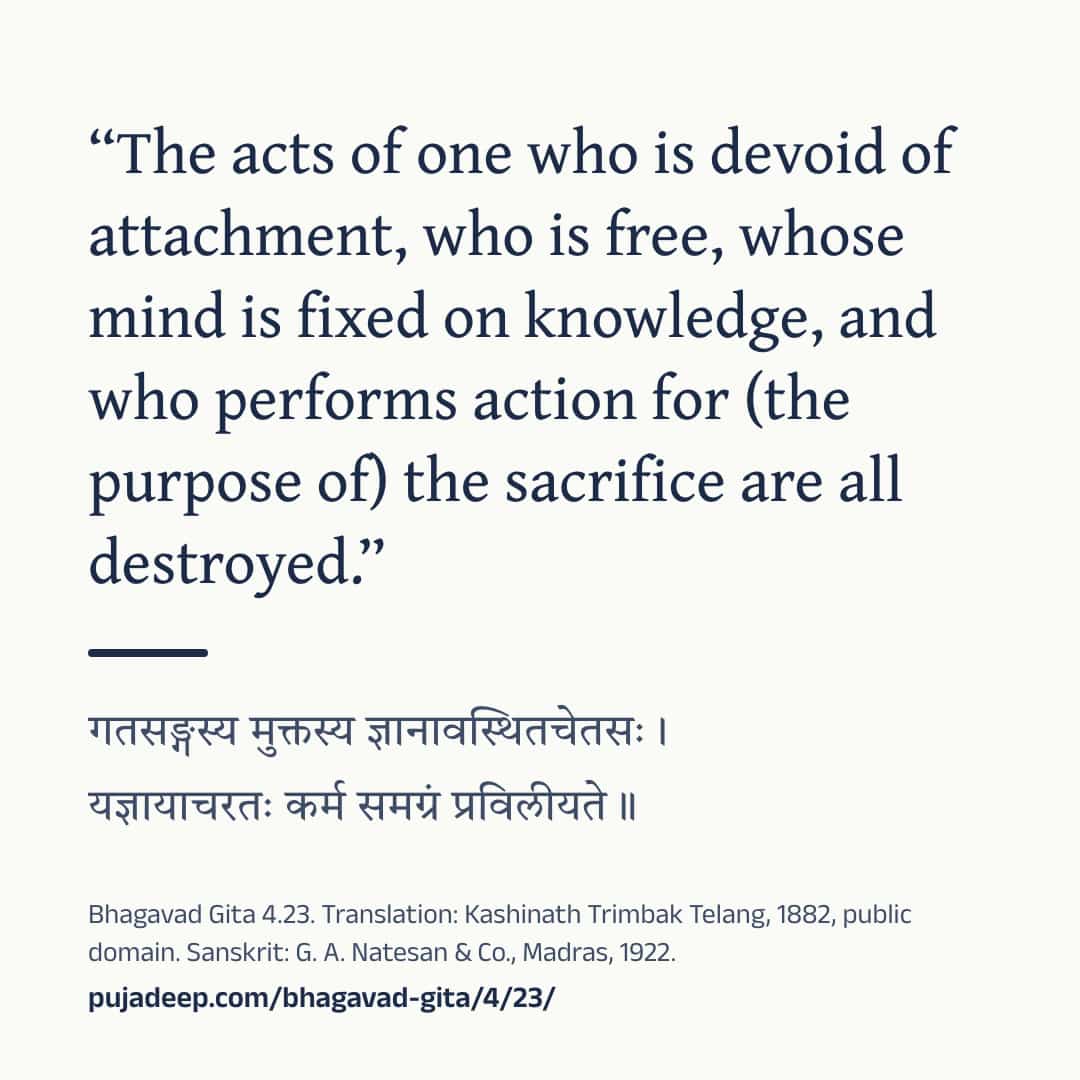
Drawing the picture
See the words
Bhagavad Gita 4.23

गतसङ्गस्य मुक्तस्य ज्ञानावस्थितचेतसः ।
यज्ञायाचरतः कर्म समग्रं प्रविलीयते ॥

“The acts of one who is devoid of attachment, who is free, whose mind is fixed on knowledge, and who performs action for (the purpose of) the sacrifice are all destroyed.”
(K. T. Telang, The Bhagavadgîtâ (The Sacred Books of the East, vol. VIII, Oxford: Clarendon Press, 1882), pp. 60–61, public domain)

“For, with attachment dead, harmonious, his thoughts established in wisdom, his works sacrifices, all his action melts away.”
(Annie Besant, The Bhagavad Gîtâ, or The Lord's Song (London: Theosophical Publishing Society, 1895), p. 53, public domain)
This sentence begins in 4.22.

“Devoid of attachment, liberated, with mind centred in knowledge, performing work for Yajna alone, his whole Karma dissolves away.”
(Swami Swarupananda, Srimad-Bhagavad-Gita (Mayavati: Prabuddha Bharata Press, 1909; first printed in Prabuddha Bharata, 1907–1909), p. 95, public domain)

Sanskrit: G. A. Natesan & Co., Madras, 1922.
https://pujadeep.com/bhagavad-gita/4/23/ Nothing is sent from this site. Your own app sends it, to the chat you choose. The picture quotes the translation you chose on this page, with its name and year.
Sanskrit text: The Bhagavad-Gita, or The Lord's Song, with the text in Devanagari and an English translation, 1922. Meanings: written for Pujadeep and checked against the cited edition. Source and changes
Questions families ask
Who speaks Bhagavad Gita 4.23?
Krishna speaks this verse, in chapter 4 (Jnana Karma Sannyasa Yoga).
Where does the Sanskrit text come from?
Sanskrit text: The Bhagavad-Gita, or The Lord's Song, with the text in Devanagari and an English translation, 1922. Meanings: written for Pujadeep and checked against the cited edition. See the source
Is the meaning on this page a translation?
Explanation written for this site from the sources listed here, and checked against the cited edition. It is not a translation and not the only way to read the text. Free to quote with credit.
Source and licence
- Sanskrit text
- The Bhagavad-Gita, or The Lord's Song, with the text in Devanagari and an English translation (Annie Besant, G. A. Natesan & Co., Madras, 1922). Public domain. The Sanskrit on these pages was read from this printing’s page images.
- Translation
- The Bhagavadgîtâ with the Sanatsugâtîya and the Anugîtâ, translated by Kâshinâth Trimbak Telang (The Sacred Books of the East, vol. VIII, ed. F. Max Müller) (Kashinath Trimbak Telang, F. Max Müller, Clarendon Press, Oxford, 1882). Public domain. Shown verbatim, as printed.
- Translation
- The Bhagavad Gîtâ, or The Lord's Song, translated by Annie Besant (Annie Besant, Theosophical Publishing Society, London, 1895). Public domain. Shown verbatim, as printed.
- Translation
- Srimad-Bhagavad-Gita, with Sanskrit Text; Paraphrase with Word-by-word Literal Translation; English Rendering and Comments, Index, &c., by the Swami Swarupananda (Himalayan Series, No. XX) (Swami Swarupananda, The Editors and Publishers, Advaita Ashrama, Mayavati, Prabuddha Bharata Press, Mayavati, Almora, Himalayas, 1909). Public domain. Shown verbatim, as printed.
- Common wording
- In this text, 32 words follow today's common wording, checked against sanskritdocuments.org; Sanskrit Wikisource; Gita Press, Gorakhpur; GRETIL, Göttingen and Bhaktivedanta Book Trust.
- Our explanation
- Explanation written for this site from the sources listed here, and checked against the cited edition. It is not a translation and not the only way to read the text. Free to quote with credit.
- Checked
- Checked against the cited edition, October 15, 2026.
- Updated
- October 27, 2026