Bhagavad Gita 4.24: meaning and translation
Chapter 4: Jnana Karma Sannyasa Yoga. Krishna says
Krishna: The means of offering (the ladle) is Brahman, the offering is Brahman, and it is offered by Brahman into the fire that is Brahman.
Click or tap a word for its meaning and its dictionary page.
Text and layers
Text and layers
These choices stay in this browser.
Bhagavad Gita 4.24
ब्रह्मार्पणं ब्रह्म हविर्ब्रह्माग्नौ ब्रह्मणा हुतम् ।ब्रह्मैव तेन गन्तव्यं ब्रह्मकर्मसमाधिना ॥
Brahmarpanam brahma havirbrahmagnau brahmana hutamBrahmaiva tena gantavyam brahmakarmasamadhina
brahmārpaṇaṃ brahma havirbrahmāgnau brahmaṇā hutam |brahmaiva tena gantavyaṃ brahmakarmasamādhinā ||
Our explanation The means of offering (the ladle) is Brahman, the offering is Brahman, and it is offered by Brahman into the fire that is Brahman. The one who sees Brahman in every action goes to Brahman. The schools read "all is Brahman" here in different ways (see the views). Pujadeep also lists this verse among the prayers before meals (Brahmarpanam).
हिंदी अर्थ अर्पण (आहुति देने का साधन) ब्रह्म है, हवि (आहुति) ब्रह्म है, और ब्रह्म रूपी अग्नि में ब्रह्म द्वारा ही आहुति दी जाती है। जो हर कर्म में ब्रह्म को देखता है, वह ब्रह्म को ही प्राप्त होता है। अलग-अलग परंपराएँ इस श्लोक को अपने ढंग से समझाती हैं। पूजादीप इस श्लोक को भोजन से पहले की प्रार्थनाओं में भी रखता है (ब्रह्मार्पणम्)।
Word by word
Every word, with its dictionary page
Word by word
- ब्रह्मार्पणम् brahmārpaṇam · the offering is Brahman (compound (neuter), nominative singular) Dictionary: brahman, Monier-Williams 1899, p. 738, col. 1 “one self-existent impersonal Spirit, the one universal Soul”; arpaṇa, Monier-Williams 1899, p. 92, col. 3 “offering, delivering, consigning, entrusting”
- ब्रह्म brahma · Brahman (noun (neuter), nominative singular) Dictionary: brahman, Monier-Williams 1899, p. 738, col. 1 “one self-existent impersonal Spirit, the one universal Soul”
- हविः haviḥ · the oblation (noun (neuter), nominative singular) Dictionary: havis, Monier-Williams 1899, p. 1294, col. 1 “an oblation or burnt offering, anything offered as an oblation with fire”
- ब्रह्माग्नौ brahmāgnau · into the fire that is Brahman (compound (masculine), locative singular) Dictionary: brahman, Monier-Williams 1899, p. 738, col. 1 “one self-existent impersonal Spirit, the one universal Soul”; agni, Monier-Williams 1899, p. 5, col. 1 “fire; sacrificial fire”
- ब्रह्मणा brahmaṇā · by Brahman (the one who offers) (noun (neuter), instrumental singular) Dictionary: brahman, Monier-Williams 1899, p. 738, col. 1 “one self-existent impersonal Spirit, the one universal Soul”
- हुतम् hutam · is offered (past participle (neuter), nominative singular) Dictionary: huta, Monier-Williams 1899, p. 1301, col. 1 “offered in fire, poured out (as clarified butter)”
- ब्रह्म brahma · Brahman (noun (neuter), nominative singular) Dictionary: brahman, Monier-Williams 1899, p. 738, col. 1 “one self-existent impersonal Spirit, the one universal Soul”
- एव eva · alone (indeclinable) Dictionary: 1. eva, Monier-Williams 1899, p. 232, col. 2 “just, exactly, very, same, only, even, alone, merely”
- तेन tena · by him (pronoun (masculine), instrumental singular) Dictionary: tad, Monier-Williams 1899, p. 434, col. 1 “m. he, f. she, n. it, that, this”
- गन्तव्यम् gantavyam · is to be reached (gerundive (to be done) (neuter), nominative singular) Dictionary: gantavya, Monier-Williams 1899, p. 347, col. 3 “to be gone to or attained”
- ब्रह्मकर्मसमाधिना brahmakarmasamādhinā · by one absorbed in Brahman while acting (compound (masculine), instrumental singular) Dictionary: brahman, Monier-Williams 1899, p. 738, col. 1 “one self-existent impersonal Spirit, the one universal Soul”; karman, Monier-Williams 1899, p. 258, col. 2 “act, action, performance, business”; samādhi, Monier-Williams 1899, p. 1159, col. 3 “intense application or fixing the mind on, intentness, attention”
Old translations
Kashinath Trimbak Telang, 1882. Public domain. Page 61.
Brahman is the oblation; with Brahman (as a sacrificial instrument) it is offered up; Brahman is in the fire; and by Brahman it is thrown; and Brahman, too, is the goal to which he proceeds who meditates on Brahman in the action1.
Footnotes (the translator’s own) - This thorough identification with the Brahman explains why the action is 'destroyed' and does not 'fetter' the doer. ↩
Compare 3 translations
Kashinath Trimbak Telang, 1882. Public domain. Page 61.
Brahman is the oblation; with Brahman (as a sacrificial instrument) it is offered up; Brahman is in the fire; and by Brahman it is thrown; and Brahman, too, is the goal to which he proceeds who meditates on Brahman in the action1.
Footnotes (the translator’s own) - This thorough identification with the Brahman explains why the action is 'destroyed' and does not 'fetter' the doer. ↩
You are reading this one
Annie Besant, 1895. Public domain. Page 53.
Brahman the oblation, Brahman the clarified butter, are offered to Brahman the fire, by Brahman; unto Brahman verily shall he go who in his action meditateth wholly upon Brahman.
You are reading this one
Swami Swarupananda, 1909 (first printed 1907). Public domain. Page 95.
The process is Brahman, the clarified butter is Brahman, in the fire of Brahman offered by Brahman, by seeing Brahman in action, he reaches Brahman alone.
You are reading this one
Cite this verse
The translation: K. T. Telang, The Bhagavadgîtâ (The Sacred Books of the East, vol. VIII, Oxford: Clarendon Press, 1882), p. 61. Bhagavad Gita 4.24.
The translation: Annie Besant, The Bhagavad Gîtâ, or The Lord's Song (London: Theosophical Publishing Society, 1895), p. 53. Bhagavad Gita 4.24.
The translation: Swami Swarupananda, Srimad-Bhagavad-Gita (Mayavati: Prabuddha Bharata Press, 1909; first printed in Prabuddha Bharata, 1907–1909), p. 95. Bhagavad Gita 4.24.
Our explanation: “Bhagavad Gita 4.24: meaning and translation.” Pujadeep. Updated October 27, 2026. https://pujadeep.com/bhagavad-gita/4/24/
Pujadeep’s explanations are free to quote with credit: name Pujadeep and link to the page. How to credit
Classical readings, by school
Each reading is named by its school. None is presented as the only meaning.
What Advaita, Vishishtadvaita and Dvaita teach, in short
Shankara Advaita
Shankara says that for one who has realised Brahman, the ladle, the oblation, the fire, the one who offers, the act and its goal are nothing but Brahman, just as the 'silver' seen in mother-of-pearl is only mother-of-pearl. For such a person action is no longer action, so it does not bind.
Source: The Bhagavad-Gita, with the commentary of Sri Sankaracharya, translated by A. Mahadeva Sastri (2nd ed., Mysore: G. T. A. Printing Works, 1901), commentary on 4.24, pp. 125–127. Summarised in our own words; none of its text is reproduced.
Ramanuja Vishishtadvaita
Ramanuja says the ladle and the other parts of the rite are Brahman because, as created things, they are effects of Brahman. The seeker regards every action as having Brahman for its soul; work done in this way becomes itself a form of knowledge. To reach Brahman is to realise the self, whose nature is like Brahman's.
Source: Sri Bhagavad-Gita with Sri Ramanujacharya's Visishtadvaita commentary, translated by A. Govindacharya (Madras, 1898), commentary on 4.24, p. 156. Summarised in our own words; none of its text is reproduced.
Share
Show the ways to share
Send one picture or the text to one chat. The picture names its source and the address of this page.
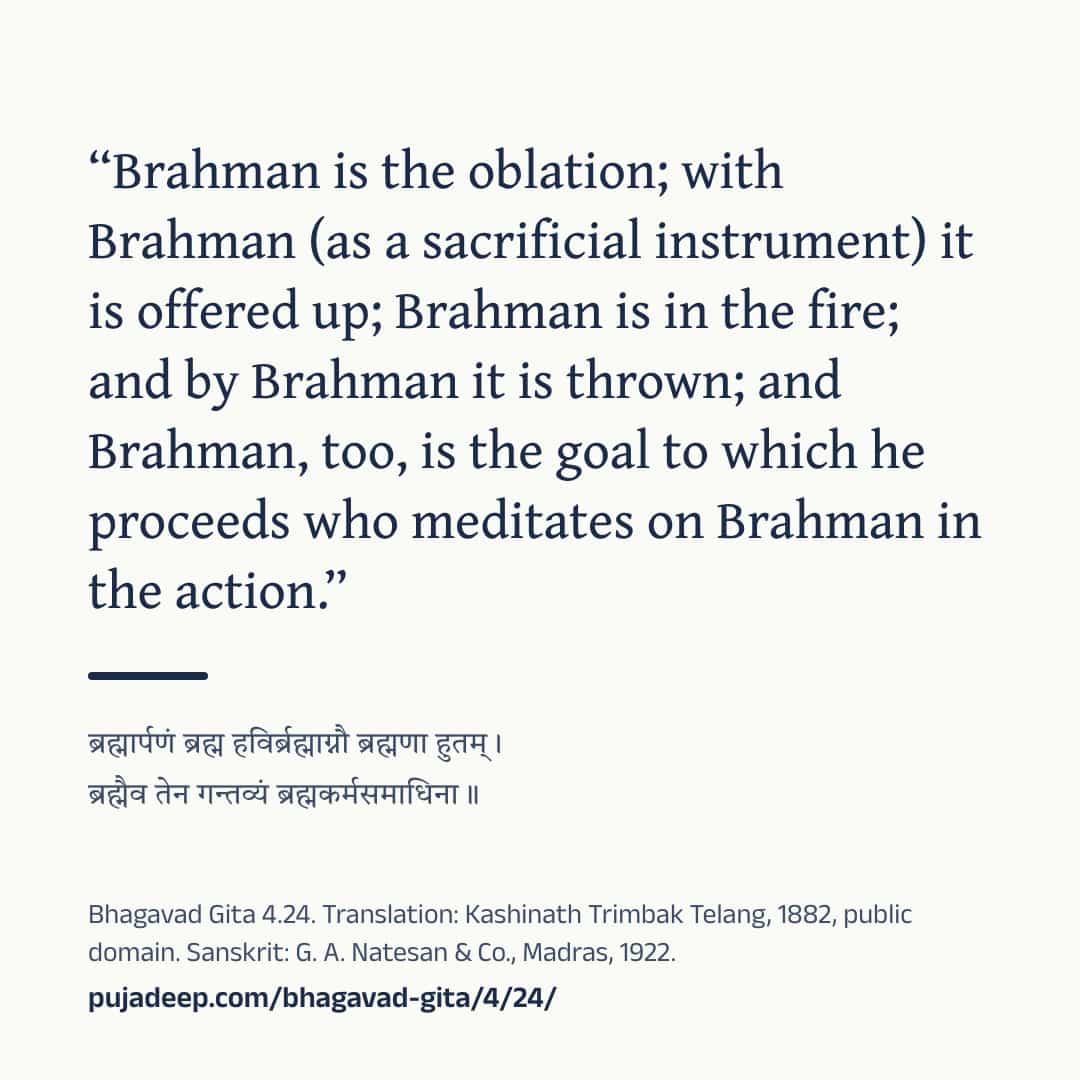
Drawing the picture
See the words
Bhagavad Gita 4.24

ब्रह्मार्पणं ब्रह्म हविर्ब्रह्माग्नौ ब्रह्मणा हुतम् ।
ब्रह्मैव तेन गन्तव्यं ब्रह्मकर्मसमाधिना ॥

“Brahman is the oblation; with Brahman (as a sacrificial instrument) it is offered up; Brahman is in the fire; and by Brahman it is thrown; and Brahman, too, is the goal to which he proceeds who meditates on Brahman in the action.”
(K. T. Telang, The Bhagavadgîtâ (The Sacred Books of the East, vol. VIII, Oxford: Clarendon Press, 1882), p. 61, public domain)

“Brahman the oblation, Brahman the clarified butter, are offered to Brahman the fire, by Brahman; unto Brahman verily shall he go who in his action meditateth wholly upon Brahman.”
(Annie Besant, The Bhagavad Gîtâ, or The Lord's Song (London: Theosophical Publishing Society, 1895), p. 53, public domain)

“The process is Brahman, the clarified butter is Brahman, in the fire of Brahman offered by Brahman, by seeing Brahman in action, he reaches Brahman alone.”
(Swami Swarupananda, Srimad-Bhagavad-Gita (Mayavati: Prabuddha Bharata Press, 1909; first printed in Prabuddha Bharata, 1907–1909), p. 95, public domain)

Sanskrit: G. A. Natesan & Co., Madras, 1922.
https://pujadeep.com/bhagavad-gita/4/24/ Nothing is sent from this site. Your own app sends it, to the chat you choose. The picture quotes the translation you chose on this page, with its name and year.
Sanskrit text: The Bhagavad-Gita, or The Lord's Song, with the text in Devanagari and an English translation, 1922. Meanings: written for Pujadeep and checked against the cited edition. Source and changes
Questions families ask
Who speaks Bhagavad Gita 4.24?
Krishna speaks this verse, in chapter 4 (Jnana Karma Sannyasa Yoga).
Where does the Sanskrit text come from?
Sanskrit text: The Bhagavad-Gita, or The Lord's Song, with the text in Devanagari and an English translation, 1922. Meanings: written for Pujadeep and checked against the cited edition. See the source
Is the meaning on this page a translation?
Explanation written for this site from the sources listed here, and checked against the cited edition. It is not a translation and not the only way to read the text. Free to quote with credit.
Source and licence
- Sanskrit text
- The Bhagavad-Gita, or The Lord's Song, with the text in Devanagari and an English translation (Annie Besant, G. A. Natesan & Co., Madras, 1922). Public domain. The Sanskrit on these pages was read from this printing’s page images.
- Translation
- The Bhagavadgîtâ with the Sanatsugâtîya and the Anugîtâ, translated by Kâshinâth Trimbak Telang (The Sacred Books of the East, vol. VIII, ed. F. Max Müller) (Kashinath Trimbak Telang, F. Max Müller, Clarendon Press, Oxford, 1882). Public domain. Shown verbatim, as printed.
- Translation
- The Bhagavad Gîtâ, or The Lord's Song, translated by Annie Besant (Annie Besant, Theosophical Publishing Society, London, 1895). Public domain. Shown verbatim, as printed.
- Translation
- Srimad-Bhagavad-Gita, with Sanskrit Text; Paraphrase with Word-by-word Literal Translation; English Rendering and Comments, Index, &c., by the Swami Swarupananda (Himalayan Series, No. XX) (Swami Swarupananda, The Editors and Publishers, Advaita Ashrama, Mayavati, Prabuddha Bharata Press, Mayavati, Almora, Himalayas, 1909). Public domain. Shown verbatim, as printed.
- Commentary
- The Bhagavad-Gita, with the commentary of Sri Sankaracharya, translated by A. Mahadeva Sastri (2nd ed., Mysore: G. T. A. Printing Works, 1901) (Public-domain scan, University of California Libraries). Summarised in our own words; none of its text is reproduced.
- Commentary
- Sri Bhagavad-Gita with Sri Ramanujacharya's Visishtadvaita commentary, translated by A. Govindacharya (Madras, 1898) (Scan uploaded to archive.org (folkscanomy collection)). Summarised in our own words; none of its text is reproduced.
- Common wording
- In this text, 32 words follow today's common wording, checked against sanskritdocuments.org; Sanskrit Wikisource; Gita Press, Gorakhpur; GRETIL, Göttingen and Bhaktivedanta Book Trust.
- Our explanation
- Explanation written for this site from the sources listed here, and checked against the cited edition. It is not a translation and not the only way to read the text. Free to quote with credit.
- Checked
- Checked against the cited edition, October 15, 2026.
- Updated
- October 27, 2026