Bhagavad Gita 4.26: meaning and translation
Chapter 4: Jnana Karma Sannyasa Yoga. Krishna says
Krishna: Some offer hearing and the other senses into the fires of restraint.
Click or tap a word for its meaning and its dictionary page.
Text and layers
Text and layers
These choices stay in this browser.
Bhagavad Gita 4.26
श्रोत्रादीनीन्द्रियाण्यन्ये संयमाग्निषु जुह्वति ।शब्दादीन्विषयानन्य इन्द्रियाग्निषु जुह्वति ॥
Shrotradinindriyanyanye sanyamagnishu juhvatiShabdadinvishayananya indriyagnishu juhvati
śrotrādīnīndriyāṇyanye saṃyamāgniṣu juhvati |śabdādīnviṣayānanya indriyāgniṣu juhvati ||
Our explanation Some offer hearing and the other senses into the fires of restraint. Others offer sound and the other objects of the senses into the fires of the senses.
हिंदी अर्थ कुछ लोग श्रोत्र (सुनने की शक्ति) आदि इंद्रियों को संयम रूपी अग्नि में होम करते हैं। दूसरे शब्द आदि विषयों को इंद्रिय रूपी अग्नि में होम करते हैं।
Word by word
Every word, with its dictionary page
Word by word
- श्रोत्रादीनि śrotrādīni · hearing and the rest (compound (neuter), accusative plural) Dictionary: śrotra, Monier-Williams 1899, p. 1103, col. 1 “the organ of hearing, ear, auricle”; 1. ādi, Monier-Williams 1899, p. 136, col. 3 “beginning, commencement; a firstling, first-fruits”
- इन्द्रियाणि indriyāṇi · the senses (noun (neuter), accusative plural) Dictionary: indriya, Monier-Williams 1899, p. 167, col. 2 “faculty of sense, sense, organ of sense”
- अन्ये anye · others (pronoun (masculine), nominative plural) Dictionary: 2. anya, Monier-Williams 1899, p. 45, col. 2 “other, different”
- संयमाग्निषु saṃyamāgniṣu · into the fires of restraint (compound (masculine), locative plural) Dictionary: saṃ-yama, Monier-Williams 1899, p. 1112, col. 1 “holding together, restraint, control, (esp.) control of the senses, self-control”; agni, Monier-Williams 1899, p. 5, col. 1 “fire; sacrificial fire”
- जुह्वति juhvati · offer (present, 3rd person plural) Dictionary: 1. hu, Monier-Williams 1899, p. 1301, col. 1 “to sacrifice (esp. pour butter into the fire), offer or present an oblation”
- शब्दादीन् śabdādīn · sound and the rest (compound (masculine), accusative plural) Dictionary: śabda, Monier-Williams 1899, p. 1052, col. 2 “sound, noise, voice, tone, note”; 1. ādi, Monier-Williams 1899, p. 136, col. 3 “beginning, commencement; a firstling, first-fruits”
- विषयान् viṣayān · objects of the senses (noun (masculine), accusative plural) Dictionary: viṣaya, Monier-Williams 1899, p. 997, col. 1 “sphere (of influence or activity)”
- अन्ये anye · others (pronoun (masculine), nominative plural) Dictionary: 2. anya, Monier-Williams 1899, p. 45, col. 2 “other, different”
- इन्द्रियाग्निषु indriyāgniṣu · into the fires of the senses (compound (masculine), locative plural) Dictionary: indriya, Monier-Williams 1899, p. 167, col. 2 “faculty of sense, sense, organ of sense”; agni, Monier-Williams 1899, p. 5, col. 1 “fire; sacrificial fire”
- जुह्वति juhvati · offer (present, 3rd person plural) Dictionary: 1. hu, Monier-Williams 1899, p. 1301, col. 1 “to sacrifice (esp. pour butter into the fire), offer or present an oblation”
Old translations
Kashinath Trimbak Telang, 1882. Public domain. Page 61.
Others offer up the senses, such as the sense of hearing and others, in the fires of restraint1; others offer up the objects of sense, such as sound and so forth, into the fires of the senses2.
Footnotes (the translator’s own) Compare 3 translations
Kashinath Trimbak Telang, 1882. Public domain. Page 61.
Others offer up the senses, such as the sense of hearing and others, in the fires of restraint1; others offer up the objects of sense, such as sound and so forth, into the fires of the senses2.
Footnotes (the translator’s own) You are reading this one
Annie Besant, 1895. Public domain. Page 54.
Some pour as sacrifice hearing and the other senses into the fires of concentration; some pour sound and the other objects of sense into the fires of the senses as sacrifice;
This sentence begins in 4.25. This sentence goes on in 4.27.
You are reading this one
Swami Swarupananda, 1909 (first printed 1907). Public domain. Page 96.
Some again offer hearing and other senses as sacrifice in the fire of control, while others offer sound and other sense-objects as sacrifice in the fire of the senses.
You are reading this one
Cite this verse
The translation: K. T. Telang, The Bhagavadgîtâ (The Sacred Books of the East, vol. VIII, Oxford: Clarendon Press, 1882), p. 61. Bhagavad Gita 4.26.
The translation: Annie Besant, The Bhagavad Gîtâ, or The Lord's Song (London: Theosophical Publishing Society, 1895), p. 54. Bhagavad Gita 4.26.
The translation: Swami Swarupananda, Srimad-Bhagavad-Gita (Mayavati: Prabuddha Bharata Press, 1909; first printed in Prabuddha Bharata, 1907–1909), p. 96. Bhagavad Gita 4.26.
Our explanation: “Bhagavad Gita 4.26: meaning and translation.” Pujadeep. Updated October 27, 2026. https://pujadeep.com/bhagavad-gita/4/26/
Pujadeep’s explanations are free to quote with credit: name Pujadeep and link to the page. How to credit
Classical readings, by school
No readings by school on this verse yet.
Share
Show the ways to share
Send one picture or the text to one chat. The picture names its source and the address of this page.
Drawing the picture
See the words
Bhagavad Gita 4.26

श्रोत्रादीनीन्द्रियाण्यन्ये संयमाग्निषु जुह्वति ।
शब्दादीन्विषयानन्य इन्द्रियाग्निषु जुह्वति ॥

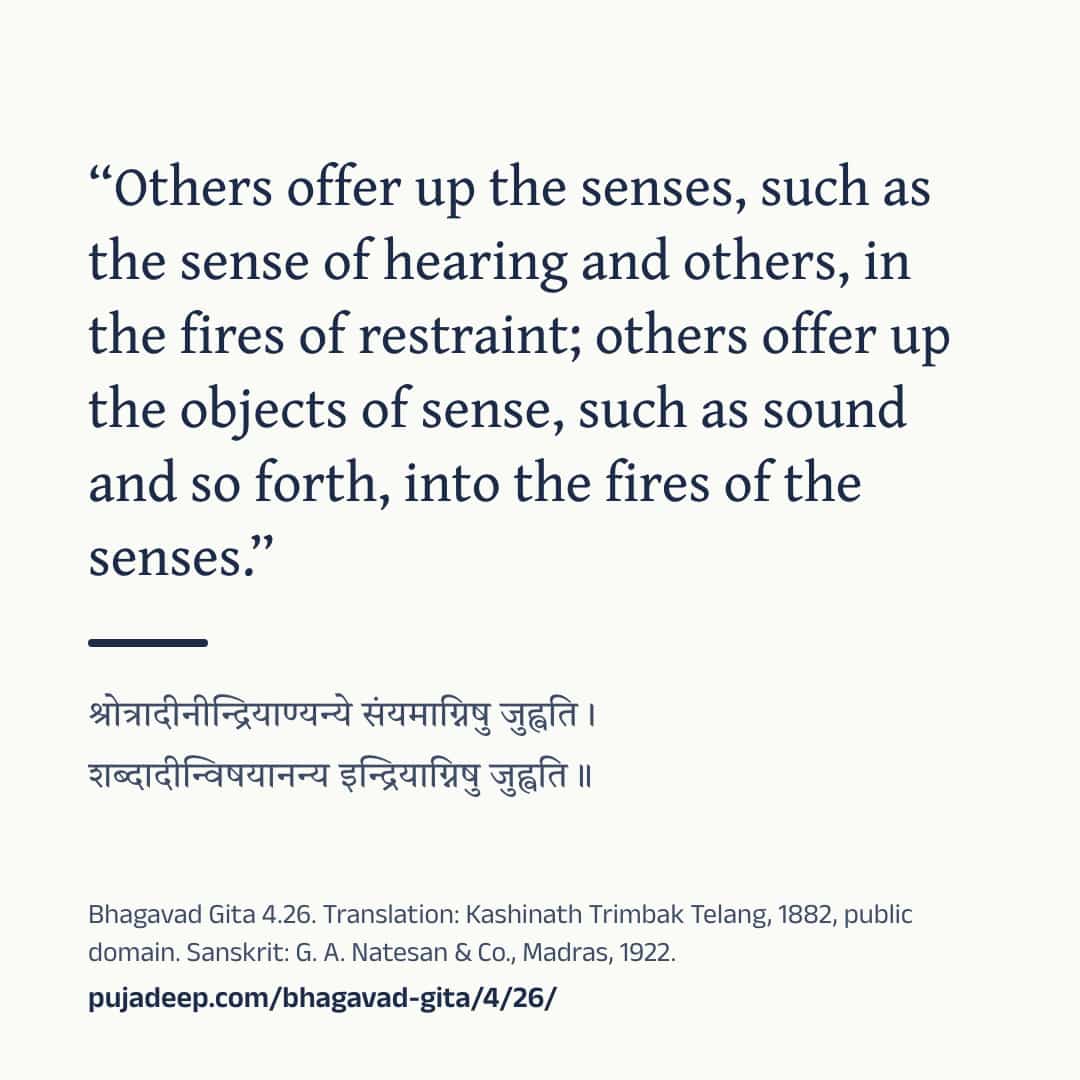
“Others offer up the senses, such as the sense of hearing and others, in the fires of restraint; others offer up the objects of sense, such as sound and so forth, into the fires of the senses.”
(K. T. Telang, The Bhagavadgîtâ (The Sacred Books of the East, vol. VIII, Oxford: Clarendon Press, 1882), p. 61, public domain)

“Some pour as sacrifice hearing and the other senses into the fires of concentration; some pour sound and the other objects of sense into the fires of the senses as sacrifice;”
(Annie Besant, The Bhagavad Gîtâ, or The Lord's Song (London: Theosophical Publishing Society, 1895), p. 54, public domain)
This sentence begins in 4.25. This sentence goes on in 4.27.

“Some again offer hearing and other senses as sacrifice in the fire of control, while others offer sound and other sense-objects as sacrifice in the fire of the senses.”
(Swami Swarupananda, Srimad-Bhagavad-Gita (Mayavati: Prabuddha Bharata Press, 1909; first printed in Prabuddha Bharata, 1907–1909), p. 96, public domain)

Sanskrit: G. A. Natesan & Co., Madras, 1922.
https://pujadeep.com/bhagavad-gita/4/26/ Nothing is sent from this site. Your own app sends it, to the chat you choose. The picture quotes the translation you chose on this page, with its name and year.
Sanskrit text: The Bhagavad-Gita, or The Lord's Song, with the text in Devanagari and an English translation, 1922. Meanings: written for Pujadeep and checked against the cited edition. Source and changes
Questions families ask
Who speaks Bhagavad Gita 4.26?
Krishna speaks this verse, in chapter 4 (Jnana Karma Sannyasa Yoga).
Where does the Sanskrit text come from?
Sanskrit text: The Bhagavad-Gita, or The Lord's Song, with the text in Devanagari and an English translation, 1922. Meanings: written for Pujadeep and checked against the cited edition. See the source
Is the meaning on this page a translation?
Explanation written for this site from the sources listed here, and checked against the cited edition. It is not a translation and not the only way to read the text. Free to quote with credit.
Source and licence
- Sanskrit text
- The Bhagavad-Gita, or The Lord's Song, with the text in Devanagari and an English translation (Annie Besant, G. A. Natesan & Co., Madras, 1922). Public domain. The Sanskrit on these pages was read from this printing’s page images.
- Translation
- The Bhagavadgîtâ with the Sanatsugâtîya and the Anugîtâ, translated by Kâshinâth Trimbak Telang (The Sacred Books of the East, vol. VIII, ed. F. Max Müller) (Kashinath Trimbak Telang, F. Max Müller, Clarendon Press, Oxford, 1882). Public domain. Shown verbatim, as printed.
- Translation
- The Bhagavad Gîtâ, or The Lord's Song, translated by Annie Besant (Annie Besant, Theosophical Publishing Society, London, 1895). Public domain. Shown verbatim, as printed.
- Translation
- Srimad-Bhagavad-Gita, with Sanskrit Text; Paraphrase with Word-by-word Literal Translation; English Rendering and Comments, Index, &c., by the Swami Swarupananda (Himalayan Series, No. XX) (Swami Swarupananda, The Editors and Publishers, Advaita Ashrama, Mayavati, Prabuddha Bharata Press, Mayavati, Almora, Himalayas, 1909). Public domain. Shown verbatim, as printed.
- Common wording
- In this text, 32 words follow today's common wording, checked against sanskritdocuments.org; Sanskrit Wikisource; Gita Press, Gorakhpur; GRETIL, Göttingen and Bhaktivedanta Book Trust.
- Our explanation
- Explanation written for this site from the sources listed here, and checked against the cited edition. It is not a translation and not the only way to read the text. Free to quote with credit.
- Checked
- Checked against the cited edition, October 15, 2026.
- Updated
- October 27, 2026