Bhagavad Gita 4.31: meaning and translation
Chapter 4: Jnana Karma Sannyasa Yoga. Krishna says
Those who eat what remains of the offering, which is like amṛta (the nectar of immortality), reach the eternal Brahman, Krishna says.
Click or tap a word for its meaning and its dictionary page.
Text and layers
Text and layers
These choices stay in this browser.
Bhagavad Gita 4.31
यज्ञशिष्टामृतभुजो यान्ति ब्रह्म सनातनम् ।नायं लोकोऽस्त्ययज्ञस्य कुतोऽन्यः कुरुसत्तम ॥
Yajnashishtamritabhujo yanti brahma sanatanamNayam lokostyayajnasya kutonyah kurusattama
yajñaśiṣṭāmṛtabhujo yānti brahma sanātanam |nāyaṃ loko’styayajñasya kuto’nyaḥ kurusattama ||
Our explanation Those who eat what remains of the offering, which is like amṛta (the nectar of immortality), reach the eternal Brahman, Krishna says. Even this world, he adds, is not for one who makes no offering; how then the other world?
हिंदी अर्थ कृष्ण कहते हैं कि जो यज्ञ से बचे हुए अमृत जैसे अन्न को खाते हैं, वे सनातन ब्रह्म को प्राप्त होते हैं। वे जोड़ते हैं कि जो यज्ञ नहीं करता, उसके लिए यह लोक भी नहीं है, फिर दूसरा लोक कैसे होगा?
Word by word
Every word, with its dictionary page
Word by word
- यज्ञशिष्टामृतभुजः yajñaśiṣṭāmṛtabhujaḥ · who eat the amṛta left from yajña (compound (masculine), nominative plural) Dictionary: yajña, Monier-Williams 1899, p. 839, col. 2 “worship, devotion, prayer, praise; act of worship or devotion, offering, oblation, sacrifice”; 1. śiṣṭa, Monier-Williams 1899, p. 1076, col. 3 “left, remaining, escaped, residual”; a-mṛta, Monier-Williams 1899, p. 82, col. 2 “immortality”; 3. bhuj, Monier-Williams 1899, p. 759, col. 2 “to enjoy, use, possess”
- यान्ति yānti · reach (present, 3rd person plural) Dictionary: 1. yā, Monier-Williams 1899, p. 849, col. 1 “to go, proceed, move, walk, set out”
- ब्रह्म brahma · Brahman (noun (neuter), accusative singular) Dictionary: brahman, Monier-Williams 1899, p. 738, col. 1 “one self-existent impersonal Spirit, the one universal Soul”
- सनातनम् sanātanam · eternal (adjective (neuter), accusative singular) Dictionary: sanātana, Monier-Williams 1899, p. 1141, col. 1 “eternal, perpetual, permanent, everlasting, primeval, ancient”
- न na · not (indeclinable) Dictionary: 2. na, Monier-Williams 1899, p. 523, col. 1 “ind. not, no, nor, neither”
- अयम् ayam · this (pronoun (masculine), nominative singular) Dictionary: 1. idam, Monier-Williams 1899, p. 165, col. 2 “this, this here, referring to something near the speaker”
- लोकः lokaḥ · world (noun (masculine), nominative singular) Dictionary: loka, Monier-Williams 1899, p. 906, col. 1 “the wide space or world”
- अस्ति asti · is (present, 3rd person singular) Dictionary: 1. as, Monier-Williams 1899, p. 117, col. 2 “to be, live, exist, be present”
- अयज्ञस्य ayajñasya · for one who makes no offering (noun (masculine), genitive singular) Dictionary: a-yajña, Monier-Williams 1899, p. 84, col. 3 “not offering a sacrifice”
- कुतः kutaḥ · how then (indeclinable) Dictionary: kutas, Monier-Williams 1899, p. 290, col. 2 “from where? whence?”
- अन्यः anyaḥ · the other (world) (pronoun (masculine), nominative singular) Dictionary: 2. anya, Monier-Williams 1899, p. 45, col. 2 “other, different”
- कुरुसत्तम kurusattama · O best of the Kurus (compound (masculine), vocative singular) Dictionary: kuru, Monier-Williams 1899, p. 294, col. 1; sat-tama, Monier-Williams 1899, p. 1134, col. 3 “very good or right, the best, first, chief of (gen. or comp.)”
Old translations
Kashinath Trimbak Telang, 1882. Public domain. Page 62.
Those who eat the nectar-like leavings of the sacrifice repair to the eternal Brahman1. This world is not for those who perform no sacrifice, whence (then) the other, O best of the Kauravas!
Footnotes (the translator’s own) - Supra, p. 53. ↩
Compare 3 translations
Kashinath Trimbak Telang, 1882. Public domain. Page 62.
Those who eat the nectar-like leavings of the sacrifice repair to the eternal Brahman1. This world is not for those who perform no sacrifice, whence (then) the other, O best of the Kauravas!
Footnotes (the translator’s own) - Supra, p. 53. ↩
You are reading this one
Annie Besant, 1895. Public domain. Page 55.
The eaters of the amrita1 remains of sacrifices go to the Eternal Brahman. This world is not for the non-sacrificer, much less the other, O best of the Kurus.
Footnotes (the translator’s own) - Amrita is the elixir of immortality. ↩
You are reading this one
Swami Swarupananda, 1909 (first printed 1907). Public domain.
Swarupananda renders the second half of verse 30 and verse 31 together; see 4.30. Read it at 4.30
You are reading this one
Cite this verse
The translation: K. T. Telang, The Bhagavadgîtâ (The Sacred Books of the East, vol. VIII, Oxford: Clarendon Press, 1882), p. 62. Bhagavad Gita 4.31.
The translation: Annie Besant, The Bhagavad Gîtâ, or The Lord's Song (London: Theosophical Publishing Society, 1895), p. 55. Bhagavad Gita 4.31.
The translation: Swami Swarupananda, Srimad-Bhagavad-Gita (Mayavati: Prabuddha Bharata Press, 1909; first printed in Prabuddha Bharata, 1907–1909), p. 99. Bhagavad Gita 4.30–31.
Our explanation: “Bhagavad Gita 4.31: meaning and translation.” Pujadeep. Updated October 27, 2026. https://pujadeep.com/bhagavad-gita/4/31/
Pujadeep’s explanations are free to quote with credit: name Pujadeep and link to the page. How to credit
Classical readings, by school
No readings by school on this verse yet.
Share
Show the ways to share
Send one picture or the text to one chat. The picture names its source and the address of this page.
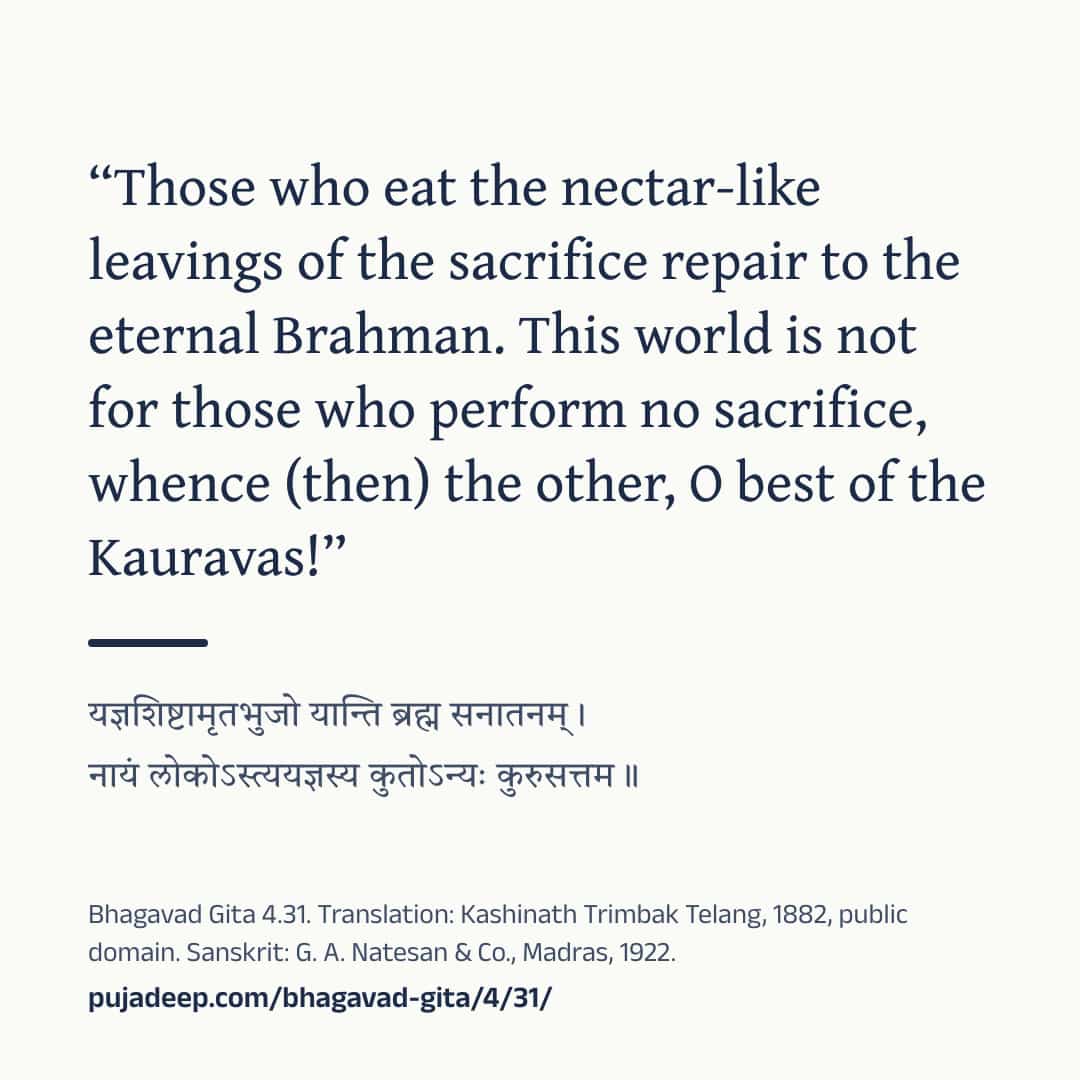
Drawing the picture
See the words
Bhagavad Gita 4.31

यज्ञशिष्टामृतभुजो यान्ति ब्रह्म सनातनम् ।
नायं लोकोऽस्त्ययज्ञस्य कुतोऽन्यः कुरुसत्तम ॥

“Those who eat the nectar-like leavings of the sacrifice repair to the eternal Brahman. This world is not for those who perform no sacrifice, whence (then) the other, O best of the Kauravas!”
(K. T. Telang, The Bhagavadgîtâ (The Sacred Books of the East, vol. VIII, Oxford: Clarendon Press, 1882), p. 62, public domain)

“The eaters of the amrita remains of sacrifices go to the Eternal Brahman. This world is not for the non-sacrificer, much less the other, O best of the Kurus.”
(Annie Besant, The Bhagavad Gîtâ, or The Lord's Song (London: Theosophical Publishing Society, 1895), p. 55, public domain)

Sanskrit: G. A. Natesan & Co., Madras, 1922.
https://pujadeep.com/bhagavad-gita/4/31/ Nothing is sent from this site. Your own app sends it, to the chat you choose. The picture quotes the translation you chose on this page, with its name and year.
Sanskrit text: The Bhagavad-Gita, or The Lord's Song, with the text in Devanagari and an English translation, 1922. Meanings: written for Pujadeep and checked against the cited edition. Source and changes
Questions families ask
Who speaks Bhagavad Gita 4.31?
Krishna speaks this verse, in chapter 4 (Jnana Karma Sannyasa Yoga).
Where does the Sanskrit text come from?
Sanskrit text: The Bhagavad-Gita, or The Lord's Song, with the text in Devanagari and an English translation, 1922. Meanings: written for Pujadeep and checked against the cited edition. See the source
Is the meaning on this page a translation?
Explanation written for this site from the sources listed here, and checked against the cited edition. It is not a translation and not the only way to read the text. Free to quote with credit.
Source and licence
- Sanskrit text
- The Bhagavad-Gita, or The Lord's Song, with the text in Devanagari and an English translation (Annie Besant, G. A. Natesan & Co., Madras, 1922). Public domain. The Sanskrit on these pages was read from this printing’s page images.
- Translation
- The Bhagavadgîtâ with the Sanatsugâtîya and the Anugîtâ, translated by Kâshinâth Trimbak Telang (The Sacred Books of the East, vol. VIII, ed. F. Max Müller) (Kashinath Trimbak Telang, F. Max Müller, Clarendon Press, Oxford, 1882). Public domain. Shown verbatim, as printed.
- Translation
- The Bhagavad Gîtâ, or The Lord's Song, translated by Annie Besant (Annie Besant, Theosophical Publishing Society, London, 1895). Public domain. Shown verbatim, as printed.
- Translation
- Srimad-Bhagavad-Gita, with Sanskrit Text; Paraphrase with Word-by-word Literal Translation; English Rendering and Comments, Index, &c., by the Swami Swarupananda (Himalayan Series, No. XX) (Swami Swarupananda, The Editors and Publishers, Advaita Ashrama, Mayavati, Prabuddha Bharata Press, Mayavati, Almora, Himalayas, 1909). Public domain. Shown verbatim, as printed.
- Common wording
- In this text, 32 words follow today's common wording, checked against sanskritdocuments.org; Sanskrit Wikisource; Gita Press, Gorakhpur; GRETIL, Göttingen and Bhaktivedanta Book Trust.
- Our explanation
- Explanation written for this site from the sources listed here, and checked against the cited edition. It is not a translation and not the only way to read the text. Free to quote with credit.
- Checked
- Checked against the cited edition, October 15, 2026.
- Updated
- October 27, 2026