Bhagavad Gita 4.25: meaning and translation
Chapter 4: Jnana Karma Sannyasa Yoga. Krishna says
Krishna now describes many kinds of offering (yajña).
Click or tap a word for its meaning and its dictionary page.
Text and layers
Text and layers
These choices stay in this browser.
Bhagavad Gita 4.25
दैवमेवापरे यज्ञं योगिनः पर्युपासते ।ब्रह्माग्नावपरे यज्ञं यज्ञेनैवोपजुह्वति ॥
Daivamevapare yajnam yoginah paryupasateBrahmagnavapare yajnam yajnenaivopajuhvati
daivamevāpare yajñaṃ yoginaḥ paryupāsate |brahmāgnāvapare yajñaṃ yajñenaivopajuhvati ||
Our explanation Krishna now describes many kinds of offering (yajña). Some yogis make offerings to the gods (devas). Others offer the sacrifice, by means of the sacrifice itself, into the fire that is Brahman.
हिंदी अर्थ अब कृष्ण यज्ञ के कई प्रकार बताते हैं। कुछ योगी देवताओं के लिए यज्ञ करते हैं। दूसरे ब्रह्म रूपी अग्नि में यज्ञ के द्वारा ही यज्ञ की आहुति देते हैं।
Word by word
Every word, with its dictionary page
Word by word
- दैवम् daivam · to the gods (adjective (masculine), accusative singular) Dictionary: 1. daiva, Monier-Williams 1899, p. 497, col. 2 “belonging to or coming from the gods, divine, celestial”
- एव eva · only (indeclinable) Dictionary: 1. eva, Monier-Williams 1899, p. 232, col. 2 “just, exactly, very, same, only, even, alone, merely”
- अपरे apare · some (pronoun (masculine), nominative plural) Dictionary: 2. apara, Monier-Williams 1899, p. 50, col. 3 “other, another”
- यज्ञम् yajñam · offering (noun (masculine), accusative singular) Dictionary: yajña, Monier-Williams 1899, p. 839, col. 2 “worship, devotion, prayer, praise; act of worship or devotion, offering, oblation, sacrifice”
- योगिनः yoginaḥ · yogis (noun (masculine), nominative plural) Dictionary: yogin, Monier-Williams 1899, p. 857, col. 3 “a follower of the Yoga system, a Yogin (usually called Yogī) or contemplative saint”
- पर्युपासते paryupāsate · perform, honour (present, 3rd person plural) Dictionary: pary-upās, Monier-Williams 1899, p. 608, col. 3 “to approach respectfully, attend upon, worship”
- ब्रह्माग्नौ brahmāgnau · into the fire of Brahman (compound (masculine), locative singular) Dictionary: brahman, Monier-Williams 1899, p. 738, col. 1 “one self-existent impersonal Spirit, the one universal Soul”; agni, Monier-Williams 1899, p. 5, col. 1 “fire; sacrificial fire”
- अपरे apare · others (pronoun (masculine), nominative plural) Dictionary: 2. apara, Monier-Williams 1899, p. 50, col. 3 “other, another”
- यज्ञम् yajñam · the offering (noun (masculine), accusative singular) Dictionary: yajña, Monier-Williams 1899, p. 839, col. 2 “worship, devotion, prayer, praise; act of worship or devotion, offering, oblation, sacrifice”
- यज्ञेन yajñena · by the offering (noun (masculine), instrumental singular) Dictionary: yajña, Monier-Williams 1899, p. 839, col. 2 “worship, devotion, prayer, praise; act of worship or devotion, offering, oblation, sacrifice”
- एव eva · itself (indeclinable) Dictionary: 1. eva, Monier-Williams 1899, p. 232, col. 2 “just, exactly, very, same, only, even, alone, merely”
- उपजुह्वति upajuhvati · offer (present, 3rd person plural) Dictionary: upa-hu, Monier-Williams 1899, p. 212, col. 1 “to sacrifice or offer a libation in addition to”
Old translations
Kashinath Trimbak Telang, 1882. Public domain. Page 61.
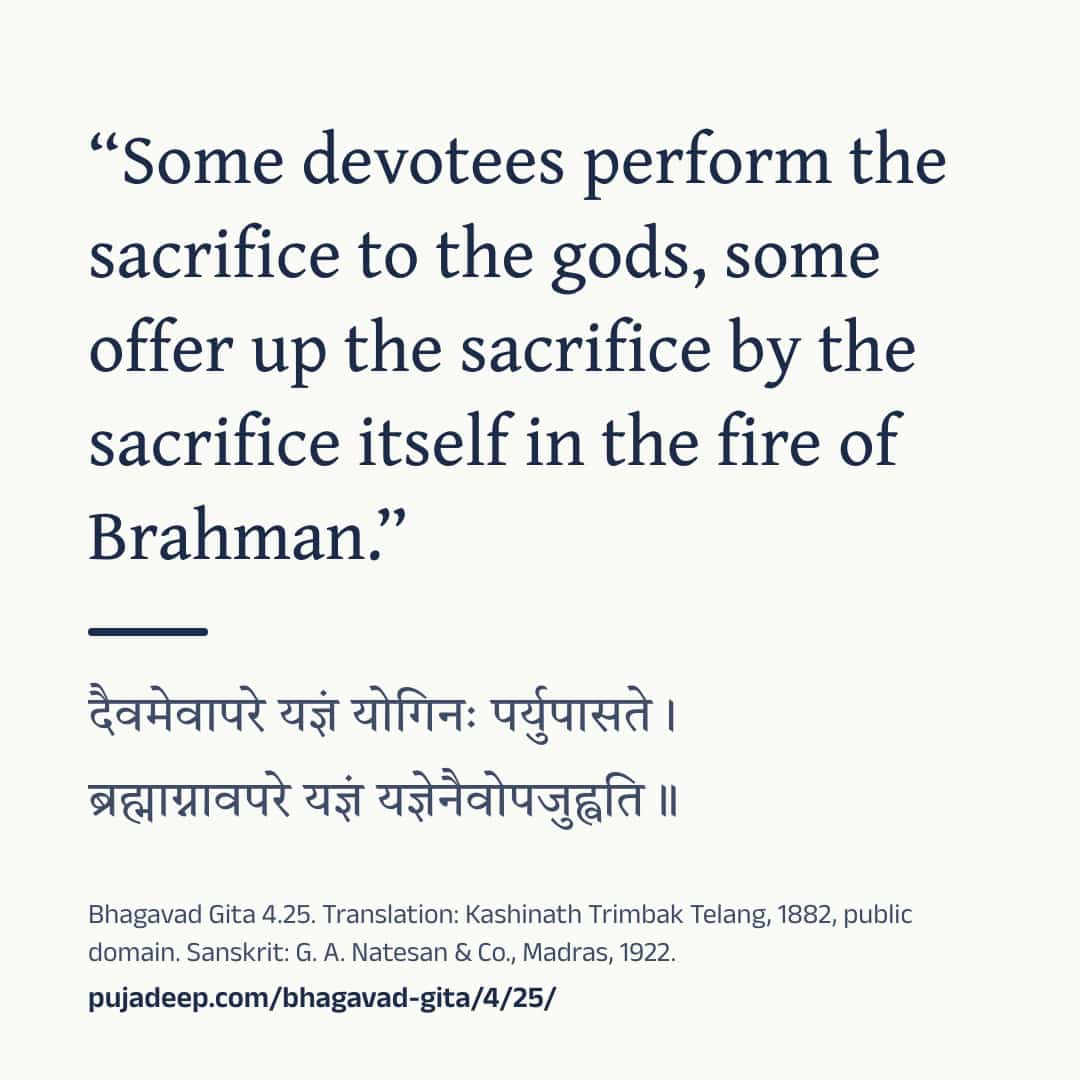
Some devotees perform the sacrifice to the gods, some offer up the sacrifice by the sacrifice itself in the fire of Brahman1.
Footnotes (the translator’s own) - I. e. all acts, religious and other, offered up to the Brahman in the mode above stated. ↩
Compare 3 translations
Kashinath Trimbak Telang, 1882. Public domain. Page 61.
Some devotees perform the sacrifice to the gods, some offer up the sacrifice by the sacrifice itself in the fire of Brahman1.
Footnotes (the translator’s own) - I. e. all acts, religious and other, offered up to the Brahman in the mode above stated. ↩
You are reading this one
Annie Besant, 1895. Public domain. Page 53–54.
Some Yogîs offer up sacrifice to the Gods1; others sacrifice only by pouring sacrifice into the fire of Brahman;
This sentence goes on in 4.26.
Footnotes (the translator’s own) - Literally, divine sacrifice. ↩
You are reading this one
Swami Swarupananda, 1909 (first printed 1907). Public domain. Page 96.
Some Yogis perform sacrifices to Devas alone, while others offer the self as sacrifice by the self in the fire of Brahman alone.
You are reading this one
Cite this verse
The translation: K. T. Telang, The Bhagavadgîtâ (The Sacred Books of the East, vol. VIII, Oxford: Clarendon Press, 1882), p. 61. Bhagavad Gita 4.25.
The translation: Annie Besant, The Bhagavad Gîtâ, or The Lord's Song (London: Theosophical Publishing Society, 1895), pp. 53–54. Bhagavad Gita 4.25.
The translation: Swami Swarupananda, Srimad-Bhagavad-Gita (Mayavati: Prabuddha Bharata Press, 1909; first printed in Prabuddha Bharata, 1907–1909), p. 96. Bhagavad Gita 4.25.
Our explanation: “Bhagavad Gita 4.25: meaning and translation.” Pujadeep. Updated October 27, 2026. https://pujadeep.com/bhagavad-gita/4/25/
Pujadeep’s explanations are free to quote with credit: name Pujadeep and link to the page. How to credit
Classical readings, by school
No readings by school on this verse yet.
Share
Show the ways to share
Send one picture or the text to one chat. The picture names its source and the address of this page.
Drawing the picture
See the words
Bhagavad Gita 4.25

दैवमेवापरे यज्ञं योगिनः पर्युपासते ।
ब्रह्माग्नावपरे यज्ञं यज्ञेनैवोपजुह्वति ॥

“Some devotees perform the sacrifice to the gods, some offer up the sacrifice by the sacrifice itself in the fire of Brahman.”
(K. T. Telang, The Bhagavadgîtâ (The Sacred Books of the East, vol. VIII, Oxford: Clarendon Press, 1882), p. 61, public domain)

“Some Yogîs offer up sacrifice to the Gods; others sacrifice only by pouring sacrifice into the fire of Brahman;”
(Annie Besant, The Bhagavad Gîtâ, or The Lord's Song (London: Theosophical Publishing Society, 1895), pp. 53–54, public domain)
This sentence goes on in 4.26.

“Some Yogis perform sacrifices to Devas alone, while others offer the self as sacrifice by the self in the fire of Brahman alone.”
(Swami Swarupananda, Srimad-Bhagavad-Gita (Mayavati: Prabuddha Bharata Press, 1909; first printed in Prabuddha Bharata, 1907–1909), p. 96, public domain)

Sanskrit: G. A. Natesan & Co., Madras, 1922.
https://pujadeep.com/bhagavad-gita/4/25/ Nothing is sent from this site. Your own app sends it, to the chat you choose. The picture quotes the translation you chose on this page, with its name and year.
Sanskrit text: The Bhagavad-Gita, or The Lord's Song, with the text in Devanagari and an English translation, 1922. Meanings: written for Pujadeep and checked against the cited edition. Source and changes
Questions families ask
Who speaks Bhagavad Gita 4.25?
Krishna speaks this verse, in chapter 4 (Jnana Karma Sannyasa Yoga).
Where does the Sanskrit text come from?
Sanskrit text: The Bhagavad-Gita, or The Lord's Song, with the text in Devanagari and an English translation, 1922. Meanings: written for Pujadeep and checked against the cited edition. See the source
Is the meaning on this page a translation?
Explanation written for this site from the sources listed here, and checked against the cited edition. It is not a translation and not the only way to read the text. Free to quote with credit.
Source and licence
- Sanskrit text
- The Bhagavad-Gita, or The Lord's Song, with the text in Devanagari and an English translation (Annie Besant, G. A. Natesan & Co., Madras, 1922). Public domain. The Sanskrit on these pages was read from this printing’s page images.
- Translation
- The Bhagavadgîtâ with the Sanatsugâtîya and the Anugîtâ, translated by Kâshinâth Trimbak Telang (The Sacred Books of the East, vol. VIII, ed. F. Max Müller) (Kashinath Trimbak Telang, F. Max Müller, Clarendon Press, Oxford, 1882). Public domain. Shown verbatim, as printed.
- Translation
- The Bhagavad Gîtâ, or The Lord's Song, translated by Annie Besant (Annie Besant, Theosophical Publishing Society, London, 1895). Public domain. Shown verbatim, as printed.
- Translation
- Srimad-Bhagavad-Gita, with Sanskrit Text; Paraphrase with Word-by-word Literal Translation; English Rendering and Comments, Index, &c., by the Swami Swarupananda (Himalayan Series, No. XX) (Swami Swarupananda, The Editors and Publishers, Advaita Ashrama, Mayavati, Prabuddha Bharata Press, Mayavati, Almora, Himalayas, 1909). Public domain. Shown verbatim, as printed.
- Common wording
- In this text, 32 words follow today's common wording, checked against sanskritdocuments.org; Sanskrit Wikisource; Gita Press, Gorakhpur; GRETIL, Göttingen and Bhaktivedanta Book Trust.
- Our explanation
- Explanation written for this site from the sources listed here, and checked against the cited edition. It is not a translation and not the only way to read the text. Free to quote with credit.
- Checked
- Checked against the cited edition, October 15, 2026.
- Updated
- October 27, 2026