Bhagavad Gita 4.22: meaning and translation
Chapter 4: Jnana Karma Sannyasa Yoga. Krishna says
Content with whatever comes on its own, beyond the pairs of opposites such as pleasure and pain, free of envy, and the same in success and failure, such a person, Krishna says, is not bound even after acting.
Click or tap a word for its meaning and its dictionary page.
Text and layers
Text and layers
These choices stay in this browser.
Bhagavad Gita 4.22
यदृच्छालाभसन्तुष्टो द्वन्द्वातीतो विमत्सरः ।समः सिद्धावसिद्धौ च कृत्वाऽपि न निबध्यते ॥
Yadrichchhalabhasantushto dvandvatito vimatsarahSamah siddhavasiddhau cha kritvapi na nibadhyate
yadṛcchālābhasantuṣṭo dvandvātīto vimatsaraḥ |samaḥ siddhāvasiddhau ca kṛtvā’pi na nibadhyate ||
Our explanation Content with whatever comes on its own, beyond the pairs of opposites such as pleasure and pain, free of envy, and the same in success and failure, such a person, Krishna says, is not bound even after acting.
हिंदी अर्थ कृष्ण कहते हैं कि जो अपने-आप मिलने वाली चीज़ से संतुष्ट है, सुख-दुःख जैसे द्वंद्वों से ऊपर है, ईर्ष्या से रहित है, और सफलता-असफलता में सम रहता है, वह कर्म करके भी नहीं बँधता।
Word by word
Every word, with its dictionary page
Word by word
- यदृच्छालाभसन्तुष्टः yadṛcchālābhasantuṣṭaḥ · content with what comes unsought (compound (masculine), nominative singular) Dictionary: yad-ṛcchā, Monier-Williams 1899, p. 844, col. 3 “self-will, spontaneity, accident, chance”; lābha, Monier-Williams 1899, p. 897, col. 1 “obtaining, getting, attaining, acquisition, gain, profit”; saṃ-tuṣṭa, Monier-Williams 1899, p. 1142, col. 2 “quite satisfied or contented, well pleased or delighted with”
- द्वन्द्वातीतः dvandvātītaḥ · beyond the pairs of opposites (compound (masculine), nominative singular) Dictionary: dvaṃdva, Monier-Williams 1899, p. 503, col. 2 “a pair of opposites (e.g. heat and cold, joy and sorrow &c.)”; atīta, Monier-Williams 1899, p. 16, col. 2 “one who has gone through or got over or beyond”
- विमत्सरः vimatsaraḥ · free of envy (adjective (masculine), nominative singular) Dictionary: vi-matsara, Monier-Williams 1899, p. 951, col. 3 “free from envy or jealousy, unenvious, unselfish”
- समः samaḥ · the same, even (adjective (masculine), nominative singular) Dictionary: 2. sama, Monier-Williams 1899, p. 1152, col. 1 “always the same, constant, unchanged, fair, impartial towards”
- सिद्धौ siddhau · in success (noun (feminine), locative singular) Dictionary: 2. siddhi, Monier-Williams 1899, p. 1216, col. 2 “accomplishment, performance, fulfilment, complete attainment (of any object), success”
- असिद्धौ asiddhau · in failure (noun (feminine), locative singular) Dictionary: a-siddhi, Monier-Williams 1899, p. 120, col. 3 “imperfect accomplishment, failure”
- च ca · and (indeclinable) Dictionary: 2. ca, Monier-Williams 1899, p. 380, col. 1 “and, both, also, moreover, as well as”
- कृत्वा kṛtvā · having acted (absolutive (having done)) Dictionary: 1. kṛ, Monier-Williams 1899, p. 301, col. 1 “to do, make, perform, accomplish, cause, effect”
- अपि api · even (indeclinable) Dictionary: api, Monier-Williams 1899, p. 55, col. 1 “in the sense of even, also, very”
- न na · not (indeclinable) Dictionary: 2. na, Monier-Williams 1899, p. 523, col. 1 “ind. not, no, nor, neither”
- निबध्यते nibadhyate · is bound (present passive, 3rd person singular) Dictionary: ni-bandh, Monier-Williams 1899, p. 550, col. 1 “to bind on, tie, fasten to”
1 printing differs
Edition differences. Another printing or text reads this place differently.
- Spelling A digital text reads Same words. The 1922 edition marks the merged vowel with an avagraha (ऽ); this e-text does not. Edition: कृत्वाऽपि.
Old translations
Kashinath Trimbak Telang, 1882. Public domain. Page 60.
Satisfied with earnings coming spontaneously1, rising above the pairs of opposites, free from all animosity, and equable on success or ill-success, he is not fettered down, even though he performs (actions).
Footnotes (the translator’s own) - Cf. infra, p. 101; and Sutta Nipâta, p. 12. ↩
Compare 3 translations
Kashinath Trimbak Telang, 1882. Public domain. Page 60.
Satisfied with earnings coming spontaneously1, rising above the pairs of opposites, free from all animosity, and equable on success or ill-success, he is not fettered down, even though he performs (actions).
Footnotes (the translator’s own) - Cf. infra, p. 101; and Sutta Nipâta, p. 12. ↩
You are reading this one
Annie Besant, 1895. Public domain. Page 53.
Content with whatsoever he receiveth, free from the pairs of opposites, without envy, balanced in success and failure, though he hath acted he is not bound;
This sentence goes on in 4.23.
You are reading this one
Swami Swarupananda, 1909 (first printed 1907). Public domain. Page 94–95.
Content with what comes to him without effort, unaffected by the pairs of opposites, free from envy, even-minded in success and failure, though acting, he is not bound.
You are reading this one
Cite this verse
The translation: K. T. Telang, The Bhagavadgîtâ (The Sacred Books of the East, vol. VIII, Oxford: Clarendon Press, 1882), p. 60. Bhagavad Gita 4.22.
The translation: Annie Besant, The Bhagavad Gîtâ, or The Lord's Song (London: Theosophical Publishing Society, 1895), p. 53. Bhagavad Gita 4.22.
The translation: Swami Swarupananda, Srimad-Bhagavad-Gita (Mayavati: Prabuddha Bharata Press, 1909; first printed in Prabuddha Bharata, 1907–1909), pp. 94–95. Bhagavad Gita 4.22.
Our explanation: “Bhagavad Gita 4.22: meaning and translation.” Pujadeep. Updated October 27, 2026. https://pujadeep.com/bhagavad-gita/4/22/
Pujadeep’s explanations are free to quote with credit: name Pujadeep and link to the page. How to credit
Classical readings, by school
No readings by school on this verse yet.
Share
Show the ways to share
Send one picture or the text to one chat. The picture names its source and the address of this page.
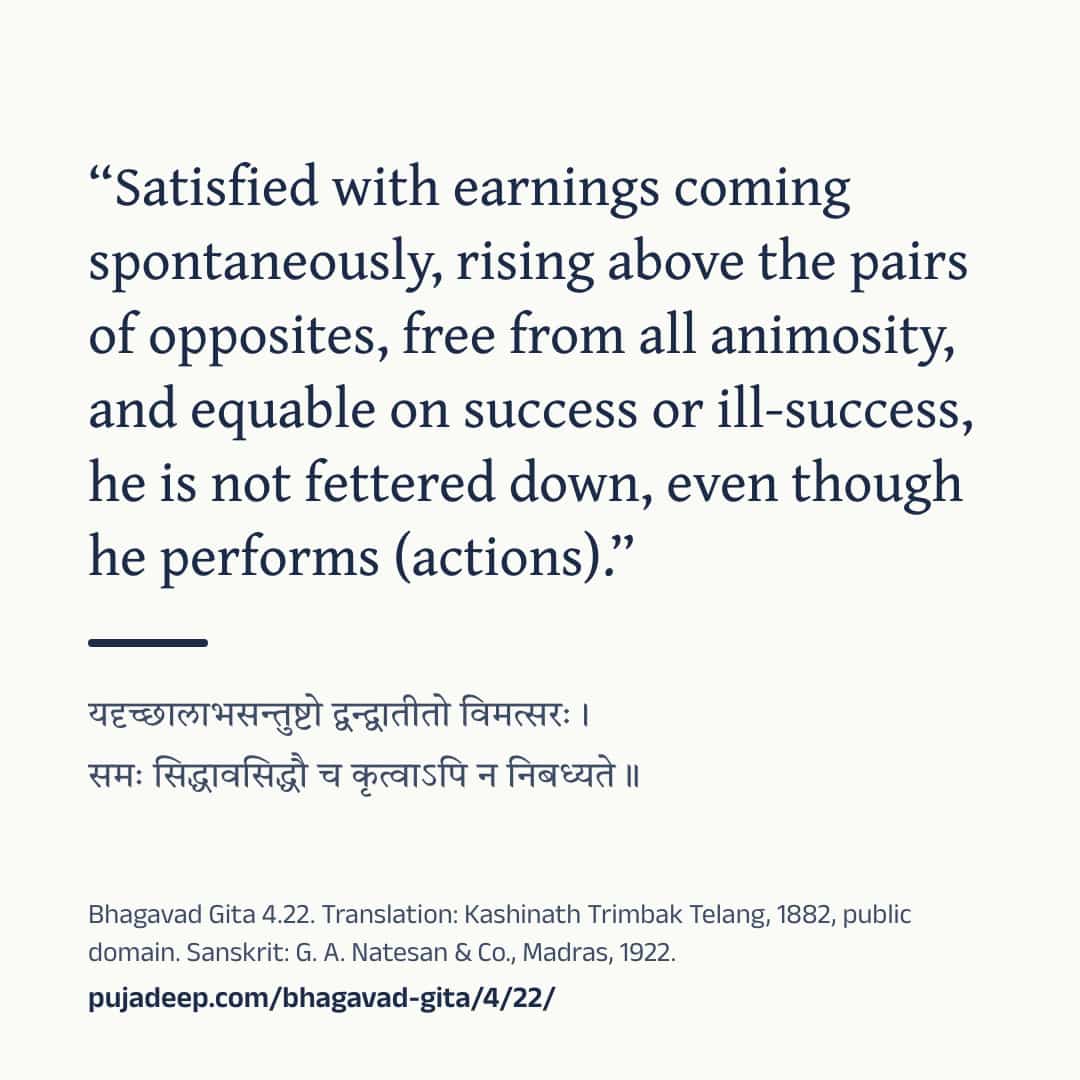
Drawing the picture
See the words
Bhagavad Gita 4.22

यदृच्छालाभसन्तुष्टो द्वन्द्वातीतो विमत्सरः ।
समः सिद्धावसिद्धौ च कृत्वाऽपि न निबध्यते ॥

“Satisfied with earnings coming spontaneously, rising above the pairs of opposites, free from all animosity, and equable on success or ill-success, he is not fettered down, even though he performs (actions).”
(K. T. Telang, The Bhagavadgîtâ (The Sacred Books of the East, vol. VIII, Oxford: Clarendon Press, 1882), p. 60, public domain)

“Content with whatsoever he receiveth, free from the pairs of opposites, without envy, balanced in success and failure, though he hath acted he is not bound;”
(Annie Besant, The Bhagavad Gîtâ, or The Lord's Song (London: Theosophical Publishing Society, 1895), p. 53, public domain)
This sentence goes on in 4.23.

“Content with what comes to him without effort, unaffected by the pairs of opposites, free from envy, even-minded in success and failure, though acting, he is not bound.”
(Swami Swarupananda, Srimad-Bhagavad-Gita (Mayavati: Prabuddha Bharata Press, 1909; first printed in Prabuddha Bharata, 1907–1909), pp. 94–95, public domain)

Sanskrit: G. A. Natesan & Co., Madras, 1922.
https://pujadeep.com/bhagavad-gita/4/22/ Nothing is sent from this site. Your own app sends it, to the chat you choose. The picture quotes the translation you chose on this page, with its name and year.
Sanskrit text: The Bhagavad-Gita, or The Lord's Song, with the text in Devanagari and an English translation, 1922. Meanings: written for Pujadeep and checked against the cited edition. Source and changes
Questions families ask
Who speaks Bhagavad Gita 4.22?
Krishna speaks this verse, in chapter 4 (Jnana Karma Sannyasa Yoga).
Where does the Sanskrit text come from?
Sanskrit text: The Bhagavad-Gita, or The Lord's Song, with the text in Devanagari and an English translation, 1922. Meanings: written for Pujadeep and checked against the cited edition. See the source
Is the meaning on this page a translation?
Explanation written for this site from the sources listed here, and checked against the cited edition. It is not a translation and not the only way to read the text. Free to quote with credit.
Source and licence
- Sanskrit text
- The Bhagavad-Gita, or The Lord's Song, with the text in Devanagari and an English translation (Annie Besant, G. A. Natesan & Co., Madras, 1922). Public domain. The Sanskrit on these pages was read from this printing’s page images.
- Translation
- The Bhagavadgîtâ with the Sanatsugâtîya and the Anugîtâ, translated by Kâshinâth Trimbak Telang (The Sacred Books of the East, vol. VIII, ed. F. Max Müller) (Kashinath Trimbak Telang, F. Max Müller, Clarendon Press, Oxford, 1882). Public domain. Shown verbatim, as printed.
- Translation
- The Bhagavad Gîtâ, or The Lord's Song, translated by Annie Besant (Annie Besant, Theosophical Publishing Society, London, 1895). Public domain. Shown verbatim, as printed.
- Translation
- Srimad-Bhagavad-Gita, with Sanskrit Text; Paraphrase with Word-by-word Literal Translation; English Rendering and Comments, Index, &c., by the Swami Swarupananda (Himalayan Series, No. XX) (Swami Swarupananda, The Editors and Publishers, Advaita Ashrama, Mayavati, Prabuddha Bharata Press, Mayavati, Almora, Himalayas, 1909). Public domain. Shown verbatim, as printed.
- Common wording
- In this text, 32 words follow today's common wording, checked against sanskritdocuments.org; Sanskrit Wikisource; Gita Press, Gorakhpur; GRETIL, Göttingen and Bhaktivedanta Book Trust.
- Our explanation
- Explanation written for this site from the sources listed here, and checked against the cited edition. It is not a translation and not the only way to read the text. Free to quote with credit.
- Checked
- Checked against the cited edition, October 15, 2026.
- Updated
- October 27, 2026