Bhagavad Gita 4.13: meaning and translation
Chapter 4: Jnana Karma Sannyasa Yoga. Krishna says
Krishna says that he created the four varṇas, the four classes of society, according to the division of qualities (guṇa) and work (karma).
Click or tap a word for its meaning and its dictionary page.
Text and layers
Text and layers
These choices stay in this browser.
Bhagavad Gita 4.13
चातुर्वर्ण्यं मया सृष्टं गुणकर्मविभागशः ।तस्य कर्तारमपि मां विद्ध्यकर्तारमव्ययम् ॥
Chaturvarnyam maya srishtam gunakarmavibhagashahTasya kartaramapi mam viddhyakartaramavyayam
cāturvarṇyaṃ mayā sṛṣṭaṃ guṇakarmavibhāgaśaḥ |tasya kartāramapi māṃ viddhyakartāramavyayam ||
Our explanation Krishna says that he created the four varṇas, the four classes of society, according to the division of qualities (guṇa) and work (karma). Though he made them, Arjuna should know him as one who does not act and does not change. Both old translations render varṇa as "castes".
हिंदी अर्थ कृष्ण कहते हैं कि चार वर्ण (समाज के चार वर्ग) उन्होंने गुण और कर्म के विभाग के अनुसार बनाए हैं। वे उनके रचयिता हैं, फिर भी अर्जुन उन्हें अकर्ता (जो कर्म नहीं करता) और अविनाशी जानें। दोनों पुराने अंग्रेज़ी अनुवाद वर्ण के लिए 'जाति' (कास्ट) शब्द रखते हैं।
Word by word
Every word, with its dictionary page
Word by word
- चातुर्वर्ण्यम् cāturvarṇyam · the four varṇas (classes) (noun (neuter), nominative singular) Dictionary: cāturvarṇya, Monier-Williams 1899, p. 392, col. 2 “the four castes”
- मया mayā · by "me" (Krishna) (pronoun, instrumental singular) Dictionary: 1. mad, Monier-Williams 1899, p. 777, col. 2 “base of the first pers. pron. in the sg. number (esp. in comp.)”
- सृष्टम् sṛṣṭam · was created (past participle (neuter), nominative singular) Dictionary: 1. sṛj, Monier-Williams 1899, p. 1245, col. 2 “to emit from one's self, i.e. create, procreate, produce, beget”
- गुणकर्मविभागशः guṇakarmavibhāgaśaḥ · by division of guṇa and karma (compound, adverb (-śas)) Dictionary: guṇa, Monier-Williams 1899, p. 357, col. 1 “a quality, peculiarity, attribute or property”; karman, Monier-Williams 1899, p. 258, col. 2 “act, action, performance, business”; vi-bhāga, Monier-Williams 1899, p. 977, col. 2 “distribution, apportionment”
- तस्य tasya · of it (pronoun (neuter), genitive singular) Dictionary: tad, Monier-Williams 1899, p. 434, col. 1 “m. he, f. she, n. it, that, this”
- कर्तारम् kartāram · the maker (noun (masculine), accusative singular) Dictionary: kartṛ, Monier-Williams 1899, p. 257, col. 3 “one who makes or does or acts or effects, a doer, maker, agent, author”
- अपि api · though (indeclinable) Dictionary: api, Monier-Williams 1899, p. 55, col. 1 “in the sense of even, also, very”
- माम् mām · "me" (Krishna) (pronoun, accusative singular) Dictionary: 1. mad, Monier-Williams 1899, p. 777, col. 2 “base of the first pers. pron. in the sg. number (esp. in comp.)”
- विद्धि viddhi · know (imperative, 2nd person singular) Dictionary: 1. vid, Monier-Williams 1899, p. 963, col. 2 “to know, understand, perceive, learn”
- अकर्तारम् akartāram · non-doer (noun (masculine), accusative singular) Dictionary: a-kartṛ, Monier-Williams 1899, p. 1, col. 3 “not an agent”
- अव्ययम् avyayam · unchanging (adjective (masculine), accusative singular) Dictionary: 2. a-vyaya, Monier-Williams 1899, p. 111, col. 3 “not liable to change, imperishable, undecaying”
Old translations
Kashinath Trimbak Telang, 1882. Public domain. Page 59.
The fourfold division of castes was created by me according to the apportionment of qualities and duties. But though I am its author, know me to be inexhaustible, and not the author.
Compare 3 translations
Kashinath Trimbak Telang, 1882. Public domain. Page 59.
The fourfold division of castes was created by me according to the apportionment of qualities and duties. But though I am its author, know me to be inexhaustible, and not the author.
You are reading this one
Annie Besant, 1895. Public domain. Page 51.
The four castes emanated from Me, by the different distribution of energies and actions; know Me to be the author of them, though the actionless and inexhaustible.
You are reading this one
Swami Swarupananda, 1909 (first printed 1907). Public domain. Page 90.
The fourfold caste was created by Me, by the differentiation of Guna and Karma. Though I am the author thereof, know Me to be non-doer, and changeless.
You are reading this one
Cite this verse
The translation: K. T. Telang, The Bhagavadgîtâ (The Sacred Books of the East, vol. VIII, Oxford: Clarendon Press, 1882), p. 59. Bhagavad Gita 4.13.
The translation: Annie Besant, The Bhagavad Gîtâ, or The Lord's Song (London: Theosophical Publishing Society, 1895), p. 51. Bhagavad Gita 4.13.
The translation: Swami Swarupananda, Srimad-Bhagavad-Gita (Mayavati: Prabuddha Bharata Press, 1909; first printed in Prabuddha Bharata, 1907–1909), p. 90. Bhagavad Gita 4.13.
Our explanation: “Bhagavad Gita 4.13: meaning and translation.” Pujadeep. Updated October 27, 2026. https://pujadeep.com/bhagavad-gita/4/13/
Pujadeep’s explanations are free to quote with credit: name Pujadeep and link to the page. How to credit
Classical readings, by school
No readings by school on this verse yet.
Share
Show the ways to share
Send one picture or the text to one chat. The picture names its source and the address of this page.
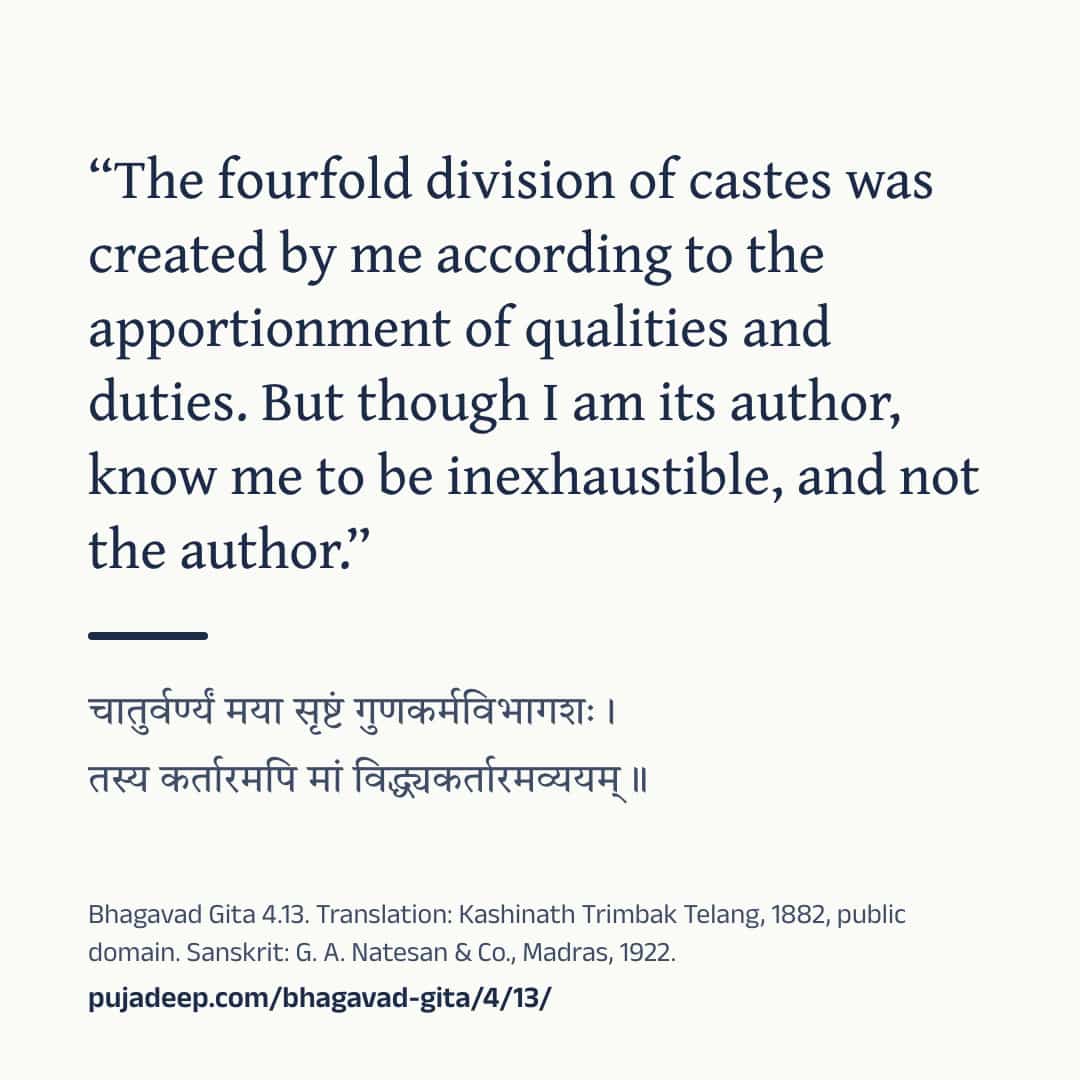
Drawing the picture
See the words
Bhagavad Gita 4.13

चातुर्वर्ण्यं मया सृष्टं गुणकर्मविभागशः ।
तस्य कर्तारमपि मां विद्ध्यकर्तारमव्ययम् ॥

“The fourfold division of castes was created by me according to the apportionment of qualities and duties. But though I am its author, know me to be inexhaustible, and not the author.”
(K. T. Telang, The Bhagavadgîtâ (The Sacred Books of the East, vol. VIII, Oxford: Clarendon Press, 1882), p. 59, public domain)

“The four castes emanated from Me, by the different distribution of energies and actions; know Me to be the author of them, though the actionless and inexhaustible.”
(Annie Besant, The Bhagavad Gîtâ, or The Lord's Song (London: Theosophical Publishing Society, 1895), p. 51, public domain)

“The fourfold caste was created by Me, by the differentiation of Guna and Karma. Though I am the author thereof, know Me to be non-doer, and changeless.”
(Swami Swarupananda, Srimad-Bhagavad-Gita (Mayavati: Prabuddha Bharata Press, 1909; first printed in Prabuddha Bharata, 1907–1909), p. 90, public domain)

Sanskrit: G. A. Natesan & Co., Madras, 1922.
https://pujadeep.com/bhagavad-gita/4/13/ Nothing is sent from this site. Your own app sends it, to the chat you choose. The picture quotes the translation you chose on this page, with its name and year.
Sanskrit text: The Bhagavad-Gita, or The Lord's Song, with the text in Devanagari and an English translation, 1922. Meanings: written for Pujadeep and checked against the cited edition. Source and changes
Questions families ask
Who speaks Bhagavad Gita 4.13?
Krishna speaks this verse, in chapter 4 (Jnana Karma Sannyasa Yoga).
Where does the Sanskrit text come from?
Sanskrit text: The Bhagavad-Gita, or The Lord's Song, with the text in Devanagari and an English translation, 1922. Meanings: written for Pujadeep and checked against the cited edition. See the source
Is the meaning on this page a translation?
Explanation written for this site from the sources listed here, and checked against the cited edition. It is not a translation and not the only way to read the text. Free to quote with credit.
Source and licence
- Sanskrit text
- The Bhagavad-Gita, or The Lord's Song, with the text in Devanagari and an English translation (Annie Besant, G. A. Natesan & Co., Madras, 1922). Public domain. The Sanskrit on these pages was read from this printing’s page images.
- Translation
- The Bhagavadgîtâ with the Sanatsugâtîya and the Anugîtâ, translated by Kâshinâth Trimbak Telang (The Sacred Books of the East, vol. VIII, ed. F. Max Müller) (Kashinath Trimbak Telang, F. Max Müller, Clarendon Press, Oxford, 1882). Public domain. Shown verbatim, as printed.
- Translation
- The Bhagavad Gîtâ, or The Lord's Song, translated by Annie Besant (Annie Besant, Theosophical Publishing Society, London, 1895). Public domain. Shown verbatim, as printed.
- Translation
- Srimad-Bhagavad-Gita, with Sanskrit Text; Paraphrase with Word-by-word Literal Translation; English Rendering and Comments, Index, &c., by the Swami Swarupananda (Himalayan Series, No. XX) (Swami Swarupananda, The Editors and Publishers, Advaita Ashrama, Mayavati, Prabuddha Bharata Press, Mayavati, Almora, Himalayas, 1909). Public domain. Shown verbatim, as printed.
- Common wording
- In this text, 32 words follow today's common wording, checked against sanskritdocuments.org; Sanskrit Wikisource; Gita Press, Gorakhpur; GRETIL, Göttingen and Bhaktivedanta Book Trust.
- Our explanation
- Explanation written for this site from the sources listed here, and checked against the cited edition. It is not a translation and not the only way to read the text. Free to quote with credit.
- Checked
- Checked against the cited edition, October 15, 2026.
- Updated
- October 27, 2026