Bhagavad Gita 4.7: meaning and translation
Chapter 4: Jnana Karma Sannyasa Yoga. Krishna says
Krishna tells Arjuna that whenever dharma declines and adharma rises, he brings himself forth.
Click or tap a word for its meaning and its dictionary page.
Text and layers
Text and layers
These choices stay in this browser.
Bhagavad Gita 4.7
यदा यदा हि धर्मस्य ग्लानिर्भवति भारत ।अभ्युत्थानमधर्मस्य तदाऽऽत्मानं सृजाम्यहम् ॥
Yada yada hi dharmasya glanirbhavati bharataAbhyutthanamadharmasya tadatmanam srijamyaham
yadā yadā hi dharmasya glānirbhavati bhārata |abhyutthānamadharmasya tadā’’tmānaṃ sṛjāmyaham ||
Our explanation Krishna tells Arjuna that whenever dharma declines and adharma rises, he brings himself forth. This is one of the best-known verses of the Gita. Besant's footnote explains adharma as the opposite of dharma: all that is disorderly, against the nature of things.
हिंदी अर्थ कृष्ण अर्जुन से कहते हैं कि जब-जब धर्म की हानि होती है और अधर्म बढ़ता है, तब-तब वे स्वयं को प्रकट करते हैं। यह गीता के सबसे प्रसिद्ध श्लोकों में से एक है। बेसेंट की टिप्पणी के अनुसार अधर्म धर्म का उलटा है: जो कुछ अव्यवस्थित है और चीज़ों के स्वभाव के विरुद्ध है।
Word by word
Every word, with its dictionary page
Word by word
- यदा yadā · when (indeclinable) Dictionary: yadā, Monier-Williams 1899, p. 844, col. 1 “when, at what time, whenever”
- यदा yadā · (when)ever (indeclinable) Dictionary: yadā, Monier-Williams 1899, p. 844, col. 1 “when, at what time, whenever”
- हि hi · indeed (indeclinable) Dictionary: 2. hi, Monier-Williams 1899, p. 1297, col. 3 “for, because, on account of”
- धर्मस्य dharmasya · of dharma (noun (masculine), genitive singular) Dictionary: 1. dharma, Monier-Williams 1899, p. 510, col. 3 “usage, practice, customary observance or prescribed conduct, duty”
- ग्लानिः glāniḥ · decline (noun (feminine), nominative singular) Dictionary: glāni, Monier-Williams 1899, p. 374, col. 3 “decrease”
- भवति bhavati · there is (present, 3rd person singular) Dictionary: 1. bhū, Monier-Williams 1899, p. 760, col. 2 “to become, be”
- भारत bhārata · O Bharata (Arjuna) (noun (masculine), vocative singular) Dictionary: bhārata, Monier-Williams 1899, p. 753, col. 1
- अभ्युत्थानम् abhyutthānam · rise (noun (neuter), nominative singular) Dictionary: abhy-utthāna, Monier-Williams 1899, p. 78, col. 1 “elevation, gaining a high position”
- अधर्मस्य adharmasya · of adharma (noun (masculine), genitive singular) Dictionary: a-dharma, Monier-Williams 1899, p. 20, col. 1 “unrighteousness, injustice, irreligion, wickedness”
- तदा tadā · then (indeclinable) Dictionary: tadā, Monier-Williams 1899, p. 434, col. 3 “at that time, then, in that case”
- आत्मानम् ātmānam · "myself" (noun (masculine), accusative singular) Dictionary: ātman, Monier-Williams 1899, p. 135, col. 1 “the breath, RV.; the soul, principle of life and sensation”
- सृजामि sṛjāmi · bring forth (present, 1st person singular) Dictionary: 1. sṛj, Monier-Williams 1899, p. 1245, col. 2 “to emit from one's self, i.e. create, procreate, produce, beget”
- अहम् aham · "I" (Krishna) (pronoun, nominative singular) Dictionary: aham, Monier-Williams 1899, p. 124, col. 2 “nom. sg. ‘I,’”
1 printing differs
Edition differences. Another printing or text reads this place differently.
- Spelling A digital text reads Same words. The 1922 edition marks the merged vowel with an avagraha (ऽ); this e-text does not. Edition: तदाऽऽत्मानं.
Old translations
Kashinath Trimbak Telang, 1882. Public domain. Page 59.
Whensoever, O descendant of Bharata! piety languishes, and impiety is in the ascendant, I create myself.
Compare 3 translations
Kashinath Trimbak Telang, 1882. Public domain. Page 59.
Whensoever, O descendant of Bharata! piety languishes, and impiety is in the ascendant, I create myself.
You are reading this one
Annie Besant, 1895. Public domain. Page 50.
Whenever there is decay of Dharma, O Bhârata, and there is exaltation of Adharma,1 then I Myself come forth;
This sentence goes on in 4.8.
Footnotes (the translator’s own) - The opposite of Dharma, all that is disorderly, against the nature of things. ↩
You are reading this one
Swami Swarupananda, 1909 (first printed 1907). Public domain. Page 87.
Whenever, O descendant of Bharata, there is decline of Dharma, and rise of Adharma, then I body Myself forth.
You are reading this one
Cite this verse
The translation: K. T. Telang, The Bhagavadgîtâ (The Sacred Books of the East, vol. VIII, Oxford: Clarendon Press, 1882), p. 59. Bhagavad Gita 4.7.
The translation: Annie Besant, The Bhagavad Gîtâ, or The Lord's Song (London: Theosophical Publishing Society, 1895), p. 50. Bhagavad Gita 4.7.
The translation: Swami Swarupananda, Srimad-Bhagavad-Gita (Mayavati: Prabuddha Bharata Press, 1909; first printed in Prabuddha Bharata, 1907–1909), p. 87. Bhagavad Gita 4.7.
Our explanation: “Bhagavad Gita 4.7: meaning and translation.” Pujadeep. Updated October 27, 2026. https://pujadeep.com/bhagavad-gita/4/7/
Pujadeep’s explanations are free to quote with credit: name Pujadeep and link to the page. How to credit
Classical readings, by school
Each reading is named by its school. None is presented as the only meaning.
What Advaita, Vishishtadvaita and Dvaita teach, in short
Shankara Advaita
Shankara takes dharma here as the dharma of the varṇas and of the āśramas (the stages of life), which is the means both to worldly well-being and to liberation. When it declines, the Lord manifests himself through māyā.
Source: The Bhagavad-Gita, with the commentary of Sri Sankaracharya, translated by A. Mahadeva Sastri (2nd ed., Mysore: G. T. A. Printing Works, 1901), commentary on 4.7, p. 107. Summarised in our own words; none of its text is reproduced.
Ramanuja Vishishtadvaita
Ramanuja says there are no fixed times for the Lord's descents. Whenever the dharma practised by the four varṇas and āśramas declines, and wherever adharma grows, he appears of his own free will.
Source: Sri Bhagavad-Gita with Sri Ramanujacharya's Visishtadvaita commentary, translated by A. Govindacharya (Madras, 1898), commentary on 4.7, pp. 140–141. Summarised in our own words; none of its text is reproduced.
This verse is on our page of well-known Gita verses, by theme
Share
Show the ways to share
Send one picture or the text to one chat. The picture names its source and the address of this page.
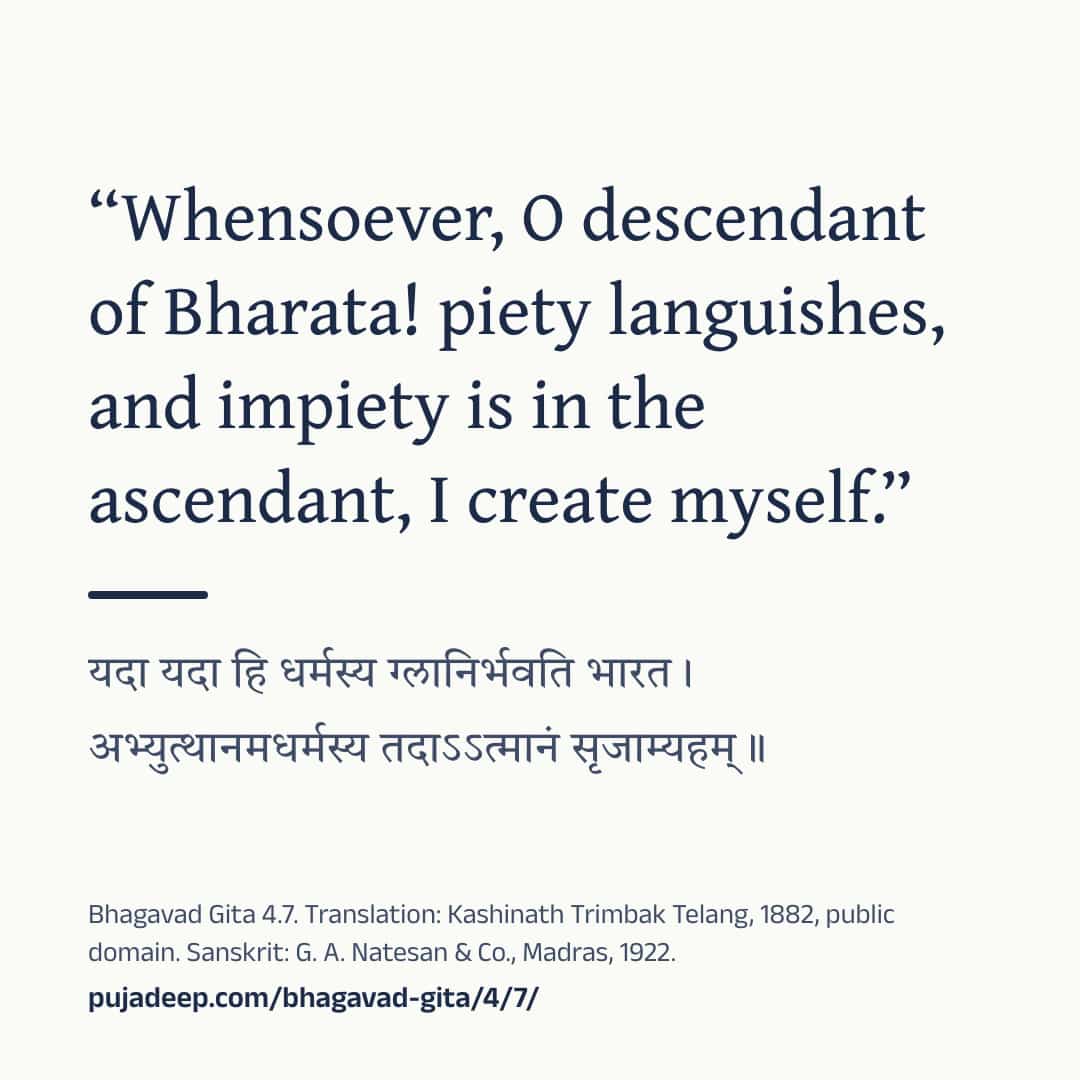
Drawing the picture
See the words
Bhagavad Gita 4.7

यदा यदा हि धर्मस्य ग्लानिर्भवति भारत ।
अभ्युत्थानमधर्मस्य तदाऽऽत्मानं सृजाम्यहम् ॥

“Whensoever, O descendant of Bharata! piety languishes, and impiety is in the ascendant, I create myself.”
(K. T. Telang, The Bhagavadgîtâ (The Sacred Books of the East, vol. VIII, Oxford: Clarendon Press, 1882), p. 59, public domain)

“Whenever there is decay of Dharma, O Bhârata, and there is exaltation of Adharma, then I Myself come forth;”
(Annie Besant, The Bhagavad Gîtâ, or The Lord's Song (London: Theosophical Publishing Society, 1895), p. 50, public domain)
This sentence goes on in 4.8.

“Whenever, O descendant of Bharata, there is decline of Dharma, and rise of Adharma, then I body Myself forth.”
(Swami Swarupananda, Srimad-Bhagavad-Gita (Mayavati: Prabuddha Bharata Press, 1909; first printed in Prabuddha Bharata, 1907–1909), p. 87, public domain)

Sanskrit: G. A. Natesan & Co., Madras, 1922.
https://pujadeep.com/bhagavad-gita/4/7/ Nothing is sent from this site. Your own app sends it, to the chat you choose. The picture quotes the translation you chose on this page, with its name and year.
Sanskrit text: The Bhagavad-Gita, or The Lord's Song, with the text in Devanagari and an English translation, 1922. Meanings: written for Pujadeep and checked against the cited edition. Source and changes
Questions families ask
Who speaks Bhagavad Gita 4.7?
Krishna speaks this verse, in chapter 4 (Jnana Karma Sannyasa Yoga).
Where does the Sanskrit text come from?
Sanskrit text: The Bhagavad-Gita, or The Lord's Song, with the text in Devanagari and an English translation, 1922. Meanings: written for Pujadeep and checked against the cited edition. See the source
Is the meaning on this page a translation?
Explanation written for this site from the sources listed here, and checked against the cited edition. It is not a translation and not the only way to read the text. Free to quote with credit.
Source and licence
- Sanskrit text
- The Bhagavad-Gita, or The Lord's Song, with the text in Devanagari and an English translation (Annie Besant, G. A. Natesan & Co., Madras, 1922). Public domain. The Sanskrit on these pages was read from this printing’s page images.
- Translation
- The Bhagavadgîtâ with the Sanatsugâtîya and the Anugîtâ, translated by Kâshinâth Trimbak Telang (The Sacred Books of the East, vol. VIII, ed. F. Max Müller) (Kashinath Trimbak Telang, F. Max Müller, Clarendon Press, Oxford, 1882). Public domain. Shown verbatim, as printed.
- Translation
- The Bhagavad Gîtâ, or The Lord's Song, translated by Annie Besant (Annie Besant, Theosophical Publishing Society, London, 1895). Public domain. Shown verbatim, as printed.
- Translation
- Srimad-Bhagavad-Gita, with Sanskrit Text; Paraphrase with Word-by-word Literal Translation; English Rendering and Comments, Index, &c., by the Swami Swarupananda (Himalayan Series, No. XX) (Swami Swarupananda, The Editors and Publishers, Advaita Ashrama, Mayavati, Prabuddha Bharata Press, Mayavati, Almora, Himalayas, 1909). Public domain. Shown verbatim, as printed.
- Commentary
- The Bhagavad-Gita, with the commentary of Sri Sankaracharya, translated by A. Mahadeva Sastri (2nd ed., Mysore: G. T. A. Printing Works, 1901) (Public-domain scan, University of California Libraries). Summarised in our own words; none of its text is reproduced.
- Commentary
- Sri Bhagavad-Gita with Sri Ramanujacharya's Visishtadvaita commentary, translated by A. Govindacharya (Madras, 1898) (Scan uploaded to archive.org (folkscanomy collection)). Summarised in our own words; none of its text is reproduced.
- Common wording
- In this text, 32 words follow today's common wording, checked against sanskritdocuments.org; Sanskrit Wikisource; Gita Press, Gorakhpur; GRETIL, Göttingen and Bhaktivedanta Book Trust.
- Our explanation
- Explanation written for this site from the sources listed here, and checked against the cited edition. It is not a translation and not the only way to read the text. Free to quote with credit.
- Checked
- Checked against the cited edition, October 15, 2026.
- Updated
- October 27, 2026