Bhagavad Gita 4.8: meaning and translation
Chapter 4: Jnana Karma Sannyasa Yoga. Krishna says
Krishna says why he comes: to protect the good, to destroy those who do evil, and to set dharma firmly in place.
Click or tap a word for its meaning and its dictionary page.
Text and layers
Text and layers
These choices stay in this browser.
Bhagavad Gita 4.8
परित्राणाय साधूनां विनाशाय च दुष्कृताम् ।धर्मसंस्थापनार्थाय सम्भवामि युगे युगे ॥
Paritranaya sadhunam vinashaya cha dushkritamDharmasansthapanarthaya sambhavami yuge yuge
paritrāṇāya sādhūnāṃ vināśāya ca duṣkṛtām |dharmasaṃsthāpanārthāya sambhavāmi yuge yuge ||
Our explanation Krishna says why he comes: to protect the good, to destroy those who do evil, and to set dharma firmly in place. For this he is born in age after age (yuge yuge). Together, 4.7 and 4.8 are the Gita's own words on why the divine takes birth, the teaching of avatāra.
हिंदी अर्थ कृष्ण बताते हैं कि वे क्यों आते हैं: सज्जनों की रक्षा के लिए, बुरे काम करने वालों के विनाश के लिए, और धर्म को दृढ़ता से स्थापित करने के लिए। इसके लिए वे युग-युग में जन्म लेते हैं। श्लोक 7 और 8 मिलकर गीता के अपने शब्दों में बताते हैं कि भगवान अवतार क्यों लेते हैं।
Word by word
Every word, with its dictionary page
Word by word
- परित्राणाय paritrāṇāya · to protect (noun (neuter), dative singular) Dictionary: pari-trāṇa, Monier-Williams 1899, p. 595, col. 3 “rescue, preservation, deliverance”
- साधूनाम् sādhūnām · of the good (noun (masculine), genitive plural) Dictionary: sādhu, Monier-Williams 1899, p. 1201, col. 2 “good, virtuous, honourable, righteous ... a good or virtuous or honest man”
- विनाशाय vināśāya · for the destruction (noun (masculine), dative singular) Dictionary: vi-nāśa, Monier-Williams 1899, p. 969, col. 3 “utter loss, annihilation, perdition, destruction, decay, death”
- च ca · and (indeclinable) Dictionary: 2. ca, Monier-Williams 1899, p. 380, col. 1 “and, both, also, moreover, as well as”
- दुष्कृताम् duṣkṛtām · of evil-doers (noun (masculine), genitive plural) Dictionary: duṣ-kṛt, Monier-Williams 1899, p. 487, col. 3 “acting wickedly, criminal, evil-doer”
- धर्मसंस्थापनार्थाय dharmasaṃsthāpanārthāya · to establish dharma firmly (compound (masculine), dative singular) Dictionary: 1. dharma, Monier-Williams 1899, p. 510, col. 3 “usage, practice, customary observance or prescribed conduct, duty”; saṃ-sthāpana, Monier-Williams 1899, p. 1121, col. 3 “fixing, setting up, raising, erecting”; artha, Monier-Williams 1899, p. 90, col. 3 “aim, purpose”
- सम्भवामि sambhavāmi · come into being (present, 1st person singular) Dictionary: sam-bhū, Monier-Williams 1899, p. 1178, col. 3 “to be or come together, assemble, meet, be joined or united with”
- युगे yuge · in age (noun (neuter), locative singular) Dictionary: yuga, Monier-Williams 1899, p. 854, col. 1 “an age of the world, long mundane period of years”
- युगे yuge · after age (noun (neuter), locative singular) Dictionary: yuga, Monier-Williams 1899, p. 854, col. 1 “an age of the world, long mundane period of years”
Old translations
Kashinath Trimbak Telang, 1882. Public domain. Page 59.
I am born age after age, for the protection of the good, for the destruction of evil-doers, and the establishment of piety.
Compare 3 translations
Kashinath Trimbak Telang, 1882. Public domain. Page 59.
I am born age after age, for the protection of the good, for the destruction of evil-doers, and the establishment of piety.
You are reading this one
Annie Besant, 1895. Public domain. Page 50.
For the protection of the good, for the destruction of evil-doers, for the sake of firmly establishing Dharma, I am born from age to age.
This sentence begins in 4.7.
You are reading this one
Swami Swarupananda, 1909 (first printed 1907). Public domain. Page 87.
For the protection of the good, for the destruction of the wicked, and for the establishment of Dharma, I come into being in every age.
You are reading this one
Cite this verse
The translation: K. T. Telang, The Bhagavadgîtâ (The Sacred Books of the East, vol. VIII, Oxford: Clarendon Press, 1882), p. 59. Bhagavad Gita 4.8.
The translation: Annie Besant, The Bhagavad Gîtâ, or The Lord's Song (London: Theosophical Publishing Society, 1895), p. 50. Bhagavad Gita 4.8.
The translation: Swami Swarupananda, Srimad-Bhagavad-Gita (Mayavati: Prabuddha Bharata Press, 1909; first printed in Prabuddha Bharata, 1907–1909), p. 87. Bhagavad Gita 4.8.
Our explanation: “Bhagavad Gita 4.8: meaning and translation.” Pujadeep. Updated October 27, 2026. https://pujadeep.com/bhagavad-gita/4/8/
Pujadeep’s explanations are free to quote with credit: name Pujadeep and link to the page. How to credit
Classical readings, by school
Each reading is named by its school. None is presented as the only meaning.
What Advaita, Vishishtadvaita and Dvaita teach, in short
Shankara Advaita
Shankara explains 'the good' briefly as those who walk the right path, and reads the verse as the purpose of the Lord's appearing: to protect them, to destroy evil-doers and to establish dharma firmly.
Source: The Bhagavad-Gita, with the commentary of Sri Sankaracharya, translated by A. Mahadeva Sastri (2nd ed., Mysore: G. T. A. Printing Works, 1901), commentary on 4.8, p. 107. Summarised in our own words; none of its text is reproduced.
Ramanuja Vishishtadvaita
Ramanuja says 'the good' (sādhus) are devotees who cannot bear to be without the sight of the Lord. Protecting them means letting them see him, his deeds, and speak with him. 'Age after age' means whenever he chooses, not only in particular yugas.
Source: Sri Bhagavad-Gita with Sri Ramanujacharya's Visishtadvaita commentary, translated by A. Govindacharya (Madras, 1898), commentary on 4.8, pp. 141–142. Summarised in our own words; none of its text is reproduced.
This verse is on our page of well-known Gita verses, by theme
Share
Show the ways to share
Send one picture or the text to one chat. The picture names its source and the address of this page.
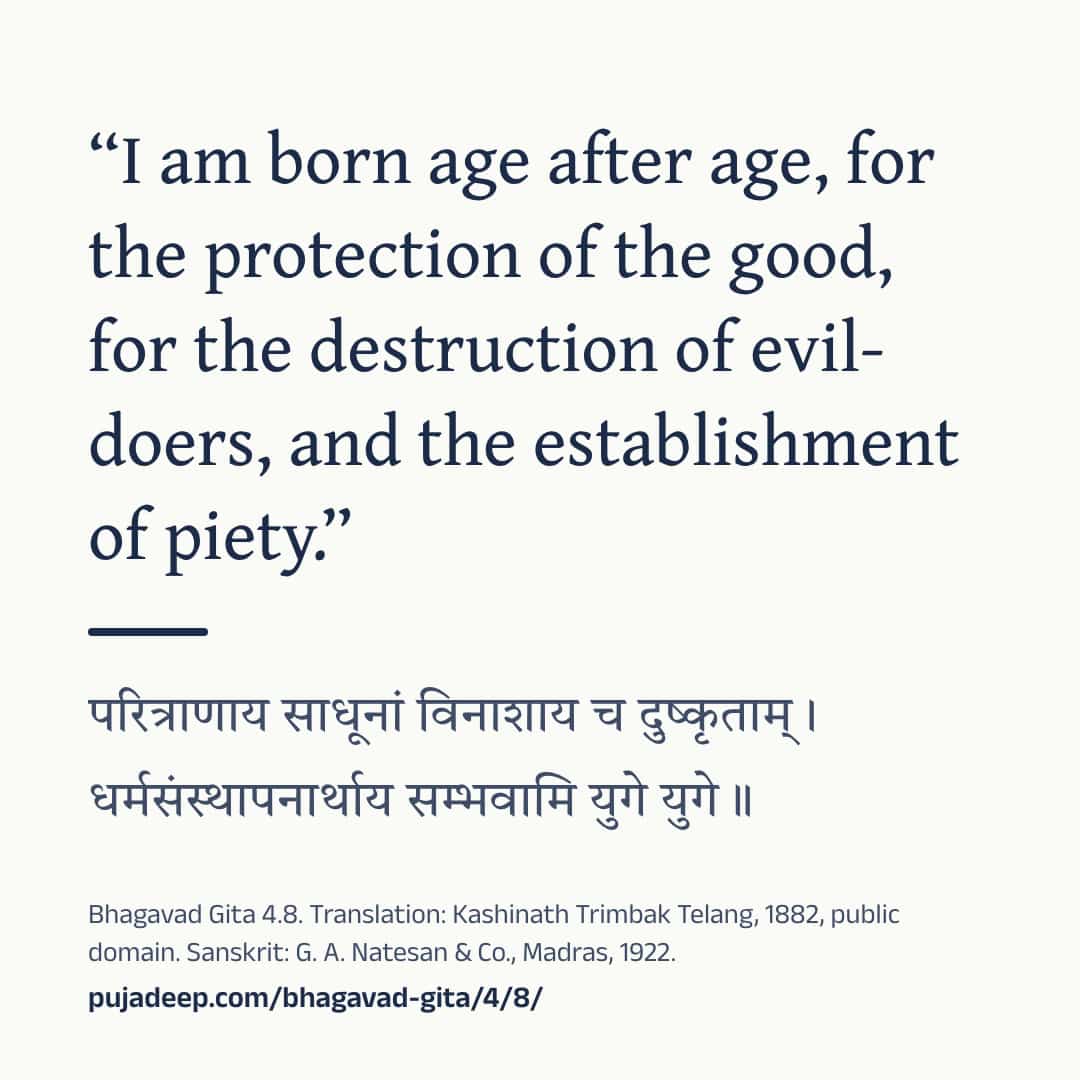
Drawing the picture
See the words
Bhagavad Gita 4.8

परित्राणाय साधूनां विनाशाय च दुष्कृताम् ।
धर्मसंस्थापनार्थाय सम्भवामि युगे युगे ॥

“I am born age after age, for the protection of the good, for the destruction of evil-doers, and the establishment of piety.”
(K. T. Telang, The Bhagavadgîtâ (The Sacred Books of the East, vol. VIII, Oxford: Clarendon Press, 1882), p. 59, public domain)

“For the protection of the good, for the destruction of evil-doers, for the sake of firmly establishing Dharma, I am born from age to age.”
(Annie Besant, The Bhagavad Gîtâ, or The Lord's Song (London: Theosophical Publishing Society, 1895), p. 50, public domain)
This sentence begins in 4.7.

“For the protection of the good, for the destruction of the wicked, and for the establishment of Dharma, I come into being in every age.”
(Swami Swarupananda, Srimad-Bhagavad-Gita (Mayavati: Prabuddha Bharata Press, 1909; first printed in Prabuddha Bharata, 1907–1909), p. 87, public domain)

Sanskrit: G. A. Natesan & Co., Madras, 1922.
https://pujadeep.com/bhagavad-gita/4/8/ Nothing is sent from this site. Your own app sends it, to the chat you choose. The picture quotes the translation you chose on this page, with its name and year.
Sanskrit text: The Bhagavad-Gita, or The Lord's Song, with the text in Devanagari and an English translation, 1922. Meanings: written for Pujadeep and checked against the cited edition. Source and changes
Questions families ask
Who speaks Bhagavad Gita 4.8?
Krishna speaks this verse, in chapter 4 (Jnana Karma Sannyasa Yoga).
Where does the Sanskrit text come from?
Sanskrit text: The Bhagavad-Gita, or The Lord's Song, with the text in Devanagari and an English translation, 1922. Meanings: written for Pujadeep and checked against the cited edition. See the source
Is the meaning on this page a translation?
Explanation written for this site from the sources listed here, and checked against the cited edition. It is not a translation and not the only way to read the text. Free to quote with credit.
Source and licence
- Sanskrit text
- The Bhagavad-Gita, or The Lord's Song, with the text in Devanagari and an English translation (Annie Besant, G. A. Natesan & Co., Madras, 1922). Public domain. The Sanskrit on these pages was read from this printing’s page images.
- Translation
- The Bhagavadgîtâ with the Sanatsugâtîya and the Anugîtâ, translated by Kâshinâth Trimbak Telang (The Sacred Books of the East, vol. VIII, ed. F. Max Müller) (Kashinath Trimbak Telang, F. Max Müller, Clarendon Press, Oxford, 1882). Public domain. Shown verbatim, as printed.
- Translation
- The Bhagavad Gîtâ, or The Lord's Song, translated by Annie Besant (Annie Besant, Theosophical Publishing Society, London, 1895). Public domain. Shown verbatim, as printed.
- Translation
- Srimad-Bhagavad-Gita, with Sanskrit Text; Paraphrase with Word-by-word Literal Translation; English Rendering and Comments, Index, &c., by the Swami Swarupananda (Himalayan Series, No. XX) (Swami Swarupananda, The Editors and Publishers, Advaita Ashrama, Mayavati, Prabuddha Bharata Press, Mayavati, Almora, Himalayas, 1909). Public domain. Shown verbatim, as printed.
- Commentary
- The Bhagavad-Gita, with the commentary of Sri Sankaracharya, translated by A. Mahadeva Sastri (2nd ed., Mysore: G. T. A. Printing Works, 1901) (Public-domain scan, University of California Libraries). Summarised in our own words; none of its text is reproduced.
- Commentary
- Sri Bhagavad-Gita with Sri Ramanujacharya's Visishtadvaita commentary, translated by A. Govindacharya (Madras, 1898) (Scan uploaded to archive.org (folkscanomy collection)). Summarised in our own words; none of its text is reproduced.
- Common wording
- In this text, 32 words follow today's common wording, checked against sanskritdocuments.org; Sanskrit Wikisource; Gita Press, Gorakhpur; GRETIL, Göttingen and Bhaktivedanta Book Trust.
- Our explanation
- Explanation written for this site from the sources listed here, and checked against the cited edition. It is not a translation and not the only way to read the text. Free to quote with credit.
- Checked
- Checked against the cited edition, October 15, 2026.
- Updated
- October 27, 2026