Bhagavad Gita 4.18: meaning and translation
Chapter 4: Jnana Karma Sannyasa Yoga. Krishna says
Krishna says that the one who sees inaction in action and action in inaction is wise among people.
Click or tap a word for its meaning and its dictionary page.
Text and layers
Text and layers
These choices stay in this browser.
Bhagavad Gita 4.18
कर्मण्यकर्म यः पश्येदकर्मणि च कर्म यः ।स बुद्धिमान्मनुष्येषु स युक्तः कृत्स्नकर्मकृत् ॥
Karmanyakarma yah pashyedakarmani cha karma yahSa buddhimanmanushyeshu sa yuktah kritsnakarmakrit
karmaṇyakarma yaḥ paśyedakarmaṇi ca karma yaḥ |sa buddhimānmanuṣyeṣu sa yuktaḥ kṛtsnakarmakṛt ||
Our explanation Krishna says that the one who sees inaction in action and action in inaction is wise among people. Such a person is steady in yoga (yukta) while doing all their work. Commentators explain this paradox in different ways.
हिंदी अर्थ कृष्ण कहते हैं कि जो कर्म में अकर्म और अकर्म में कर्म देखता है, वही मनुष्यों में बुद्धिमान है। वह सब कर्म करते हुए भी योग में स्थित (युक्त) रहता है। टीकाकार इस विरोधाभास को अलग-अलग ढंग से समझाते हैं।
Word by word
Every word, with its dictionary page
Word by word
- कर्मणि karmaṇi · in action (noun (neuter), locative singular) Dictionary: karman, Monier-Williams 1899, p. 258, col. 2 “act, action, performance, business”
- अकर्म akarma · inaction (noun (neuter), accusative singular) Dictionary: a-karman, Monier-Williams 1899, p. 2, col. 1 “absence of work”
- यः yaḥ · who (pronoun (masculine), nominative singular) Dictionary: yad, Monier-Williams 1899, p. 844, col. 2 “who, which, what, whichever, whatever, that”
- पश्येत् paśyet · sees (optative, 3rd person singular) Dictionary: 1. paś, Monier-Williams 1899, p. 611, col. 2 “behold, look at, observe, perceive, notice”
- अकर्मणि akarmaṇi · in inaction (noun (neuter), locative singular) Dictionary: a-karman, Monier-Williams 1899, p. 2, col. 1 “absence of work”
- च ca · and (indeclinable) Dictionary: 2. ca, Monier-Williams 1899, p. 380, col. 1 “and, both, also, moreover, as well as”
- कर्म karma · action (noun (neuter), accusative singular) Dictionary: karman, Monier-Williams 1899, p. 258, col. 2 “act, action, performance, business”
- यः yaḥ · who (pronoun (masculine), nominative singular) Dictionary: yad, Monier-Williams 1899, p. 844, col. 2 “who, which, what, whichever, whatever, that”
- सः saḥ · he (pronoun (masculine), nominative singular) Dictionary: tad, Monier-Williams 1899, p. 434, col. 1 “m. he, f. she, n. it, that, this”
- बुद्धिमान् buddhimān · wise (adjective (masculine), nominative singular) Dictionary: buddhi-mat, Monier-Williams 1899, p. 734, col. 1 “endowed with understanding, intelligent, learned, wise”
- मनुष्येषु manuṣyeṣu · among people (noun (masculine), locative plural) Dictionary: manuṣya, Monier-Williams 1899, p. 784, col. 3 “a man, human being”
- सः saḥ · he (pronoun (masculine), nominative singular) Dictionary: tad, Monier-Williams 1899, p. 434, col. 1 “m. he, f. she, n. it, that, this”
- युक्तः yuktaḥ · steady in yoga (past participle (masculine), nominative singular) Dictionary: yukta, Monier-Williams 1899, p. 853, col. 2 “yoked or joined or fastened or attached or harnessed”
- कृत्स्नकर्मकृत् kṛtsnakarmakṛt · doer of all actions (compound (masculine), nominative singular) Dictionary: kṛtsna, Monier-Williams 1899, p. 304, col. 3 “all, whole, entire”; karman, Monier-Williams 1899, p. 258, col. 2 “act, action, performance, business”; 1. kṛt, Monier-Williams 1899, p. 301, col. 3 “making, doing, performing, accomplishing, effecting”
Old translations
Kashinath Trimbak Telang, 1882. Public domain. Page 60.
He is wise among men, he is possessed of devotion, and performs all actions1, who sees inaction in action, and action in inaction.
Footnotes (the translator’s own) - Devoted though performing all actions. ↩
Compare 3 translations
Kashinath Trimbak Telang, 1882. Public domain. Page 60.
He is wise among men, he is possessed of devotion, and performs all actions1, who sees inaction in action, and action in inaction.
Footnotes (the translator’s own) - Devoted though performing all actions. ↩
You are reading this one
Annie Besant, 1895. Public domain. Page 52.
He who can see inaction in action, and action in inaction, he is spiritually wise among men, he is harmonious, he hath performed all action.
You are reading this one
Swami Swarupananda, 1909 (first printed 1907). Public domain. Page 93.
He who sees inaction in action, and action, in inaction, he is intelligent among men, he is a Yogi and a doer of all action.
You are reading this one
Cite this verse
The translation: K. T. Telang, The Bhagavadgîtâ (The Sacred Books of the East, vol. VIII, Oxford: Clarendon Press, 1882), p. 60. Bhagavad Gita 4.18.
The translation: Annie Besant, The Bhagavad Gîtâ, or The Lord's Song (London: Theosophical Publishing Society, 1895), p. 52. Bhagavad Gita 4.18.
The translation: Swami Swarupananda, Srimad-Bhagavad-Gita (Mayavati: Prabuddha Bharata Press, 1909; first printed in Prabuddha Bharata, 1907–1909), p. 93. Bhagavad Gita 4.18.
Our explanation: “Bhagavad Gita 4.18: meaning and translation.” Pujadeep. Updated October 27, 2026. https://pujadeep.com/bhagavad-gita/4/18/
Pujadeep’s explanations are free to quote with credit: name Pujadeep and link to the page. How to credit
Classical readings, by school
No readings by school on this verse yet.
Share
Show the ways to share
Send one picture or the text to one chat. The picture names its source and the address of this page.
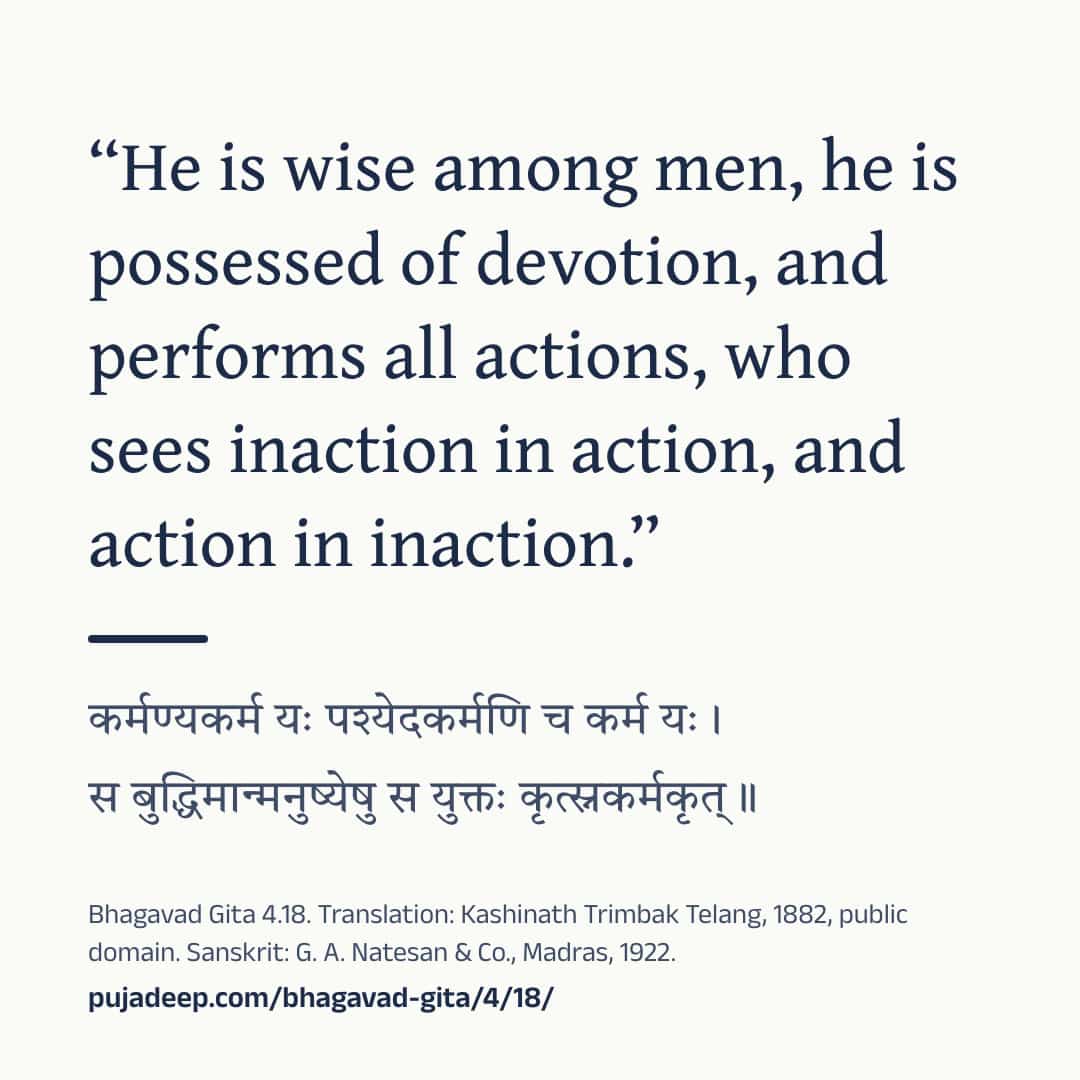
Drawing the picture
See the words
Bhagavad Gita 4.18

कर्मण्यकर्म यः पश्येदकर्मणि च कर्म यः ।
स बुद्धिमान्मनुष्येषु स युक्तः कृत्स्नकर्मकृत् ॥

“He is wise among men, he is possessed of devotion, and performs all actions, who sees inaction in action, and action in inaction.”
(K. T. Telang, The Bhagavadgîtâ (The Sacred Books of the East, vol. VIII, Oxford: Clarendon Press, 1882), p. 60, public domain)

“He who can see inaction in action, and action in inaction, he is spiritually wise among men, he is harmonious, he hath performed all action.”
(Annie Besant, The Bhagavad Gîtâ, or The Lord's Song (London: Theosophical Publishing Society, 1895), p. 52, public domain)

“He who sees inaction in action, and action, in inaction, he is intelligent among men, he is a Yogi and a doer of all action.”
(Swami Swarupananda, Srimad-Bhagavad-Gita (Mayavati: Prabuddha Bharata Press, 1909; first printed in Prabuddha Bharata, 1907–1909), p. 93, public domain)

Sanskrit: G. A. Natesan & Co., Madras, 1922.
https://pujadeep.com/bhagavad-gita/4/18/ Nothing is sent from this site. Your own app sends it, to the chat you choose. The picture quotes the translation you chose on this page, with its name and year.
Sanskrit text: The Bhagavad-Gita, or The Lord's Song, with the text in Devanagari and an English translation, 1922. Meanings: written for Pujadeep and checked against the cited edition. Source and changes
Questions families ask
Who speaks Bhagavad Gita 4.18?
Krishna speaks this verse, in chapter 4 (Jnana Karma Sannyasa Yoga).
Where does the Sanskrit text come from?
Sanskrit text: The Bhagavad-Gita, or The Lord's Song, with the text in Devanagari and an English translation, 1922. Meanings: written for Pujadeep and checked against the cited edition. See the source
Is the meaning on this page a translation?
Explanation written for this site from the sources listed here, and checked against the cited edition. It is not a translation and not the only way to read the text. Free to quote with credit.
Source and licence
- Sanskrit text
- The Bhagavad-Gita, or The Lord's Song, with the text in Devanagari and an English translation (Annie Besant, G. A. Natesan & Co., Madras, 1922). Public domain. The Sanskrit on these pages was read from this printing’s page images.
- Translation
- The Bhagavadgîtâ with the Sanatsugâtîya and the Anugîtâ, translated by Kâshinâth Trimbak Telang (The Sacred Books of the East, vol. VIII, ed. F. Max Müller) (Kashinath Trimbak Telang, F. Max Müller, Clarendon Press, Oxford, 1882). Public domain. Shown verbatim, as printed.
- Translation
- The Bhagavad Gîtâ, or The Lord's Song, translated by Annie Besant (Annie Besant, Theosophical Publishing Society, London, 1895). Public domain. Shown verbatim, as printed.
- Translation
- Srimad-Bhagavad-Gita, with Sanskrit Text; Paraphrase with Word-by-word Literal Translation; English Rendering and Comments, Index, &c., by the Swami Swarupananda (Himalayan Series, No. XX) (Swami Swarupananda, The Editors and Publishers, Advaita Ashrama, Mayavati, Prabuddha Bharata Press, Mayavati, Almora, Himalayas, 1909). Public domain. Shown verbatim, as printed.
- Common wording
- In this text, 32 words follow today's common wording, checked against sanskritdocuments.org; Sanskrit Wikisource; Gita Press, Gorakhpur; GRETIL, Göttingen and Bhaktivedanta Book Trust.
- Our explanation
- Explanation written for this site from the sources listed here, and checked against the cited edition. It is not a translation and not the only way to read the text. Free to quote with credit.
- Checked
- Checked against the cited edition, October 15, 2026.
- Updated
- October 27, 2026