Bhagavad Gita 4.30: meaning and translation
Chapter 4: Jnana Karma Sannyasa Yoga. Krishna says
Krishna: Others, who eat in measure, offer the life-breaths into the life-breaths.
Click or tap a word for its meaning and its dictionary page.
Text and layers
Text and layers
These choices stay in this browser.
Bhagavad Gita 4.30
अपरे नियताहाराः प्राणान्प्राणेषु जुह्वति ।सर्वेऽप्येते यज्ञविदो यज्ञक्षपितकल्मषाः ॥
Apare niyataharah prananpraneshu juhvatiSarvepyete yajnavido yajnakshapitakalmashah
apare niyatāhārāḥ prāṇānprāṇeṣu juhvati |sarve’pyete yajñavido yajñakṣapitakalmaṣāḥ ||
Our explanation Others, who eat in measure, offer the life-breaths into the life-breaths. All of these, Krishna says, know what offering (yajña) is, and through it their faults are washed away.
हिंदी अर्थ दूसरे, जो नियमित और सीमित आहार लेते हैं, प्राणों को प्राणों में होम करते हैं। कृष्ण कहते हैं कि ये सब यज्ञ को जानने वाले हैं, और यज्ञ से इनके पाप धुल गए हैं।
Word by word
Every word, with its dictionary page
Word by word
- अपरे apare · others (pronoun (masculine), nominative plural) Dictionary: 2. apara, Monier-Williams 1899, p. 50, col. 3 “other, another”
- नियताहाराः niyatāhārāḥ · who eat in measure (compound (masculine), nominative plural) Dictionary: ni-yata, Monier-Williams 1899, p. 552, col. 1 “restrained, checked, curbed, suppressed”; ā-hāra, Monier-Williams 1899, p. 163, col. 1 “taking food; food”
- प्राणान् prāṇān · the life-breaths (noun (masculine), accusative plural) Dictionary: prāṇa, Monier-Williams 1899, p. 705, col. 1 “the breath of life, breath, respiration, spirit, vitality”
- प्राणेषु prāṇeṣu · into the life-breaths (noun (masculine), locative plural) Dictionary: prāṇa, Monier-Williams 1899, p. 705, col. 1 “the breath of life, breath, respiration, spirit, vitality”
- जुह्वति juhvati · offer (present, 3rd person plural) Dictionary: 1. hu, Monier-Williams 1899, p. 1301, col. 1 “to sacrifice (esp. pour butter into the fire), offer or present an oblation”
- सर्वे sarve · all (pronoun (masculine), nominative plural) Dictionary: sarva, Monier-Williams 1899, p. 1184, col. 3 “whole, entire, all, every”
- अपि api · also (indeclinable) Dictionary: api, Monier-Williams 1899, p. 55, col. 1 “in the sense of even, also, very”
- एते ete · these (pronoun (masculine), nominative plural) Dictionary: etad, Monier-Williams 1899, p. 231, col. 2 “this, this here, here”
- यज्ञविदः yajñavidaḥ · knowers of yajña (compound (masculine), nominative plural) Dictionary: yajña, Monier-Williams 1899, p. 839, col. 2 “worship, devotion, prayer, praise; act of worship or devotion, offering, oblation, sacrifice”; 2. vid, Monier-Williams 1899, p. 963, col. 3 “knowing, understanding, a knower”
- यज्ञक्षपितकल्मषाः yajñakṣapitakalmaṣāḥ · whose faults are destroyed by yajña (compound (masculine), nominative plural) Dictionary: yajña, Monier-Williams 1899, p. 839, col. 2 “worship, devotion, prayer, praise; act of worship or devotion, offering, oblation, sacrifice”; kṣapita, Monier-Williams 1899, p. 326, col. 1 “destroyed, ruined, diminished”; kalmaṣa, Monier-Williams 1899, p. 263, col. 1 “moral stain, sin”
Old translations
Kashinath Trimbak Telang, 1882. Public domain. Page 61–62.
Others, who (take) limited food, offer up the life-breaths into the life-breaths. All of these, conversant with the sacrifice, have their sins destroyed by the sacrifice.
Compare 3 translations
Kashinath Trimbak Telang, 1882. Public domain. Page 61–62.
Others, who (take) limited food, offer up the life-breaths into the life-breaths. All of these, conversant with the sacrifice, have their sins destroyed by the sacrifice.
You are reading this one
Annie Besant, 1895. Public domain. Page 55.
Others, regular in food, pour as sacrifice their life-breaths in life-breaths. All these are knowers of sacrifice, and by sacrifice their sins are put an end to.
This sentence begins in 4.25.
You are reading this one
Swami Swarupananda, 1909 (first printed 1907). Public domain. Page 99.
All of these are knowers of Yajna, having their sins consumed by Yajna, and eating of the nectar—the remnant of Yajna, they go to the Eternal Brahman. (Even) this world is not for the non-performer of Yajna, how then another, O best of the Kurus?
This sentence covers verses 4.30 to 4.31.
You are reading this one
Cite this verse
The translation: K. T. Telang, The Bhagavadgîtâ (The Sacred Books of the East, vol. VIII, Oxford: Clarendon Press, 1882), pp. 61–62. Bhagavad Gita 4.30.
The translation: Annie Besant, The Bhagavad Gîtâ, or The Lord's Song (London: Theosophical Publishing Society, 1895), p. 55. Bhagavad Gita 4.30.
The translation: Swami Swarupananda, Srimad-Bhagavad-Gita (Mayavati: Prabuddha Bharata Press, 1909; first printed in Prabuddha Bharata, 1907–1909), p. 99. Bhagavad Gita 4.30–31.
Our explanation: “Bhagavad Gita 4.30: meaning and translation.” Pujadeep. Updated October 27, 2026. https://pujadeep.com/bhagavad-gita/4/30/
Pujadeep’s explanations are free to quote with credit: name Pujadeep and link to the page. How to credit
Classical readings, by school
No readings by school on this verse yet.
Share
Show the ways to share
Send one picture or the text to one chat. The picture names its source and the address of this page.
Drawing the picture
See the words
Bhagavad Gita 4.30

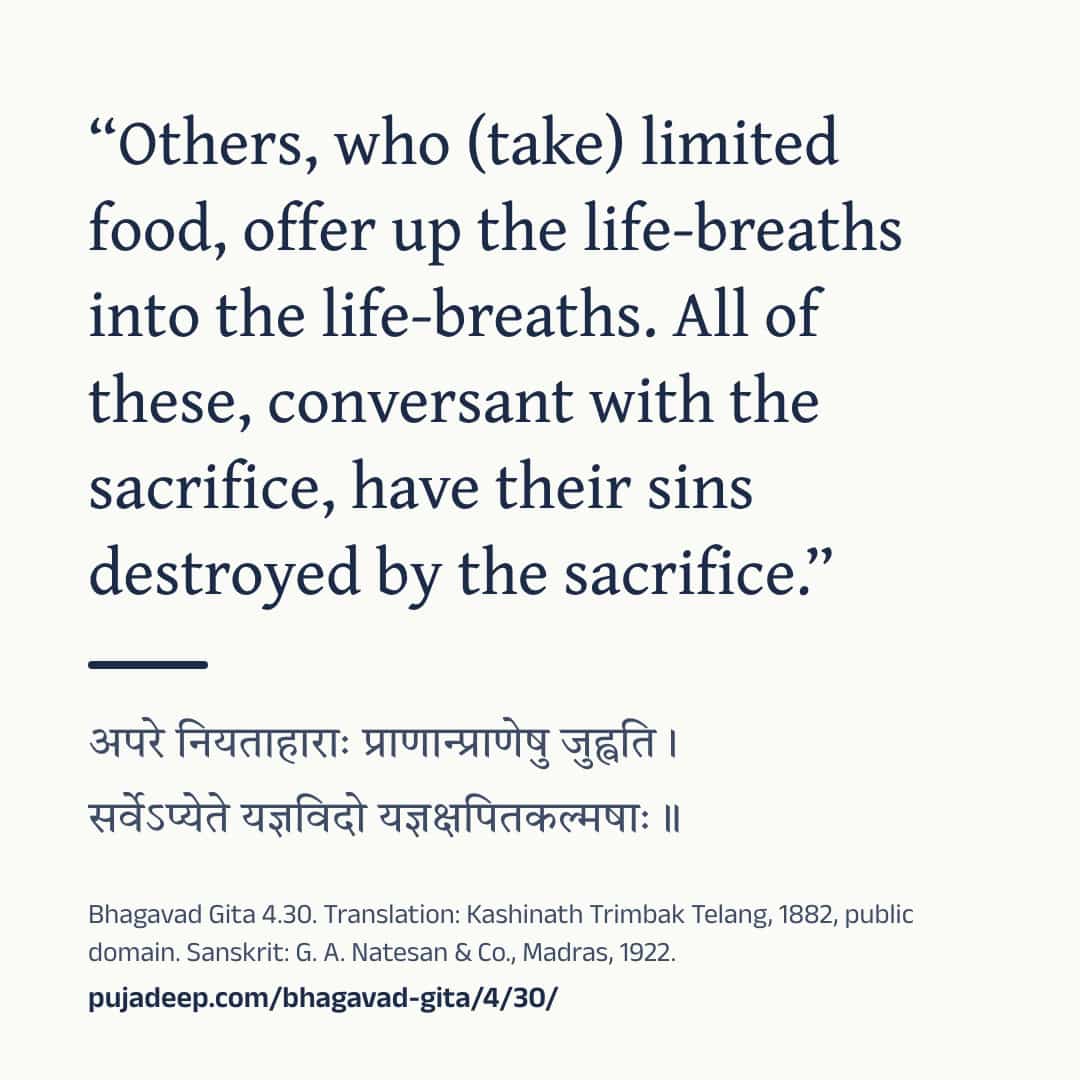
अपरे नियताहाराः प्राणान्प्राणेषु जुह्वति ।
सर्वेऽप्येते यज्ञविदो यज्ञक्षपितकल्मषाः ॥

“Others, who (take) limited food, offer up the life-breaths into the life-breaths. All of these, conversant with the sacrifice, have their sins destroyed by the sacrifice.”
(K. T. Telang, The Bhagavadgîtâ (The Sacred Books of the East, vol. VIII, Oxford: Clarendon Press, 1882), pp. 61–62, public domain)

“Others, regular in food, pour as sacrifice their life-breaths in life-breaths. All these are knowers of sacrifice, and by sacrifice their sins are put an end to.”
(Annie Besant, The Bhagavad Gîtâ, or The Lord's Song (London: Theosophical Publishing Society, 1895), p. 55, public domain)
This sentence begins in 4.25.

“All of these are knowers of Yajna, having their sins consumed by Yajna, and eating of the nectar—the remnant of Yajna, they go to the Eternal Brahman. (Even) this world is not for the non-performer of Yajna, how then another, O best of the Kurus?”
(Swami Swarupananda, Srimad-Bhagavad-Gita (Mayavati: Prabuddha Bharata Press, 1909; first printed in Prabuddha Bharata, 1907–1909), p. 99, public domain)
This sentence covers verses 4.30 to 4.31.

Sanskrit: G. A. Natesan & Co., Madras, 1922.
https://pujadeep.com/bhagavad-gita/4/30/ Nothing is sent from this site. Your own app sends it, to the chat you choose. The picture quotes the translation you chose on this page, with its name and year.
Sanskrit text: The Bhagavad-Gita, or The Lord's Song, with the text in Devanagari and an English translation, 1922. Meanings: written for Pujadeep and checked against the cited edition. Source and changes
Questions families ask
Who speaks Bhagavad Gita 4.30?
Krishna speaks this verse, in chapter 4 (Jnana Karma Sannyasa Yoga).
Where does the Sanskrit text come from?
Sanskrit text: The Bhagavad-Gita, or The Lord's Song, with the text in Devanagari and an English translation, 1922. Meanings: written for Pujadeep and checked against the cited edition. See the source
Is the meaning on this page a translation?
Explanation written for this site from the sources listed here, and checked against the cited edition. It is not a translation and not the only way to read the text. Free to quote with credit.
Source and licence
- Sanskrit text
- The Bhagavad-Gita, or The Lord's Song, with the text in Devanagari and an English translation (Annie Besant, G. A. Natesan & Co., Madras, 1922). Public domain. The Sanskrit on these pages was read from this printing’s page images.
- Translation
- The Bhagavadgîtâ with the Sanatsugâtîya and the Anugîtâ, translated by Kâshinâth Trimbak Telang (The Sacred Books of the East, vol. VIII, ed. F. Max Müller) (Kashinath Trimbak Telang, F. Max Müller, Clarendon Press, Oxford, 1882). Public domain. Shown verbatim, as printed.
- Translation
- The Bhagavad Gîtâ, or The Lord's Song, translated by Annie Besant (Annie Besant, Theosophical Publishing Society, London, 1895). Public domain. Shown verbatim, as printed.
- Translation
- Srimad-Bhagavad-Gita, with Sanskrit Text; Paraphrase with Word-by-word Literal Translation; English Rendering and Comments, Index, &c., by the Swami Swarupananda (Himalayan Series, No. XX) (Swami Swarupananda, The Editors and Publishers, Advaita Ashrama, Mayavati, Prabuddha Bharata Press, Mayavati, Almora, Himalayas, 1909). Public domain. Shown verbatim, as printed.
- Common wording
- In this text, 32 words follow today's common wording, checked against sanskritdocuments.org; Sanskrit Wikisource; Gita Press, Gorakhpur; GRETIL, Göttingen and Bhaktivedanta Book Trust.
- Our explanation
- Explanation written for this site from the sources listed here, and checked against the cited edition. It is not a translation and not the only way to read the text. Free to quote with credit.
- Checked
- Checked against the cited edition, October 15, 2026.
- Updated
- October 27, 2026