Bhagavad Gita 4.27: meaning and translation
Chapter 4: Jnana Karma Sannyasa Yoga. Krishna says
Krishna: Others offer all the workings of the senses and of the life-breath (prāṇa) into the fire of self-control, kindled by knowledge.
Click or tap a word for its meaning and its dictionary page.
Text and layers
Text and layers
These choices stay in this browser.
Bhagavad Gita 4.27
सर्वाणीन्द्रियकर्माणि प्राणकर्माणि चापरे ।आत्मसंयमयोगाग्नौ जुह्वति ज्ञानदीपिते ॥
Sarvanindriyakarmani pranakarmani chapareAtmasanyamayogagnau juhvati jnanadipite
sarvāṇīndriyakarmāṇi prāṇakarmāṇi cāpare |ātmasaṃyamayogāgnau juhvati jñānadīpite ||
Our explanation Others offer all the workings of the senses and of the life-breath (prāṇa) into the fire of self-control, kindled by knowledge.
हिंदी अर्थ दूसरे सब इंद्रियों के कर्मों और प्राणों के कर्मों को ज्ञान से जलाई गई आत्मसंयम रूपी योग-अग्नि में होम करते हैं।
Word by word
Every word, with its dictionary page
Word by word
- सर्वाणि sarvāṇi · all (pronoun (neuter), accusative plural) Dictionary: sarva, Monier-Williams 1899, p. 1184, col. 3 “whole, entire, all, every”
- इन्द्रियकर्माणि indriyakarmāṇi · workings of the senses (compound (neuter), accusative plural) Dictionary: indriya, Monier-Williams 1899, p. 167, col. 2 “faculty of sense, sense, organ of sense”; karman, Monier-Williams 1899, p. 258, col. 2 “act, action, performance, business”
- प्राणकर्माणि prāṇakarmāṇi · workings of the life-breath (compound (neuter), accusative plural) Dictionary: prāṇa, Monier-Williams 1899, p. 705, col. 1 “the breath of life, breath, respiration, spirit, vitality”; karman, Monier-Williams 1899, p. 258, col. 2 “act, action, performance, business”
- च ca · and (indeclinable) Dictionary: 2. ca, Monier-Williams 1899, p. 380, col. 1 “and, both, also, moreover, as well as”
- अपरे apare · others (pronoun (masculine), nominative plural) Dictionary: 2. apara, Monier-Williams 1899, p. 50, col. 3 “other, another”
- आत्मसंयमयोगाग्नौ ātmasaṃyamayogāgnau · into the fire of self-control (compound (masculine), locative singular) Dictionary: ātma-saṃyama, Monier-Williams 1899, p. 135, col. 3 “self-restraint”; yoga, Monier-Williams 1899, p. 856, col. 2 “the act of yoking, joining, attaching”; agni, Monier-Williams 1899, p. 5, col. 1 “fire; sacrificial fire”
- जुह्वति juhvati · offer (present, 3rd person plural) Dictionary: 1. hu, Monier-Williams 1899, p. 1301, col. 1 “to sacrifice (esp. pour butter into the fire), offer or present an oblation”
- ज्ञानदीपिते jñānadīpite · kindled by knowledge (compound (masculine), locative singular) Dictionary: jñāna, Monier-Williams 1899, p. 426, col. 1 “knowing, becoming acquainted with, knowledge”; dīpita, Monier-Williams 1899, p. 481, col. 2 “set on fire, inflamed, excited, illuminated”
Old translations
Kashinath Trimbak Telang, 1882. Public domain. Page 61.
Some again offer up all the operations of the senses and the operations of the life-breaths into the fire of devotion by self-restraint1, kindled by knowledge.
Footnotes (the translator’s own) - Stopping the bodily operations mentioned, and engaging in contemplation. ↩
Compare 3 translations
Kashinath Trimbak Telang, 1882. Public domain. Page 61.
Some again offer up all the operations of the senses and the operations of the life-breaths into the fire of devotion by self-restraint1, kindled by knowledge.
Footnotes (the translator’s own) - Stopping the bodily operations mentioned, and engaging in contemplation. ↩
You are reading this one
Annie Besant, 1895. Public domain. Page 54.
Others again into the wisdom-kindled fires of concentration in, and union with, the SELF, pour as sacrifice all the functions of the senses and the functions of life;
This sentence begins in 4.25. This sentence goes on in 4.28.
You are reading this one
Swami Swarupananda, 1909 (first printed 1907). Public domain. Page 97.
Some again offer all the actions of the senses and the functions of the vital energy, as sacrifice in the fire of control in self, kindled by knowledge.
You are reading this one
Cite this verse
The translation: K. T. Telang, The Bhagavadgîtâ (The Sacred Books of the East, vol. VIII, Oxford: Clarendon Press, 1882), p. 61. Bhagavad Gita 4.27.
The translation: Annie Besant, The Bhagavad Gîtâ, or The Lord's Song (London: Theosophical Publishing Society, 1895), p. 54. Bhagavad Gita 4.27.
The translation: Swami Swarupananda, Srimad-Bhagavad-Gita (Mayavati: Prabuddha Bharata Press, 1909; first printed in Prabuddha Bharata, 1907–1909), p. 97. Bhagavad Gita 4.27.
Our explanation: “Bhagavad Gita 4.27: meaning and translation.” Pujadeep. Updated October 27, 2026. https://pujadeep.com/bhagavad-gita/4/27/
Pujadeep’s explanations are free to quote with credit: name Pujadeep and link to the page. How to credit
Classical readings, by school
No readings by school on this verse yet.
Share
Show the ways to share
Send one picture or the text to one chat. The picture names its source and the address of this page.
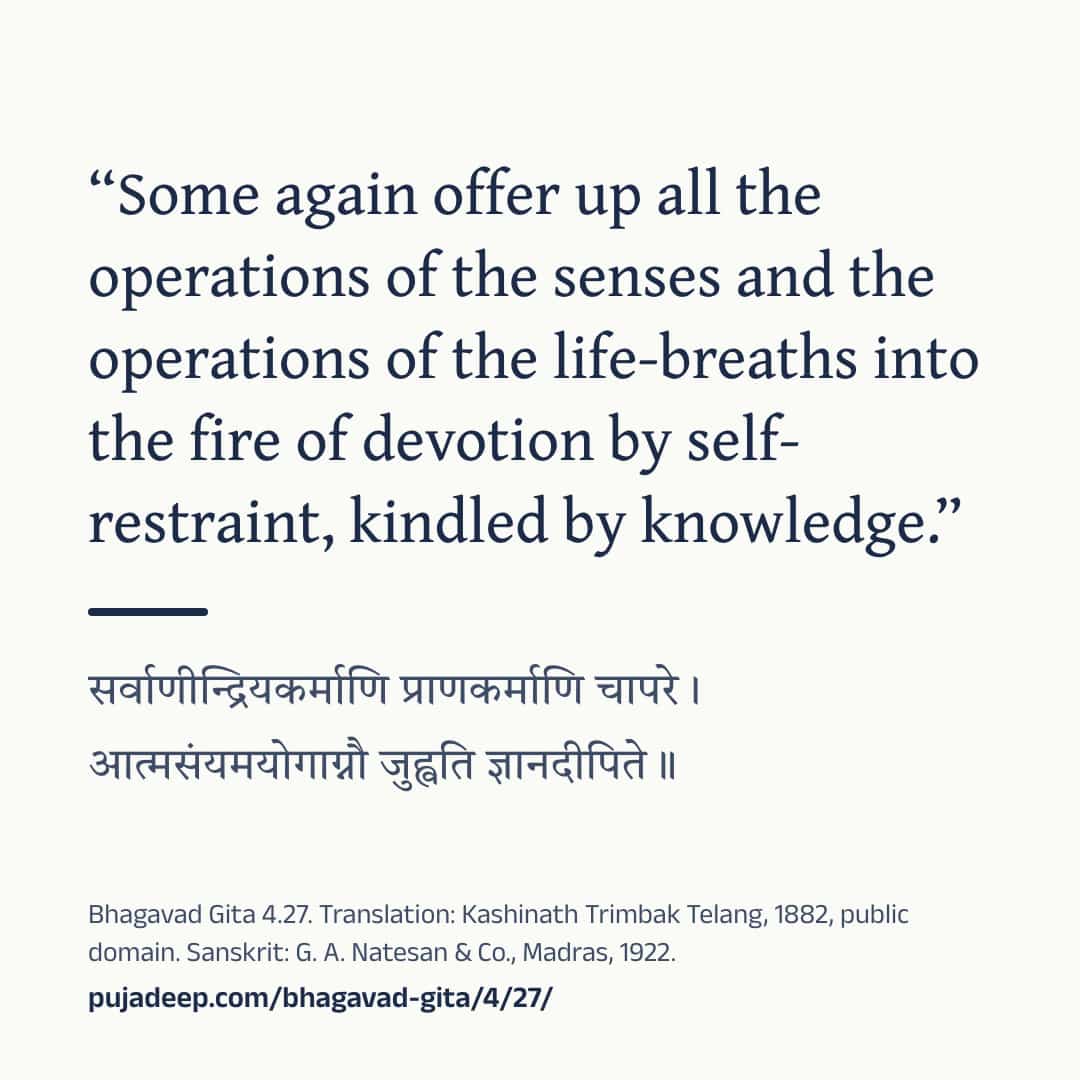
Drawing the picture
See the words
Bhagavad Gita 4.27

सर्वाणीन्द्रियकर्माणि प्राणकर्माणि चापरे ।
आत्मसंयमयोगाग्नौ जुह्वति ज्ञानदीपिते ॥

“Some again offer up all the operations of the senses and the operations of the life-breaths into the fire of devotion by self-restraint, kindled by knowledge.”
(K. T. Telang, The Bhagavadgîtâ (The Sacred Books of the East, vol. VIII, Oxford: Clarendon Press, 1882), p. 61, public domain)

“Others again into the wisdom-kindled fires of concentration in, and union with, the SELF, pour as sacrifice all the functions of the senses and the functions of life;”
(Annie Besant, The Bhagavad Gîtâ, or The Lord's Song (London: Theosophical Publishing Society, 1895), p. 54, public domain)
This sentence begins in 4.25. This sentence goes on in 4.28.

“Some again offer all the actions of the senses and the functions of the vital energy, as sacrifice in the fire of control in self, kindled by knowledge.”
(Swami Swarupananda, Srimad-Bhagavad-Gita (Mayavati: Prabuddha Bharata Press, 1909; first printed in Prabuddha Bharata, 1907–1909), p. 97, public domain)

Sanskrit: G. A. Natesan & Co., Madras, 1922.
https://pujadeep.com/bhagavad-gita/4/27/ Nothing is sent from this site. Your own app sends it, to the chat you choose. The picture quotes the translation you chose on this page, with its name and year.
Sanskrit text: The Bhagavad-Gita, or The Lord's Song, with the text in Devanagari and an English translation, 1922. Meanings: written for Pujadeep and checked against the cited edition. Source and changes
Questions families ask
Who speaks Bhagavad Gita 4.27?
Krishna speaks this verse, in chapter 4 (Jnana Karma Sannyasa Yoga).
Where does the Sanskrit text come from?
Sanskrit text: The Bhagavad-Gita, or The Lord's Song, with the text in Devanagari and an English translation, 1922. Meanings: written for Pujadeep and checked against the cited edition. See the source
Is the meaning on this page a translation?
Explanation written for this site from the sources listed here, and checked against the cited edition. It is not a translation and not the only way to read the text. Free to quote with credit.
Source and licence
- Sanskrit text
- The Bhagavad-Gita, or The Lord's Song, with the text in Devanagari and an English translation (Annie Besant, G. A. Natesan & Co., Madras, 1922). Public domain. The Sanskrit on these pages was read from this printing’s page images.
- Translation
- The Bhagavadgîtâ with the Sanatsugâtîya and the Anugîtâ, translated by Kâshinâth Trimbak Telang (The Sacred Books of the East, vol. VIII, ed. F. Max Müller) (Kashinath Trimbak Telang, F. Max Müller, Clarendon Press, Oxford, 1882). Public domain. Shown verbatim, as printed.
- Translation
- The Bhagavad Gîtâ, or The Lord's Song, translated by Annie Besant (Annie Besant, Theosophical Publishing Society, London, 1895). Public domain. Shown verbatim, as printed.
- Translation
- Srimad-Bhagavad-Gita, with Sanskrit Text; Paraphrase with Word-by-word Literal Translation; English Rendering and Comments, Index, &c., by the Swami Swarupananda (Himalayan Series, No. XX) (Swami Swarupananda, The Editors and Publishers, Advaita Ashrama, Mayavati, Prabuddha Bharata Press, Mayavati, Almora, Himalayas, 1909). Public domain. Shown verbatim, as printed.
- Common wording
- In this text, 32 words follow today's common wording, checked against sanskritdocuments.org; Sanskrit Wikisource; Gita Press, Gorakhpur; GRETIL, Göttingen and Bhaktivedanta Book Trust.
- Our explanation
- Explanation written for this site from the sources listed here, and checked against the cited edition. It is not a translation and not the only way to read the text. Free to quote with credit.
- Checked
- Checked against the cited edition, October 15, 2026.
- Updated
- October 27, 2026