Bhagavad Gita 5.1: meaning and translation
Chapter 5: Karma Sannyasa Yoga. Arjuna says
Arjuna asks a question.
Click or tap a word for its meaning and its dictionary page.
Text and layers
Text and layers
These choices stay in this browser.
Bhagavad Gita 5.1
अर्जुन उवाच ।
संन्यासं कर्मणां कृष्ण पुनर्योगं च शंससि ।यच्छ्रेय एतयोरेकं तन्मे ब्रूहि सुनिश्चितम् ॥
Sannyasam karmanam krishna punaryogam cha shansasiYachchhreya etayorekam tanme bruhi sunishchitam
saṃnyāsaṃ karmaṇāṃ kṛṣṇa punaryogaṃ ca śaṃsasi |yacchreya etayorekaṃ tanme brūhi suniścitam ||
Our explanation Arjuna asks a question. In chapter 4 Krishna praised the renunciation of actions (karma-saṃnyāsa), and he also told Arjuna to act in yoga. Arjuna asks him to say clearly which one of the two is better. The commentators explain the two paths in different ways (see the views).
हिंदी अर्थ अर्जुन एक प्रश्न पूछते हैं। अध्याय 4 में कृष्ण ने कर्मों के संन्यास (त्याग) की प्रशंसा की, और अर्जुन को योग में स्थित होकर कर्म करने को भी कहा। अर्जुन पूछते हैं कि इन दोनों में से कौन-सा एक श्रेष्ठ है, यह निश्चित रूप से बताइए। टीकाकार इन दोनों मार्गों को अलग-अलग ढंग से समझाते हैं।
Word by word
Every word, with its dictionary page
Word by word
- संन्यासम् saṃnyāsam · renunciation (accusative singular) Dictionary: saṃ-nyāsa, Monier-Williams 1899, p. 1148, col. 1 “laying aside, resignation, abandonment of (gen. or comp.)”
- कर्मणाम् karmaṇām · of actions (genitive plural) Dictionary: karman, Monier-Williams 1899, p. 258, col. 2 “act, action, performance, business”
- कृष्ण kṛṣṇa · O Krishna (vocative singular) Dictionary: kṛṣṇa, Monier-Williams 1899, p. 306, col. 2 “N. of a celebrated Avatār of the god Vishṇu, or sometimes identified with Vishṇu himself”
- पुनः punaḥ · again, then (indeclinable) Dictionary: punar, Monier-Williams 1899, p. 633, col. 2 “again, once more”
- योगम् yogam · yoga (of action) (accusative singular) Dictionary: yoga, Monier-Williams 1899, p. 856, col. 2 “the act of yoking, joining, attaching”
- च ca · and (indeclinable) Dictionary: 2. ca, Monier-Williams 1899, p. 380, col. 1 “and, both, also, moreover, as well as”
- शंससि śaṃsasi · you praise (present, 2nd person singular) Dictionary: śaṃs, Monier-Williams 1899, p. 1044, col. 1 “to praise, commend, approve”
- यत् yat · which (relative pronoun, nominative singular (neuter)) Dictionary: yad, Monier-Williams 1899, p. 844, col. 2 “who, which, what, whichever, whatever, that”
- श्रेयः śreyaḥ · better (nominative singular (neuter)) Dictionary: śreyas, Monier-Williams 1899, p. 1102, col. 2 “superior, preferable, better”
- एतयोः etayoḥ · of these two (pronoun, genitive dual) Dictionary: etad, Monier-Williams 1899, p. 231, col. 2 “this, this here, here”
- एकम् ekam · one (nominative singular (neuter)) Dictionary: eka, Monier-Williams 1899, p. 227, col. 3 “one”
- तत् tat · that (pronoun, accusative singular (neuter)) Dictionary: tad, Monier-Williams 1899, p. 434, col. 1 “that, this”
- मे me · to "me" (Arjuna) (pronoun, dative singular) Dictionary: 1. mad, Monier-Williams 1899, p. 777, col. 2 “base of the first pers. pron. in the sg. number (esp. in comp.)”
- ब्रूहि brūhi · tell (imperative, 2nd person singular) Dictionary: brū, Monier-Williams 1899, p. 742, col. 1 “to speak, say, tell”
- सुनिश्चितम् suniścitam · clearly, for certain (adverb) Dictionary: su-niścita, Monier-Williams 1899, p. 1226, col. 3 “well ascertained”
Old translations
Kashinath Trimbak Telang, 1882. Public domain. Page 63.
Arguna said:
O Krishna! you praise renunciation of actions and also the pursuit (of them). Tell me determinately which one of these two is superior.
Compare 3 translations
Kashinath Trimbak Telang, 1882. Public domain. Page 63.
Arguna said:
O Krishna! you praise renunciation of actions and also the pursuit (of them). Tell me determinately which one of these two is superior.
You are reading this one
Annie Besant, 1895. Public domain. Page 58.
Arjuna said:
Renunciation of actions, O Krishna, thou praisest, and then Yoga. Of the two which one is the better? Tell me that conclusively.
You are reading this one
Swami Swarupananda, 1909 (first printed 1907). Public domain. Page 105.
Arjuna said:
Renunciation of actions, O Krishna, thou commendest, and again, its performance. Which is the better one of these? Do thou tell me decisively.
You are reading this one
Cite this verse
The translation: K. T. Telang, The Bhagavadgîtâ (The Sacred Books of the East, vol. VIII, Oxford: Clarendon Press, 1882), p. 63. Bhagavad Gita 5.1.
The translation: Annie Besant, The Bhagavad Gîtâ, or The Lord's Song (London: Theosophical Publishing Society, 1895), p. 58. Bhagavad Gita 5.1.
The translation: Swami Swarupananda, Srimad-Bhagavad-Gita (Mayavati: Prabuddha Bharata Press, 1909; first printed in Prabuddha Bharata, 1907–1909), p. 105. Bhagavad Gita 5.1.
Our explanation: “Bhagavad Gita 5.1: meaning and translation.” Pujadeep. Updated October 25, 2026. https://pujadeep.com/bhagavad-gita/5/1/
Pujadeep’s explanations are free to quote with credit: name Pujadeep and link to the page. How to credit
Classical readings, by school
Each reading is named by its school. None is presented as the only meaning.
What Advaita, Vishishtadvaita and Dvaita teach, in short
Shankara Advaita
Shankara says the question is about a person who has not yet realised the Self. For someone who knows the Self, action based on the idea “I am the doer” is no longer possible, so the choice does not arise for him. Here “renunciation” means giving up the actions the scriptures prescribe, and “yoga” means doing them.
Source: The Bhagavad-Gita, with the commentary of Sri Sankaracharya, translated by A. Mahadeva Sastri (2nd ed., Mysore: G. T. A. Printing Works, 1901), introduction and commentary on 5.1, pp. 139–145. Summarised in our own words; none of its text is reproduced.
Ramanuja Vishishtadvaita
Ramanuja says renunciation here means the path of knowledge (jñāna-yoga) and yoga means the path of works (karma-yoga). Chapter 2 seemed to make works a preparation for knowledge, while chapters 3 and 4 made works enough by themselves; so Arjuna asks which is the quicker and easier way to reach the self (ātman).
Source: Sri Bhagavad-Gita with Sri Ramanujacharya's Visishtadvaita commentary, translated by A. Govindacharya (Madras, 1898), commentary on 5.1, p. 172. Summarised in our own words; none of its text is reproduced.
Share
Show the ways to share
Send one picture or the text to one chat. The picture names its source and the address of this page.
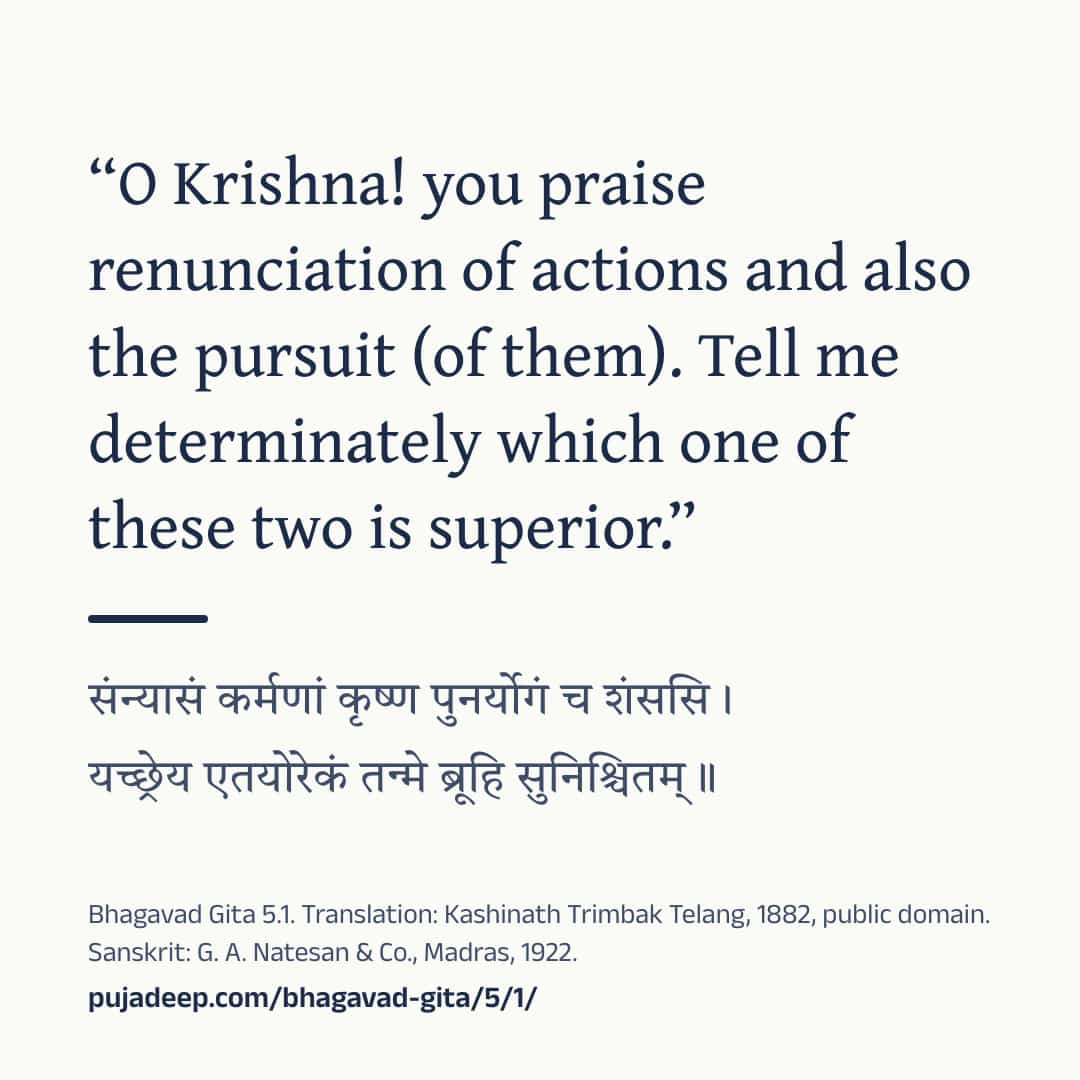
Drawing the picture
See the words
Bhagavad Gita 5.1

संन्यासं कर्मणां कृष्ण पुनर्योगं च शंससि ।
यच्छ्रेय एतयोरेकं तन्मे ब्रूहि सुनिश्चितम् ॥

“O Krishna! you praise renunciation of actions and also the pursuit (of them). Tell me determinately which one of these two is superior.”
(K. T. Telang, The Bhagavadgîtâ (The Sacred Books of the East, vol. VIII, Oxford: Clarendon Press, 1882), p. 63, public domain)

“Renunciation of actions, O Krishna, thou praisest, and then Yoga. Of the two which one is the better? Tell me that conclusively.”
(Annie Besant, The Bhagavad Gîtâ, or The Lord's Song (London: Theosophical Publishing Society, 1895), p. 58, public domain)

“Renunciation of actions, O Krishna, thou commendest, and again, its performance. Which is the better one of these? Do thou tell me decisively.”
(Swami Swarupananda, Srimad-Bhagavad-Gita (Mayavati: Prabuddha Bharata Press, 1909; first printed in Prabuddha Bharata, 1907–1909), p. 105, public domain)

Sanskrit: G. A. Natesan & Co., Madras, 1922.
https://pujadeep.com/bhagavad-gita/5/1/ Nothing is sent from this site. Your own app sends it, to the chat you choose. The picture quotes the translation you chose on this page, with its name and year.
Sanskrit text: The Bhagavad-Gita, or The Lord's Song, with the text in Devanagari and an English translation, 1922. Meanings: written for Pujadeep and checked against the cited edition. Source and changes
Questions families ask
Who speaks Bhagavad Gita 5.1?
Arjuna speaks this verse, in chapter 5 (Karma Sannyasa Yoga).
Where does the Sanskrit text come from?
Sanskrit text: The Bhagavad-Gita, or The Lord's Song, with the text in Devanagari and an English translation, 1922. Meanings: written for Pujadeep and checked against the cited edition. See the source
Is the meaning on this page a translation?
Explanation written for this site from the sources listed here, and checked against the cited edition. It is not a translation and not the only way to read the text. Free to quote with credit.
Source and licence
- Sanskrit text
- The Bhagavad-Gita, or The Lord's Song, with the text in Devanagari and an English translation (Annie Besant, G. A. Natesan & Co., Madras, 1922). Public domain. The Sanskrit on these pages was read from this printing’s page images.
- Translation
- The Bhagavadgîtâ with the Sanatsugâtîya and the Anugîtâ, translated by Kâshinâth Trimbak Telang (The Sacred Books of the East, vol. VIII, ed. F. Max Müller) (Kashinath Trimbak Telang, F. Max Müller, Clarendon Press, Oxford, 1882). Public domain. Shown verbatim, as printed.
- Translation
- The Bhagavad Gîtâ, or The Lord's Song, translated by Annie Besant (Annie Besant, Theosophical Publishing Society, London, 1895). Public domain. Shown verbatim, as printed.
- Translation
- Srimad-Bhagavad-Gita, with Sanskrit Text; Paraphrase with Word-by-word Literal Translation; English Rendering and Comments, Index, &c., by the Swami Swarupananda (Himalayan Series, No. XX) (Swami Swarupananda, The Editors and Publishers, Advaita Ashrama, Mayavati, Prabuddha Bharata Press, Mayavati, Almora, Himalayas, 1909). Public domain. Shown verbatim, as printed.
- Commentary
- The Bhagavad-Gita, with the commentary of Sri Sankaracharya, translated by A. Mahadeva Sastri (2nd ed., Mysore: G. T. A. Printing Works, 1901) (Public-domain scan, University of California Libraries). Summarised in our own words; none of its text is reproduced.
- Commentary
- Sri Bhagavad-Gita with Sri Ramanujacharya's Visishtadvaita commentary, translated by A. Govindacharya (Madras, 1898) (Scan uploaded to archive.org (folkscanomy collection)). Summarised in our own words; none of its text is reproduced.
- Common wording
- In this text, 32 words follow today's common wording, checked against sanskritdocuments.org; Sanskrit Wikisource; Gita Press, Gorakhpur; GRETIL, Göttingen and Bhaktivedanta Book Trust.
- Our explanation
- Explanation written for this site from the sources listed here, and checked against the cited edition. It is not a translation and not the only way to read the text. Free to quote with credit.
- Checked
- Checked against the cited edition, October 15, 2026.
- Updated
- October 25, 2026