Bhagavad Gita 5.4: meaning and translation
Chapter 5: Karma Sannyasa Yoga. Krishna says
Krishna says that only the immature, not the wise, speak of Sāṅkhya (the path of knowledge) and Yoga (the path of action) as separate.
Click or tap a word for its meaning and its dictionary page.
Text and layers
Text and layers
These choices stay in this browser.
Bhagavad Gita 5.4
साङ्ख्ययोगौ पृथग्बालाः प्रवदन्ति न पण्डिताः ।एकमप्यास्थितः सम्यगुभयोर्विन्दते फलम् ॥
Sankhyayogau prithagbalah pravadanti na panditahEkamapyasthitah samyagubhayorvindate phalam
sāṅkhyayogau pṛthagbālāḥ pravadanti na paṇḍitāḥ |ekamapyāsthitaḥ samyagubhayorvindate phalam ||
Our explanation Krishna says that only the immature, not the wise, speak of Sāṅkhya (the path of knowledge) and Yoga (the path of action) as separate. A person who follows even one of them well gains the fruit of both.
हिंदी अर्थ कृष्ण कहते हैं कि सांख्य (ज्ञान का मार्ग) और योग (कर्म का मार्ग) को अलग-अलग बालक, यानी अनुभवहीन लोग, बताते हैं, ज्ञानी नहीं। जो इनमें से एक में भी ठीक से स्थित है, वह दोनों का फल पाता है।
Word by word
Every word, with its dictionary page
Word by word
- साङ्ख्ययोगौ sāṅkhyayogau · Sāṅkhya and Yoga (compound, accusative dual) Dictionary: sāṃkhya, Monier-Williams 1899, p. 1199, col. 1 “N. of one of the three great divisions of Hindū philosophy”; yoga, Monier-Williams 1899, p. 856, col. 3 “Yoga philosophy”
- पृथक् pṛthak · as separate (indeclinable) Dictionary: pṛthak, Monier-Williams 1899, p. 645, col. 3 “widely apart”
- बालाः bālāḥ · the immature (nominative plural) Dictionary: bāla, Monier-Williams 1899, p. 728, col. 3 “young, childish”
- प्रवदन्ति pravadanti · say, declare (present, 3rd person plural) Dictionary: pra-vad, Monier-Williams 1899, p. 690, col. 3 “to assert, affirm, state”
- न na · not (indeclinable) Dictionary: 2. na, Monier-Williams 1899, p. 523, col. 1 “not, no, nor, neither”
- पण्डिताः paṇḍitāḥ · the wise (nominative plural) Dictionary: paṇḍita, Monier-Williams 1899, p. 580, col. 3 “learned, wise, shrewd, clever”
- एकम् ekam · one (accusative singular) Dictionary: eka, Monier-Williams 1899, p. 227, col. 3 “one”
- अपि api · even (indeclinable) Dictionary: api, Monier-Williams 1899, p. 55, col. 1 “in the sense of even, also, very”
- आस्थितः āsthitaḥ · following, resorting to (past participle, nominative singular) Dictionary: ā-sthita, Monier-Williams 1899, p. 161, col. 2 “staying or sitting on”
- सम्यक् samyak · rightly, well (indeclinable) Dictionary: samy-ak, Monier-Williams 1899, p. 1181, col. 2 “completely, wholly”
- उभयोः ubhayoḥ · of both (genitive dual) Dictionary: ubhaya, Monier-Williams 1899, p. 216, col. 2 “both, of both kinds”
- विन्दते vindate · gains (present, 3rd person singular) Dictionary: 3. vid, Monier-Williams 1899, p. 964, col. 3 “to find, discover, meet or fall in with, obtain, get, acquire”
- फलम् phalam · the fruit (accusative singular) Dictionary: phala, Monier-Williams 1899, p. 716, col. 2 “fruit (met.), consequence, effect, result”
Old translations
Kashinath Trimbak Telang, 1882. Public domain. Page 63–64.
Children—not wise men—talk of sâṅkhya and yoga as distinct. One who pursues either well obtains the fruit of both.
Compare 3 translations
Kashinath Trimbak Telang, 1882. Public domain. Page 63–64.
Children—not wise men—talk of sâṅkhya and yoga as distinct. One who pursues either well obtains the fruit of both.
You are reading this one
Annie Besant, 1895. Public domain. Page 59.
Children, not Sages, speak of the Sânkhya and Yoga as different; he who is duly established in one obtaineth the fruits of both.
You are reading this one
Swami Swarupananda, 1909 (first printed 1907). Public domain. Page 107.
Children, not the wise, speak of knowledge and performance of action, as distinct. He who truly lives in one, gains the fruits of both.
You are reading this one
Cite this verse
The translation: K. T. Telang, The Bhagavadgîtâ (The Sacred Books of the East, vol. VIII, Oxford: Clarendon Press, 1882), pp. 63–64. Bhagavad Gita 5.4.
The translation: Annie Besant, The Bhagavad Gîtâ, or The Lord's Song (London: Theosophical Publishing Society, 1895), p. 59. Bhagavad Gita 5.4.
The translation: Swami Swarupananda, Srimad-Bhagavad-Gita (Mayavati: Prabuddha Bharata Press, 1909; first printed in Prabuddha Bharata, 1907–1909), p. 107. Bhagavad Gita 5.4.
Our explanation: “Bhagavad Gita 5.4: meaning and translation.” Pujadeep. Updated October 25, 2026. https://pujadeep.com/bhagavad-gita/5/4/
Pujadeep’s explanations are free to quote with credit: name Pujadeep and link to the page. How to credit
Classical readings, by school
Each reading is named by its school. None is presented as the only meaning.
What Advaita, Vishishtadvaita and Dvaita teach, in short
Shankara Advaita
Shankara says that Sāṅkhya and Yoga are the renunciation and the yoga of action already named, with knowledge of the Self added to the first and evenness of mind added to the second. Both lead to the same result, liberation.
Source: The Bhagavad-Gita, with the commentary of Sri Sankaracharya, translated by A. Mahadeva Sastri (2nd ed., Mysore: G. T. A. Printing Works, 1901), commentary on 5.4, pp. 146–147. Summarised in our own words; none of its text is reproduced.
Ramanuja Vishishtadvaita
Ramanuja says both paths have one aim, the vision of the self (ātma-darśana). Those who claim that works lead only to knowledge, and that only knowledge leads to the vision of the self, understand little.
Source: Sri Bhagavad-Gita with Sri Ramanujacharya's Visishtadvaita commentary, translated by A. Govindacharya (Madras, 1898), commentary on 5.4, p. 174. Summarised in our own words; none of its text is reproduced.
Share
Show the ways to share
Send one picture or the text to one chat. The picture names its source and the address of this page.
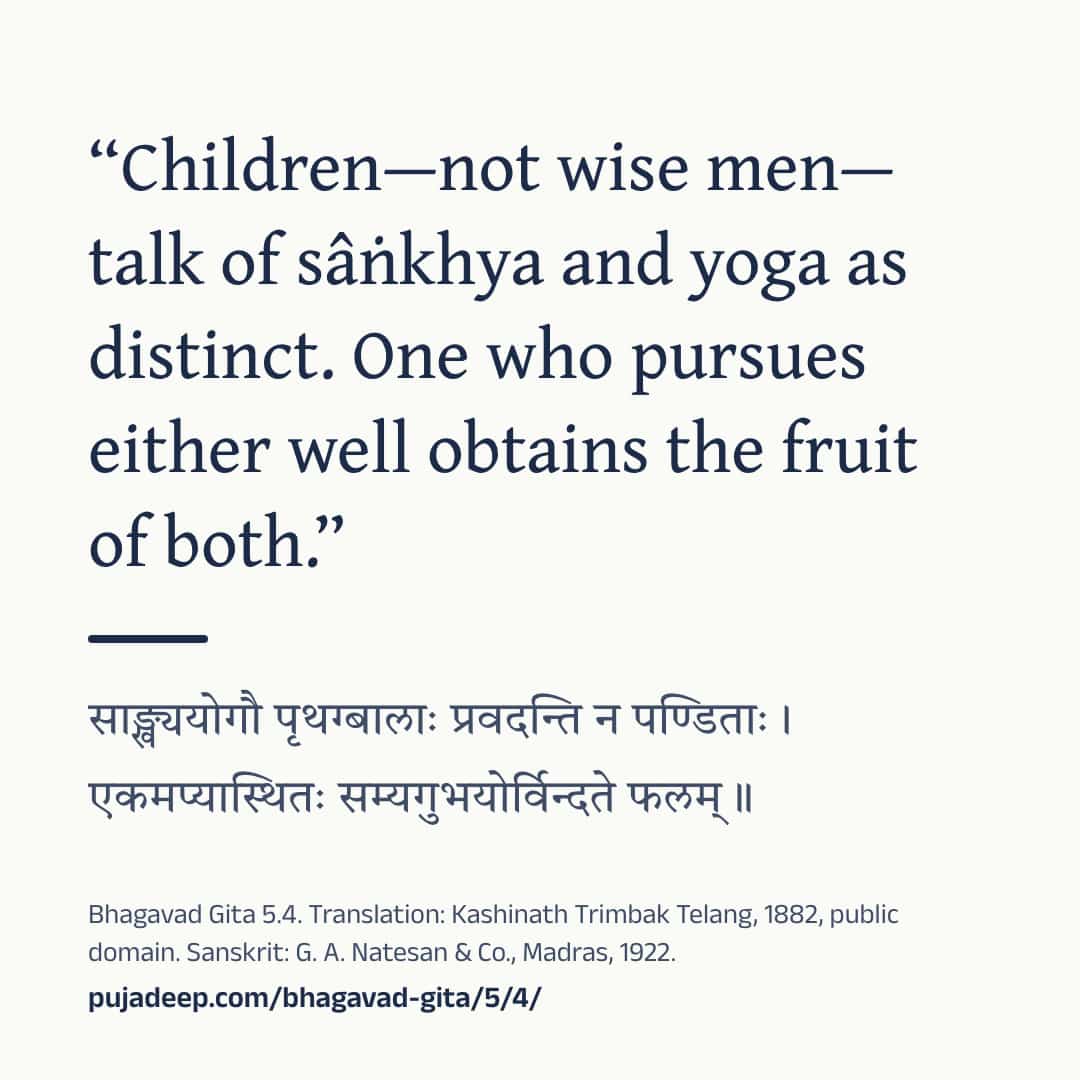
Drawing the picture
See the words
Bhagavad Gita 5.4

साङ्ख्ययोगौ पृथग्बालाः प्रवदन्ति न पण्डिताः ।
एकमप्यास्थितः सम्यगुभयोर्विन्दते फलम् ॥

“Children—not wise men—talk of sâṅkhya and yoga as distinct. One who pursues either well obtains the fruit of both.”
(K. T. Telang, The Bhagavadgîtâ (The Sacred Books of the East, vol. VIII, Oxford: Clarendon Press, 1882), pp. 63–64, public domain)

“Children, not Sages, speak of the Sânkhya and Yoga as different; he who is duly established in one obtaineth the fruits of both.”
(Annie Besant, The Bhagavad Gîtâ, or The Lord's Song (London: Theosophical Publishing Society, 1895), p. 59, public domain)

“Children, not the wise, speak of knowledge and performance of action, as distinct. He who truly lives in one, gains the fruits of both.”
(Swami Swarupananda, Srimad-Bhagavad-Gita (Mayavati: Prabuddha Bharata Press, 1909; first printed in Prabuddha Bharata, 1907–1909), p. 107, public domain)

Sanskrit: G. A. Natesan & Co., Madras, 1922.
https://pujadeep.com/bhagavad-gita/5/4/ Nothing is sent from this site. Your own app sends it, to the chat you choose. The picture quotes the translation you chose on this page, with its name and year.
Sanskrit text: The Bhagavad-Gita, or The Lord's Song, with the text in Devanagari and an English translation, 1922. Meanings: written for Pujadeep and checked against the cited edition. Source and changes
Questions families ask
Who speaks Bhagavad Gita 5.4?
Krishna speaks this verse, in chapter 5 (Karma Sannyasa Yoga).
Where does the Sanskrit text come from?
Sanskrit text: The Bhagavad-Gita, or The Lord's Song, with the text in Devanagari and an English translation, 1922. Meanings: written for Pujadeep and checked against the cited edition. See the source
Is the meaning on this page a translation?
Explanation written for this site from the sources listed here, and checked against the cited edition. It is not a translation and not the only way to read the text. Free to quote with credit.
Source and licence
- Sanskrit text
- The Bhagavad-Gita, or The Lord's Song, with the text in Devanagari and an English translation (Annie Besant, G. A. Natesan & Co., Madras, 1922). Public domain. The Sanskrit on these pages was read from this printing’s page images.
- Translation
- The Bhagavadgîtâ with the Sanatsugâtîya and the Anugîtâ, translated by Kâshinâth Trimbak Telang (The Sacred Books of the East, vol. VIII, ed. F. Max Müller) (Kashinath Trimbak Telang, F. Max Müller, Clarendon Press, Oxford, 1882). Public domain. Shown verbatim, as printed.
- Translation
- The Bhagavad Gîtâ, or The Lord's Song, translated by Annie Besant (Annie Besant, Theosophical Publishing Society, London, 1895). Public domain. Shown verbatim, as printed.
- Translation
- Srimad-Bhagavad-Gita, with Sanskrit Text; Paraphrase with Word-by-word Literal Translation; English Rendering and Comments, Index, &c., by the Swami Swarupananda (Himalayan Series, No. XX) (Swami Swarupananda, The Editors and Publishers, Advaita Ashrama, Mayavati, Prabuddha Bharata Press, Mayavati, Almora, Himalayas, 1909). Public domain. Shown verbatim, as printed.
- Commentary
- The Bhagavad-Gita, with the commentary of Sri Sankaracharya, translated by A. Mahadeva Sastri (2nd ed., Mysore: G. T. A. Printing Works, 1901) (Public-domain scan, University of California Libraries). Summarised in our own words; none of its text is reproduced.
- Commentary
- Sri Bhagavad-Gita with Sri Ramanujacharya's Visishtadvaita commentary, translated by A. Govindacharya (Madras, 1898) (Scan uploaded to archive.org (folkscanomy collection)). Summarised in our own words; none of its text is reproduced.
- Common wording
- In this text, 32 words follow today's common wording, checked against sanskritdocuments.org; Sanskrit Wikisource; Gita Press, Gorakhpur; GRETIL, Göttingen and Bhaktivedanta Book Trust.
- Our explanation
- Explanation written for this site from the sources listed here, and checked against the cited edition. It is not a translation and not the only way to read the text. Free to quote with credit.
- Checked
- Checked against the cited edition, October 15, 2026.
- Updated
- October 25, 2026