Bhagavad Gita 5.13: meaning and translation
Chapter 5: Karma Sannyasa Yoga. Krishna says
Krishna says that the embodied one who is self-controlled gives up all actions in the mind and dwells at ease in the city of nine gates, the body, neither acting nor causing anything to act.
Click or tap a word for its meaning and its dictionary page.
Text and layers
Text and layers
These choices stay in this browser.
Bhagavad Gita 5.13
सर्वकर्माणि मनसा संन्यस्यास्ते सुखं वशी ।नवद्वारे पुरे देही नैव कुर्वन्न कारयन् ॥
Sarvakarmani manasa sannyasyaste sukham vashiNavadvare pure dehi naiva kurvanna karayan
sarvakarmāṇi manasā saṃnyasyāste sukhaṃ vaśī |navadvāre pure dehī naiva kurvanna kārayan ||
Our explanation Krishna says that the embodied one who is self-controlled gives up all actions in the mind and dwells at ease in the city of nine gates, the body, neither acting nor causing anything to act.
हिंदी अर्थ कृष्ण कहते हैं कि अपने को वश में रखने वाला देहधारी मन से सब कर्मों का त्याग करके नौ द्वारों वाले नगर, यानी शरीर, में सुख से रहता है; वह न स्वयं कुछ करता है, न किसी से करवाता है।
Word by word
Every word, with its dictionary page
Word by word
- सर्वकर्माणि sarvakarmāṇi · all actions (compound, accusative plural) Dictionary: sarva, Monier-Williams 1899, p. 1184, col. 3 “whole, entire, all, every”; karman, Monier-Williams 1899, p. 258, col. 2 “act, action, performance, business”
- मनसा manasā · with the mind (instrumental singular) Dictionary: manas, Monier-Williams 1899, p. 783, col. 3 “mind (in its widest sense as applied to all the mental powers)”
- संन्यस्य saṃnyasya · giving up (absolutive ('having done')) Dictionary: saṃ-ny-as, Monier-Williams 1899, p. 1148, col. 1 “to lay aside, give up, abandon, resign”
- आस्ते āste · dwells (present, 3rd person singular) Dictionary: 2. ās, Monier-Williams 1899, p. 159, col. 3 “to sit, sit down, rest, lie”
- सुखम् sukham · at ease (adverb) Dictionary: sukha, Monier-Williams 1899, p. 1221, col. 1 “easily, comfortably, pleasantly, joyfully, willingly”
- वशी vaśī · the self-controlled one (nominative singular) Dictionary: vaśin, Monier-Williams 1899, p. 929, col. 3 “master of one's self”
- नवद्वारे navadvāre · of nine gates (compound, locative singular) Dictionary: nava-dvāra, Monier-Williams 1899, p. 531, col. 2 “9 doored”; navan, Monier-Williams 1899, p. 531, col. 3 “nine”; dvāra, Monier-Williams 1899, p. 504, col. 2 “door, gate”
- पुरे pure · in the city (locative singular) Dictionary: 2. pura, Monier-Williams 1899, p. 635, col. 3 “fortress, castle, city, town”
- देही dehī · the embodied one (nominative singular) Dictionary: dehin, Monier-Williams 1899, p. 497, col. 1 “m. the spirit, soul”
- न na · not (indeclinable) Dictionary: 2. na, Monier-Williams 1899, p. 523, col. 1 “not, no, nor, neither”
- एव eva · at all (indeclinable) Dictionary: 1. eva, Monier-Williams 1899, p. 232, col. 2 “just, exactly, very, same, only, even, alone, merely”
- कुर्वन् kurvan · acting (present participle, nominative singular) Dictionary: 1. kṛ, Monier-Williams 1899, p. 301, col. 1 “to do, make, perform, accomplish, cause, effect”
- न na · nor (indeclinable) Dictionary: 2. na, Monier-Williams 1899, p. 523, col. 1 “not, no, nor, neither”
- कारयन् kārayan · causing to act (present participle, causative, nominative singular) Dictionary: 1. kṛ, Monier-Williams 1899, p. 301, col. 1 “to do, make, perform, accomplish, cause, effect”
Old translations
Kashinath Trimbak Telang, 1882. Public domain. Page 65.
The self-restrained, embodied (self) lies at ease within the city of nine portals1, renouncing all actions by the mind, not doing nor causing (anything) to be done.
Footnotes (the translator’s own) - Cf. Prasnopanishad, p. 202; Svetâsvatara, p. 332; Sutta Nipâta, p. 52. The Kathopanishad has eleven portals (p. 132). The nine are the eyes, nostrils, ears, mouth, and the two for excretions. ↩
Compare 3 translations
Kashinath Trimbak Telang, 1882. Public domain. Page 65.
The self-restrained, embodied (self) lies at ease within the city of nine portals1, renouncing all actions by the mind, not doing nor causing (anything) to be done.
Footnotes (the translator’s own) - Cf. Prasnopanishad, p. 202; Svetâsvatara, p. 332; Sutta Nipâta, p. 52. The Kathopanishad has eleven portals (p. 132). The nine are the eyes, nostrils, ears, mouth, and the two for excretions. ↩
You are reading this one
Annie Besant, 1895. Public domain. Page 60.
Renouncing all actions by Manas, the sovereign Dweller in the body resteth serenely in the nine-gated city,1 neither acting nor causing to act.
Footnotes (the translator’s own) - The body, often called the city of Brahman. ↩
You are reading this one
Swami Swarupananda, 1909 (first printed 1907). Public domain. Page 111.
The subduer (of the senses), having renounced all actions by discrimination, rests happily in the city of the nine-gates, neither acting, nor causing (others) to act.
You are reading this one
Cite this verse
The translation: K. T. Telang, The Bhagavadgîtâ (The Sacred Books of the East, vol. VIII, Oxford: Clarendon Press, 1882), p. 65. Bhagavad Gita 5.13.
The translation: Annie Besant, The Bhagavad Gîtâ, or The Lord's Song (London: Theosophical Publishing Society, 1895), p. 60. Bhagavad Gita 5.13.
The translation: Swami Swarupananda, Srimad-Bhagavad-Gita (Mayavati: Prabuddha Bharata Press, 1909; first printed in Prabuddha Bharata, 1907–1909), p. 111. Bhagavad Gita 5.13.
Our explanation: “Bhagavad Gita 5.13: meaning and translation.” Pujadeep. Updated October 25, 2026. https://pujadeep.com/bhagavad-gita/5/13/
Pujadeep’s explanations are free to quote with credit: name Pujadeep and link to the page. How to credit
Classical readings, by school
No readings by school on this verse yet.
Share
Show the ways to share
Send one picture or the text to one chat. The picture names its source and the address of this page.
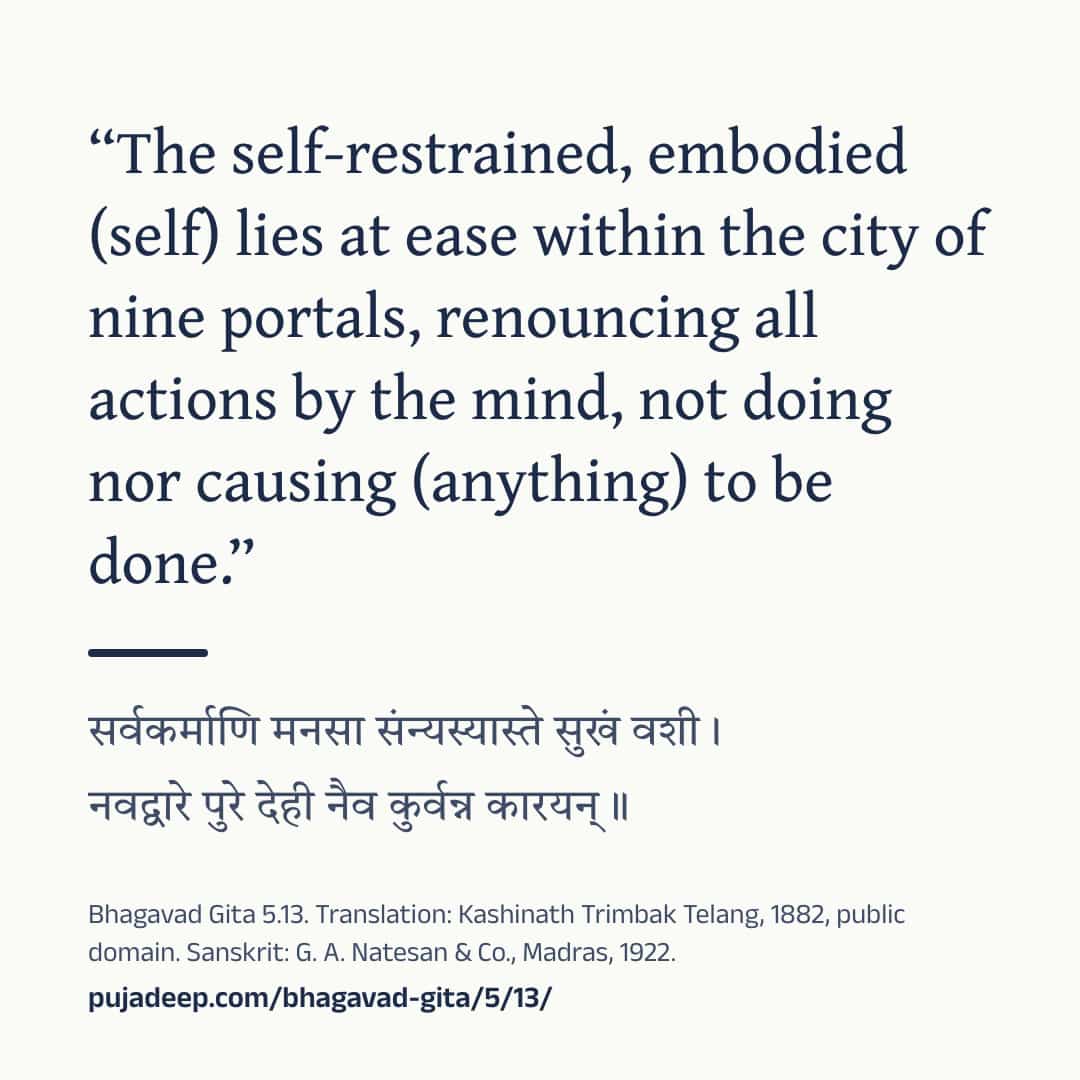
Drawing the picture
See the words
Bhagavad Gita 5.13

सर्वकर्माणि मनसा संन्यस्यास्ते सुखं वशी ।
नवद्वारे पुरे देही नैव कुर्वन्न कारयन् ॥

“The self-restrained, embodied (self) lies at ease within the city of nine portals, renouncing all actions by the mind, not doing nor causing (anything) to be done.”
(K. T. Telang, The Bhagavadgîtâ (The Sacred Books of the East, vol. VIII, Oxford: Clarendon Press, 1882), p. 65, public domain)

“Renouncing all actions by Manas, the sovereign Dweller in the body resteth serenely in the nine-gated city, neither acting nor causing to act.”
(Annie Besant, The Bhagavad Gîtâ, or The Lord's Song (London: Theosophical Publishing Society, 1895), p. 60, public domain)

“The subduer (of the senses), having renounced all actions by discrimination, rests happily in the city of the nine-gates, neither acting, nor causing (others) to act.”
(Swami Swarupananda, Srimad-Bhagavad-Gita (Mayavati: Prabuddha Bharata Press, 1909; first printed in Prabuddha Bharata, 1907–1909), p. 111, public domain)

Sanskrit: G. A. Natesan & Co., Madras, 1922.
https://pujadeep.com/bhagavad-gita/5/13/ Nothing is sent from this site. Your own app sends it, to the chat you choose. The picture quotes the translation you chose on this page, with its name and year.
Sanskrit text: The Bhagavad-Gita, or The Lord's Song, with the text in Devanagari and an English translation, 1922. Meanings: written for Pujadeep and checked against the cited edition. Source and changes
Questions families ask
Who speaks Bhagavad Gita 5.13?
Krishna speaks this verse, in chapter 5 (Karma Sannyasa Yoga).
Where does the Sanskrit text come from?
Sanskrit text: The Bhagavad-Gita, or The Lord's Song, with the text in Devanagari and an English translation, 1922. Meanings: written for Pujadeep and checked against the cited edition. See the source
Is the meaning on this page a translation?
Explanation written for this site from the sources listed here, and checked against the cited edition. It is not a translation and not the only way to read the text. Free to quote with credit.
Source and licence
- Sanskrit text
- The Bhagavad-Gita, or The Lord's Song, with the text in Devanagari and an English translation (Annie Besant, G. A. Natesan & Co., Madras, 1922). Public domain. The Sanskrit on these pages was read from this printing’s page images.
- Translation
- The Bhagavadgîtâ with the Sanatsugâtîya and the Anugîtâ, translated by Kâshinâth Trimbak Telang (The Sacred Books of the East, vol. VIII, ed. F. Max Müller) (Kashinath Trimbak Telang, F. Max Müller, Clarendon Press, Oxford, 1882). Public domain. Shown verbatim, as printed.
- Translation
- The Bhagavad Gîtâ, or The Lord's Song, translated by Annie Besant (Annie Besant, Theosophical Publishing Society, London, 1895). Public domain. Shown verbatim, as printed.
- Translation
- Srimad-Bhagavad-Gita, with Sanskrit Text; Paraphrase with Word-by-word Literal Translation; English Rendering and Comments, Index, &c., by the Swami Swarupananda (Himalayan Series, No. XX) (Swami Swarupananda, The Editors and Publishers, Advaita Ashrama, Mayavati, Prabuddha Bharata Press, Mayavati, Almora, Himalayas, 1909). Public domain. Shown verbatim, as printed.
- Common wording
- In this text, 32 words follow today's common wording, checked against sanskritdocuments.org; Sanskrit Wikisource; Gita Press, Gorakhpur; GRETIL, Göttingen and Bhaktivedanta Book Trust.
- Our explanation
- Explanation written for this site from the sources listed here, and checked against the cited edition. It is not a translation and not the only way to read the text. Free to quote with credit.
- Checked
- Checked against the cited edition, October 15, 2026.
- Updated
- October 25, 2026