Bhagavad Gita 5.20: meaning and translation
Chapter 5: Karma Sannyasa Yoga. Krishna says
Krishna says that one who knows Brahman and is established in Brahman, steady in understanding and free from delusion, does not rejoice on getting what is pleasant, nor feel shaken on getting what is unpleasant.
Click or tap a word for its meaning and its dictionary page.
Text and layers
Text and layers
These choices stay in this browser.
Bhagavad Gita 5.20
न प्रहृष्येत्प्रियं प्राप्य नोद्विजेत्प्राप्य चाप्रियम् ।स्थिरबुद्धिरसंमूढो ब्रह्मविद्ब्रह्मणि स्थितः ॥
Na prahrishyetpriyam prapya nodvijetprapya chapriyamSthirabuddhirasammudho brahmavidbrahmani sthitah
na prahṛṣyetpriyaṃ prāpya nodvijetprāpya cāpriyam |sthirabuddhirasaṃmūḍho brahmavidbrahmaṇi sthitaḥ ||
Our explanation Krishna says that one who knows Brahman and is established in Brahman, steady in understanding and free from delusion, does not rejoice on getting what is pleasant, nor feel shaken on getting what is unpleasant.
हिंदी अर्थ कृष्ण कहते हैं कि जो ब्रह्म को जानता है और ब्रह्म में स्थित है, जिसकी बुद्धि स्थिर है और जो मोह से मुक्त है, वह प्रिय वस्तु पाकर हर्षित नहीं होता और अप्रिय पाकर विचलित नहीं होता।
Word by word
Every word, with its dictionary page
Word by word
- न na · not (indeclinable) Dictionary: 2. na, Monier-Williams 1899, p. 523, col. 1 “not, no, nor, neither”
- प्रहृष्येत् prahṛṣyet · should rejoice (optative, 3rd person singular) Dictionary: pra-hṛṣ, Monier-Williams 1899, p. 701, col. 2 “to rejoice, be glad or cheerful, exult”
- प्रियम् priyam · what is pleasant (accusative singular (neuter)) Dictionary: priya, Monier-Williams 1899, p. 710, col. 1 “beloved, dear to (gen., loc., dat. or comp.), liked, favourite”
- प्राप्य prāpya · on getting (absolutive ('having done')) Dictionary: prāp, Monier-Williams 1899, p. 707, col. 2 “to attain to, reach, arrive at, meet with, find”
- न na · not (indeclinable) Dictionary: 2. na, Monier-Williams 1899, p. 523, col. 1 “not, no, nor, neither”
- उद्विजेत् udvijet · should be shaken (optative, 3rd person singular) Dictionary: ud-vij, Monier-Williams 1899, p. 192, col. 1 “to shrink from, recede, leave off”
- प्राप्य prāpya · on getting (absolutive ('having done')) Dictionary: prāp, Monier-Williams 1899, p. 707, col. 2 “to attain to, reach, arrive at, meet with, find”
- च ca · and (indeclinable) Dictionary: 2. ca, Monier-Williams 1899, p. 380, col. 1 “and, both, also, moreover, as well as”
- अप्रियम् apriyam · what is unpleasant (accusative singular (neuter)) Dictionary: a-priya, Monier-Williams 1899, p. 59, col. 2 “disagreeable, disliked”
- स्थिरबुद्धिः sthirabuddhiḥ · steady in understanding (compound, nominative singular) Dictionary: sthira-buddhi, Monier-Williams 1899, p. 1265, col. 1 “steady-minded”
- असंमूढः asaṃmūḍhaḥ · free from delusion (nominative singular) Dictionary: a-saṃmūḍha, Monier-Williams 1899, p. 119, col. 3 “not confused”
- ब्रह्मवित् brahmavit · knower of Brahman (compound, nominative singular) Dictionary: brahma-vid, Monier-Williams 1899, p. 740, col. 1 “knowing the one Brahmă, a Vedic philosopher, AV. &c. &c. (also -vida)”
- ब्रह्मणि brahmaṇi · in Brahman (locative singular) Dictionary: brahman, Monier-Williams 1899, p. 738, col. 1 “one self-existent impersonal Spirit, the one universal Soul”
- स्थितः sthitaḥ · established (past participle, nominative singular) Dictionary: sthita, Monier-Williams 1899, p. 1264, col. 1 “standing, staying, situated, resting or abiding or remaining in”
1 printing differs
Edition differences. Another printing or text reads this place differently.
- Spelling A digital text reads Same words. The e-text writes the class nasal (असम्मूढो) and separates ब्रह्मविद् ब्रह्मणि; the 1922 edition writes anusvara (असंमूढो) and joins ब्रह्मविद्ब्रह्मणि. Another digital text agrees with the edition (asaṃmūḍho).
Old translations
Kashinath Trimbak Telang, 1882. Public domain. Page 66.
He who knows Brahman, whose mind is steady, who is not deluded, and who rests in Brahman, does not exult on finding anything agreeable, nor does he grieve on finding anything disagreeable1.
Footnotes (the translator’s own) - Kathopanishad, p. 100. ↩
Compare 3 translations
Kashinath Trimbak Telang, 1882. Public domain. Page 66.
He who knows Brahman, whose mind is steady, who is not deluded, and who rests in Brahman, does not exult on finding anything agreeable, nor does he grieve on finding anything disagreeable1.
Footnotes (the translator’s own) - Kathopanishad, p. 100. ↩
You are reading this one
Annie Besant, 1895. Public domain. Page 62.
One should neither rejoice in obtaining what is pleasant, nor sorrow in obtaining what is unpleasant; with Buddhi firm, unperplexed, the Brahman-knower is established in Brahman.
You are reading this one
Swami Swarupananda, 1909 (first printed 1907). Public domain. Page 115.
Resting in Brahman, with intellect steady, and without delusion, the knower of Brahman neither rejoiceth in receiving what is pleasant, nor grieveth on receiving what is unpleasant.
You are reading this one
Cite this verse
The translation: K. T. Telang, The Bhagavadgîtâ (The Sacred Books of the East, vol. VIII, Oxford: Clarendon Press, 1882), p. 66. Bhagavad Gita 5.20.
The translation: Annie Besant, The Bhagavad Gîtâ, or The Lord's Song (London: Theosophical Publishing Society, 1895), p. 62. Bhagavad Gita 5.20.
The translation: Swami Swarupananda, Srimad-Bhagavad-Gita (Mayavati: Prabuddha Bharata Press, 1909; first printed in Prabuddha Bharata, 1907–1909), p. 115. Bhagavad Gita 5.20.
Our explanation: “Bhagavad Gita 5.20: meaning and translation.” Pujadeep. Updated October 25, 2026. https://pujadeep.com/bhagavad-gita/5/20/
Pujadeep’s explanations are free to quote with credit: name Pujadeep and link to the page. How to credit
Classical readings, by school
No readings by school on this verse yet.
Share
Show the ways to share
Send one picture or the text to one chat. The picture names its source and the address of this page.
Drawing the picture
See the words
Bhagavad Gita 5.20

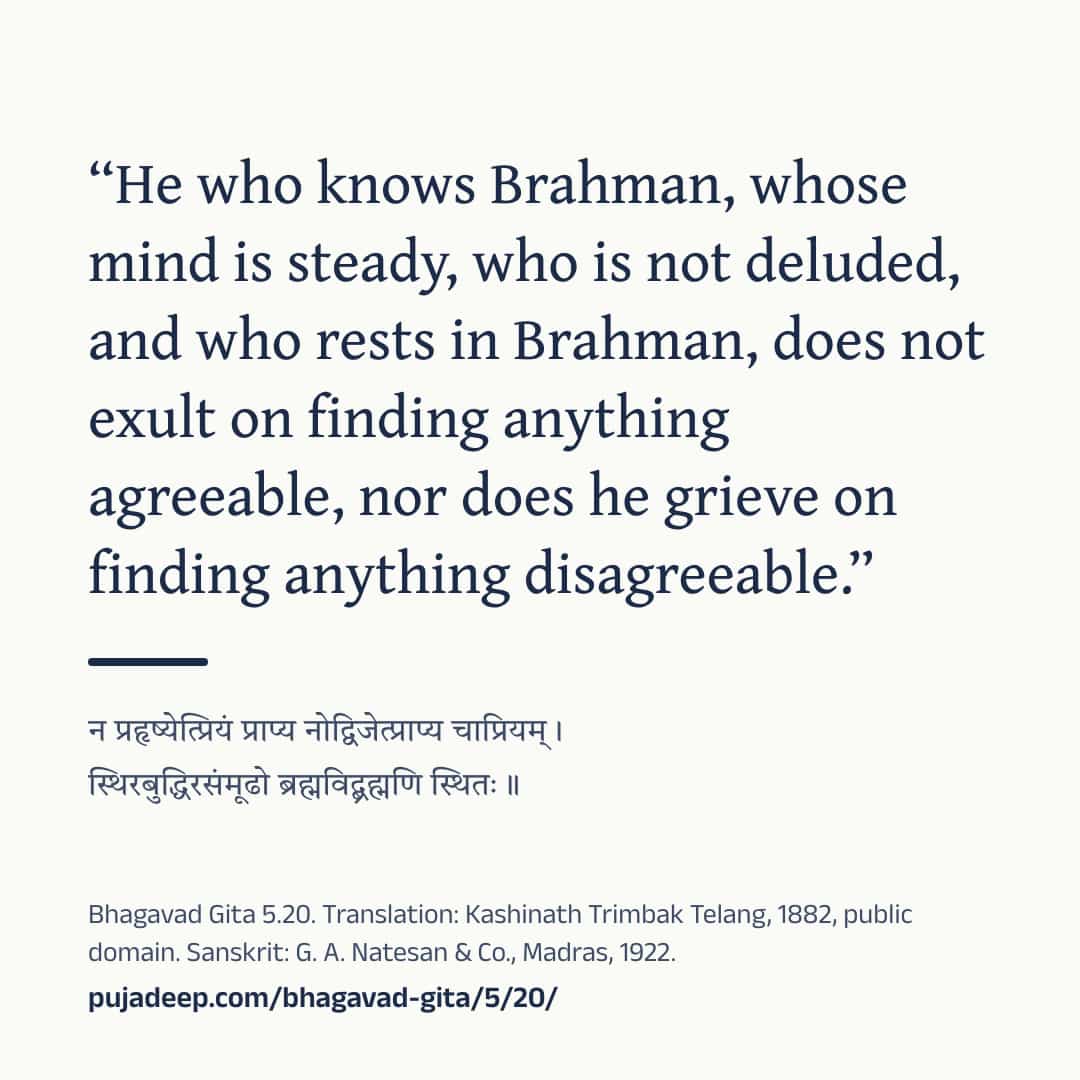
न प्रहृष्येत्प्रियं प्राप्य नोद्विजेत्प्राप्य चाप्रियम् ।
स्थिरबुद्धिरसंमूढो ब्रह्मविद्ब्रह्मणि स्थितः ॥

“He who knows Brahman, whose mind is steady, who is not deluded, and who rests in Brahman, does not exult on finding anything agreeable, nor does he grieve on finding anything disagreeable.”
(K. T. Telang, The Bhagavadgîtâ (The Sacred Books of the East, vol. VIII, Oxford: Clarendon Press, 1882), p. 66, public domain)

“One should neither rejoice in obtaining what is pleasant, nor sorrow in obtaining what is unpleasant; with Buddhi firm, unperplexed, the Brahman-knower is established in Brahman.”
(Annie Besant, The Bhagavad Gîtâ, or The Lord's Song (London: Theosophical Publishing Society, 1895), p. 62, public domain)

“Resting in Brahman, with intellect steady, and without delusion, the knower of Brahman neither rejoiceth in receiving what is pleasant, nor grieveth on receiving what is unpleasant.”
(Swami Swarupananda, Srimad-Bhagavad-Gita (Mayavati: Prabuddha Bharata Press, 1909; first printed in Prabuddha Bharata, 1907–1909), p. 115, public domain)

Sanskrit: G. A. Natesan & Co., Madras, 1922.
https://pujadeep.com/bhagavad-gita/5/20/ Nothing is sent from this site. Your own app sends it, to the chat you choose. The picture quotes the translation you chose on this page, with its name and year.
Sanskrit text: The Bhagavad-Gita, or The Lord's Song, with the text in Devanagari and an English translation, 1922. Meanings: written for Pujadeep and checked against the cited edition. Source and changes
Questions families ask
Who speaks Bhagavad Gita 5.20?
Krishna speaks this verse, in chapter 5 (Karma Sannyasa Yoga).
Where does the Sanskrit text come from?
Sanskrit text: The Bhagavad-Gita, or The Lord's Song, with the text in Devanagari and an English translation, 1922. Meanings: written for Pujadeep and checked against the cited edition. See the source
Is the meaning on this page a translation?
Explanation written for this site from the sources listed here, and checked against the cited edition. It is not a translation and not the only way to read the text. Free to quote with credit.
Source and licence
- Sanskrit text
- The Bhagavad-Gita, or The Lord's Song, with the text in Devanagari and an English translation (Annie Besant, G. A. Natesan & Co., Madras, 1922). Public domain. The Sanskrit on these pages was read from this printing’s page images.
- Translation
- The Bhagavadgîtâ with the Sanatsugâtîya and the Anugîtâ, translated by Kâshinâth Trimbak Telang (The Sacred Books of the East, vol. VIII, ed. F. Max Müller) (Kashinath Trimbak Telang, F. Max Müller, Clarendon Press, Oxford, 1882). Public domain. Shown verbatim, as printed.
- Translation
- The Bhagavad Gîtâ, or The Lord's Song, translated by Annie Besant (Annie Besant, Theosophical Publishing Society, London, 1895). Public domain. Shown verbatim, as printed.
- Translation
- Srimad-Bhagavad-Gita, with Sanskrit Text; Paraphrase with Word-by-word Literal Translation; English Rendering and Comments, Index, &c., by the Swami Swarupananda (Himalayan Series, No. XX) (Swami Swarupananda, The Editors and Publishers, Advaita Ashrama, Mayavati, Prabuddha Bharata Press, Mayavati, Almora, Himalayas, 1909). Public domain. Shown verbatim, as printed.
- Common wording
- In this text, 32 words follow today's common wording, checked against sanskritdocuments.org; Sanskrit Wikisource; Gita Press, Gorakhpur; GRETIL, Göttingen and Bhaktivedanta Book Trust.
- Our explanation
- Explanation written for this site from the sources listed here, and checked against the cited edition. It is not a translation and not the only way to read the text. Free to quote with credit.
- Checked
- Checked against the cited edition, October 15, 2026.
- Updated
- October 25, 2026