Bhagavad Gita 5.29: meaning and translation
Chapter 5: Karma Sannyasa Yoga. Krishna says
Krishna closes the chapter.
Click or tap a word for its meaning and its dictionary page.
Text and layers
Text and layers
These choices stay in this browser.
Bhagavad Gita 5.29
भोक्तारं यज्ञतपसां सर्वलोकमहेश्वरम् ।सुहृदं सर्वभूतानां ज्ञात्वा मां शान्तिमृच्छति ॥
Bhoktaram yajnatapasam sarvalokamaheshvaramSuhridam sarvabhutanam jnatva mam shantimrichchhati
bhoktāraṃ yajñatapasāṃ sarvalokamaheśvaram |suhṛdaṃ sarvabhūtānāṃ jñātvā māṃ śāntimṛcchati ||
Our explanation Krishna closes the chapter. Knowing him as the one who receives all sacrifices and austerities, the great Lord of all the worlds, and the friend (suhṛd) of all beings, he says, a person reaches peace.
हिंदी अर्थ कृष्ण अध्याय पूरा करते हैं। वे कहते हैं कि जो उन्हें सब यज्ञों और तपों का भोक्ता, सब लोकों का महान ईश्वर और सब प्राणियों का सुहृद (मित्र) जान लेता है, वह शांति पाता है।
Word by word
Every word, with its dictionary page
Word by word
- भोक्तारम् bhoktāram · the receiver, the enjoyer (accusative singular) Dictionary: bhoktṛ, Monier-Williams 1899, p. 760, col. 1 “one who enjoys or eats, enjoyer, eater, experiencer”; 3. bhuj, Monier-Williams 1899, p. 759, col. 2 “to enjoy, use, possess”
- यज्ञतपसाम् yajñatapasām · of sacrifices and austerities (compound, genitive plural) Dictionary: yajña, Monier-Williams 1899, p. 839, col. 2 “worship, devotion, prayer, praise; act of worship or devotion, offering, oblation, sacrifice”; tapas, Monier-Williams 1899, p. 437, col. 1 “religious austerity”
- सर्वलोकमहेश्वरम् sarvalokamaheśvaram · the great Lord of all the worlds (compound, accusative singular) Dictionary: sarva-loka, Monier-Williams 1899, p. 1187, col. 1 “the whole world”; maheśvara, Monier-Williams 1899, p. 802, col. 2 “a great lord, sovereign, chief”
- सुहृदम् suhṛdam · the friend (accusative singular) Dictionary: su-hṛd, Monier-Williams 1899, p. 1239, col. 3 “‘good-hearted,’ ‘kind-hearted,’ ‘well-disposed,’ a friend, ally”
- सर्वभूतानाम् sarvabhūtānām · of all beings (compound, genitive plural) Dictionary: sarva-bhūta, Monier-Williams 1899, p. 1186, col. 2 “all beings”
- ज्ञात्वा jñātvā · knowing (absolutive ('having done')) Dictionary: 1. jñā, Monier-Williams 1899, p. 425, col. 3 “to know, have knowledge, become acquainted with”
- माम् mām · "me" (Krishna) (pronoun, accusative singular) Dictionary: 1. mad, Monier-Williams 1899, p. 777, col. 2 “base of the first pers. pron. in the sg. number (esp. in comp.)”
- शान्तिम् śāntim · peace (accusative singular (feminine)) Dictionary: śānti, Monier-Williams 1899, p. 1064, col. 3 “tranquillity, peace, quiet, peace or calmness of mind”
- ऋच्छति ṛcchati · reaches (present, 3rd person singular) Dictionary: ṛ, Monier-Williams 1899, p. 223, col. 2 “to move or go towards”
Old translations
Kashinath Trimbak Telang, 1882. Public domain. Page 67.
He knowing me to be the enjoyer of all sacrifices and penances, the great Lord of all worlds, and the friend of all beings, attains tranquillity.
Compare 3 translations
Kashinath Trimbak Telang, 1882. Public domain. Page 67.
He knowing me to be the enjoyer of all sacrifices and penances, the great Lord of all worlds, and the friend of all beings, attains tranquillity.
You are reading this one
Annie Besant, 1895. Public domain. Page 63–64.
Having known Me as the Lord of sacrifice and of austerity, the mighty Ruler of all the worlds, and the Lover of all beings, he goeth to Peace.
You are reading this one
Swami Swarupananda, 1909 (first printed 1907). Public domain. Page 119.
Knowing me as the dispenser of Yajnas and asceticisms, as the Great Lord of all worlds, as the friend of all beings, he attains Peace.
You are reading this one
Cite this verse
The translation: K. T. Telang, The Bhagavadgîtâ (The Sacred Books of the East, vol. VIII, Oxford: Clarendon Press, 1882), p. 67. Bhagavad Gita 5.29.
The translation: Annie Besant, The Bhagavad Gîtâ, or The Lord's Song (London: Theosophical Publishing Society, 1895), pp. 63–64. Bhagavad Gita 5.29.
The translation: Swami Swarupananda, Srimad-Bhagavad-Gita (Mayavati: Prabuddha Bharata Press, 1909; first printed in Prabuddha Bharata, 1907–1909), p. 119. Bhagavad Gita 5.29.
Our explanation: “Bhagavad Gita 5.29: meaning and translation.” Pujadeep. Updated October 25, 2026. https://pujadeep.com/bhagavad-gita/5/29/
Pujadeep’s explanations are free to quote with credit: name Pujadeep and link to the page. How to credit
Classical readings, by school
Each reading is named by its school. None is presented as the only meaning.
What Advaita, Vishishtadvaita and Dvaita teach, in short
Shankara Advaita
Shankara reads the verse as the object of the meditation just described. The Lord is Nārāyaṇa, who receives sacrifices and austerities both as their author and as the deity they honour; he is the friend who does good to all without expecting a return, and dwells in every heart. Knowing him, people reach peace, the end of saṃsāra.
Source: The Bhagavad-Gita, with the commentary of Sri Sankaracharya, translated by A. Mahadeva Sastri (2nd ed., Mysore: G. T. A. Printing Works, 1901), commentary on 5.29, p. 162. Summarised in our own words; none of its text is reproduced.
Ramanuja Vishishtadvaita
Ramanuja says this verse shows why the path of works is easy: when all duties are done as worship of the Lord, the receiver of sacrifices, the great Lord of all, and the friend of all beings, they become service to a friend, which anyone would gladly give. Knowing him so, one reaches peace.
Source: Sri Bhagavad-Gita with Sri Ramanujacharya's Visishtadvaita commentary, translated by A. Govindacharya (Madras, 1898), commentary on 5.29, p. 190. Summarised in our own words; none of its text is reproduced.
Share
Show the ways to share
Send one picture or the text to one chat. The picture names its source and the address of this page.
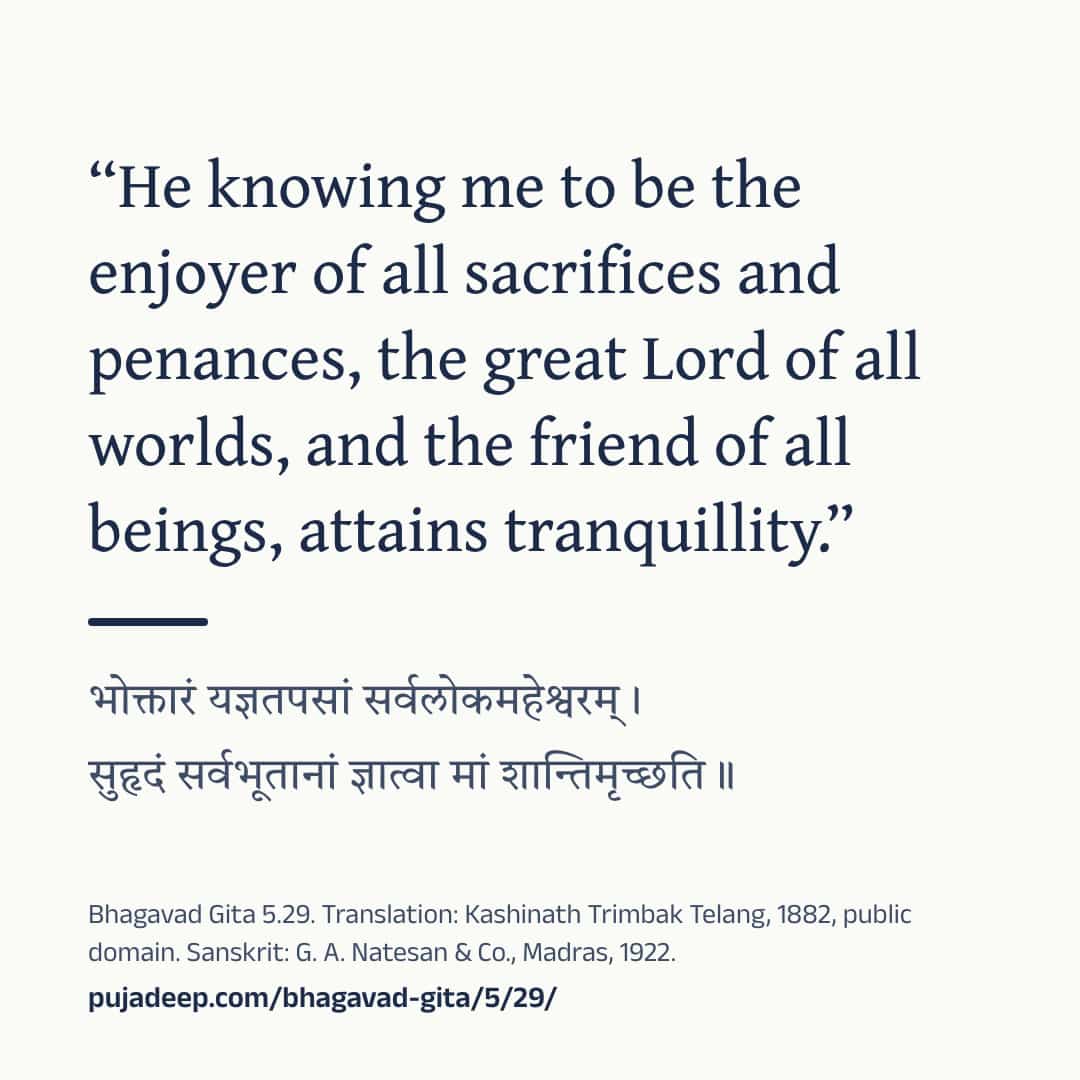
Drawing the picture
See the words
Bhagavad Gita 5.29

भोक्तारं यज्ञतपसां सर्वलोकमहेश्वरम् ।
सुहृदं सर्वभूतानां ज्ञात्वा मां शान्तिमृच्छति ॥

“He knowing me to be the enjoyer of all sacrifices and penances, the great Lord of all worlds, and the friend of all beings, attains tranquillity.”
(K. T. Telang, The Bhagavadgîtâ (The Sacred Books of the East, vol. VIII, Oxford: Clarendon Press, 1882), p. 67, public domain)

“Having known Me as the Lord of sacrifice and of austerity, the mighty Ruler of all the worlds, and the Lover of all beings, he goeth to Peace.”
(Annie Besant, The Bhagavad Gîtâ, or The Lord's Song (London: Theosophical Publishing Society, 1895), pp. 63–64, public domain)

“Knowing me as the dispenser of Yajnas and asceticisms, as the Great Lord of all worlds, as the friend of all beings, he attains Peace.”
(Swami Swarupananda, Srimad-Bhagavad-Gita (Mayavati: Prabuddha Bharata Press, 1909; first printed in Prabuddha Bharata, 1907–1909), p. 119, public domain)

Sanskrit: G. A. Natesan & Co., Madras, 1922.
https://pujadeep.com/bhagavad-gita/5/29/ Nothing is sent from this site. Your own app sends it, to the chat you choose. The picture quotes the translation you chose on this page, with its name and year.
Sanskrit text: The Bhagavad-Gita, or The Lord's Song, with the text in Devanagari and an English translation, 1922. Meanings: written for Pujadeep and checked against the cited edition. Source and changes
Questions families ask
Who speaks Bhagavad Gita 5.29?
Krishna speaks this verse, in chapter 5 (Karma Sannyasa Yoga).
Where does the Sanskrit text come from?
Sanskrit text: The Bhagavad-Gita, or The Lord's Song, with the text in Devanagari and an English translation, 1922. Meanings: written for Pujadeep and checked against the cited edition. See the source
Is the meaning on this page a translation?
Explanation written for this site from the sources listed here, and checked against the cited edition. It is not a translation and not the only way to read the text. Free to quote with credit.
Source and licence
- Sanskrit text
- The Bhagavad-Gita, or The Lord's Song, with the text in Devanagari and an English translation (Annie Besant, G. A. Natesan & Co., Madras, 1922). Public domain. The Sanskrit on these pages was read from this printing’s page images.
- Translation
- The Bhagavadgîtâ with the Sanatsugâtîya and the Anugîtâ, translated by Kâshinâth Trimbak Telang (The Sacred Books of the East, vol. VIII, ed. F. Max Müller) (Kashinath Trimbak Telang, F. Max Müller, Clarendon Press, Oxford, 1882). Public domain. Shown verbatim, as printed.
- Translation
- The Bhagavad Gîtâ, or The Lord's Song, translated by Annie Besant (Annie Besant, Theosophical Publishing Society, London, 1895). Public domain. Shown verbatim, as printed.
- Translation
- Srimad-Bhagavad-Gita, with Sanskrit Text; Paraphrase with Word-by-word Literal Translation; English Rendering and Comments, Index, &c., by the Swami Swarupananda (Himalayan Series, No. XX) (Swami Swarupananda, The Editors and Publishers, Advaita Ashrama, Mayavati, Prabuddha Bharata Press, Mayavati, Almora, Himalayas, 1909). Public domain. Shown verbatim, as printed.
- Commentary
- The Bhagavad-Gita, with the commentary of Sri Sankaracharya, translated by A. Mahadeva Sastri (2nd ed., Mysore: G. T. A. Printing Works, 1901) (Public-domain scan, University of California Libraries). Summarised in our own words; none of its text is reproduced.
- Commentary
- Sri Bhagavad-Gita with Sri Ramanujacharya's Visishtadvaita commentary, translated by A. Govindacharya (Madras, 1898) (Scan uploaded to archive.org (folkscanomy collection)). Summarised in our own words; none of its text is reproduced.
- Common wording
- In this text, 32 words follow today's common wording, checked against sanskritdocuments.org; Sanskrit Wikisource; Gita Press, Gorakhpur; GRETIL, Göttingen and Bhaktivedanta Book Trust.
- Our explanation
- Explanation written for this site from the sources listed here, and checked against the cited edition. It is not a translation and not the only way to read the text. Free to quote with credit.
- Checked
- Checked against the cited edition, October 15, 2026.
- Updated
- October 25, 2026