Bhagavad Gita 5.23: meaning and translation
Chapter 5: Karma Sannyasa Yoga. Krishna says
Krishna says that the person who, here in this life and before leaving the body, can withstand the force that rises from desire and anger is steady in yoga, and is a happy person.
Click or tap a word for its meaning and its dictionary page.
Text and layers
Text and layers
These choices stay in this browser.
Bhagavad Gita 5.23
शक्नोतीहैव यः सोढुं प्राक् शरीरविमोक्षणात् ।कामक्रोधोद्भवं वेगं स युक्तः स सुखी नरः ॥
Shaknotihaiva yah sodhum prak shariravimokshanatKamakrodhodbhavam vegam sa yuktah sa sukhi narah
śaknotīhaiva yaḥ soḍhuṃ prāk śarīravimokṣaṇāt |kāmakrodhodbhavaṃ vegaṃ sa yuktaḥ sa sukhī naraḥ ||
Our explanation Krishna says that the person who, here in this life and before leaving the body, can withstand the force that rises from desire and anger is steady in yoga, and is a happy person.
हिंदी अर्थ कृष्ण कहते हैं कि जो व्यक्ति यहीं, इसी जीवन में, शरीर छूटने से पहले, काम और क्रोध से उठने वाले वेग को सह सकता है, वह योग में स्थित है और वही सुखी मनुष्य है।
Word by word
Every word, with its dictionary page
Word by word
- शक्नोति śaknoti · is able (present, 3rd person singular) Dictionary: śak, Monier-Williams 1899, p. 1044, col. 2 “to be strong or powerful, be able to or capable of or competent for”
- इह iha · here, in this life (indeclinable) Dictionary: iha, Monier-Williams 1899, p. 169, col. 3 “in this place, here; to this place; in this world”
- एव eva · even (indeclinable) Dictionary: 1. eva, Monier-Williams 1899, p. 232, col. 2 “just, exactly, very, same, only, even, alone, merely”
- यः yaḥ · who (relative pronoun, nominative singular) Dictionary: yad, Monier-Williams 1899, p. 844, col. 2 “who, which, what, whichever, whatever, that”
- सोढुम् soḍhum · to bear (infinitive ('to do')) Dictionary: 1. sah, Monier-Williams 1899, p. 1193, col. 1 “to bear, put up with, endure, suffer, tolerate”
- प्राक् prāk · before (indeclinable) Dictionary: prāk, Monier-Williams 1899, p. 703, col. 3 “before”
- शरीरविमोक्षणात् śarīravimokṣaṇāt · the release from the body (compound, ablative singular) Dictionary: śarīra, Monier-Williams 1899, p. 1057, col. 3 “the body, bodily frame”; vi-mokṣaṇa, Monier-Williams 1899, p. 981, col. 2 “liberation, deliverance”
- कामक्रोधोद्भवम् kāmakrodhodbhavam · arising from desire and anger (compound, accusative singular) Dictionary: kāma, Monier-Williams 1899, p. 271, col. 3 “wish, desire, longing”; krodha, Monier-Williams 1899, p. 322, col. 1 “anger, wrath, passion”; ud-bhava, Monier-Williams 1899, p. 190, col. 2 “existence, generation, origin, production, birth”
- वेगम् vegam · the force, the surge (accusative singular) Dictionary: vega, Monier-Williams 1899, p. 1013, col. 3 “rush, dash, impetus”
- सः saḥ · he (pronoun, nominative singular) Dictionary: tad, Monier-Williams 1899, p. 434, col. 1 “that, this”
- युक्तः yuktaḥ · steady in yoga (past participle, nominative singular) Dictionary: yukta, Monier-Williams 1899, p. 853, col. 2 “absorbed in abstract meditation, concentrated, attentive”
- सः saḥ · he (pronoun, nominative singular) Dictionary: tad, Monier-Williams 1899, p. 434, col. 1 “that, this”
- सुखी sukhī · happy (nominative singular) Dictionary: sukhin, Monier-Williams 1899, p. 1222, col. 1 “possessing or causing happiness or pleasure, happy, joyful”
- नरः naraḥ · person (nominative singular) Dictionary: nara, Monier-Williams 1899, p. 528, col. 3 “a man, a male, a person”
1 printing differs
Edition differences. Another printing or text reads this place differently.
- Spelling A digital text reads Same letters. The e-text joins प्राक्शरीर…; the 1922 edition prints प्राक् शरीरविमोक्षणात् as two words, as another digital text does (prāk śarīra-).
Old translations
Kashinath Trimbak Telang, 1882. Public domain. Page 66.
He who even in this world, before his release from the body, is able to bear the agitations produced from desire and wrath, is a devoted man, he is a happy man.
Compare 3 translations
Kashinath Trimbak Telang, 1882. Public domain. Page 66.
He who even in this world, before his release from the body, is able to bear the agitations produced from desire and wrath, is a devoted man, he is a happy man.
You are reading this one
Annie Besant, 1895. Public domain. Page 62.
He who is able to endure here on earth, ere he be liberated from the body, the impact produced by desire and passion, he is harmonised, he is a happy man.
You are reading this one
Swami Swarupananda, 1909 (first printed 1907). Public domain. Page 117.
He who can withstand in this world, before the liberation from the body, the impulse arising from lust and anger, he is steadfast (in Yoga), he is a happy man.
You are reading this one
Cite this verse
The translation: K. T. Telang, The Bhagavadgîtâ (The Sacred Books of the East, vol. VIII, Oxford: Clarendon Press, 1882), p. 66. Bhagavad Gita 5.23.
The translation: Annie Besant, The Bhagavad Gîtâ, or The Lord's Song (London: Theosophical Publishing Society, 1895), p. 62. Bhagavad Gita 5.23.
The translation: Swami Swarupananda, Srimad-Bhagavad-Gita (Mayavati: Prabuddha Bharata Press, 1909; first printed in Prabuddha Bharata, 1907–1909), p. 117. Bhagavad Gita 5.23.
Our explanation: “Bhagavad Gita 5.23: meaning and translation.” Pujadeep. Updated October 25, 2026. https://pujadeep.com/bhagavad-gita/5/23/
Pujadeep’s explanations are free to quote with credit: name Pujadeep and link to the page. How to credit
Classical readings, by school
No readings by school on this verse yet.
Share
Show the ways to share
Send one picture or the text to one chat. The picture names its source and the address of this page.
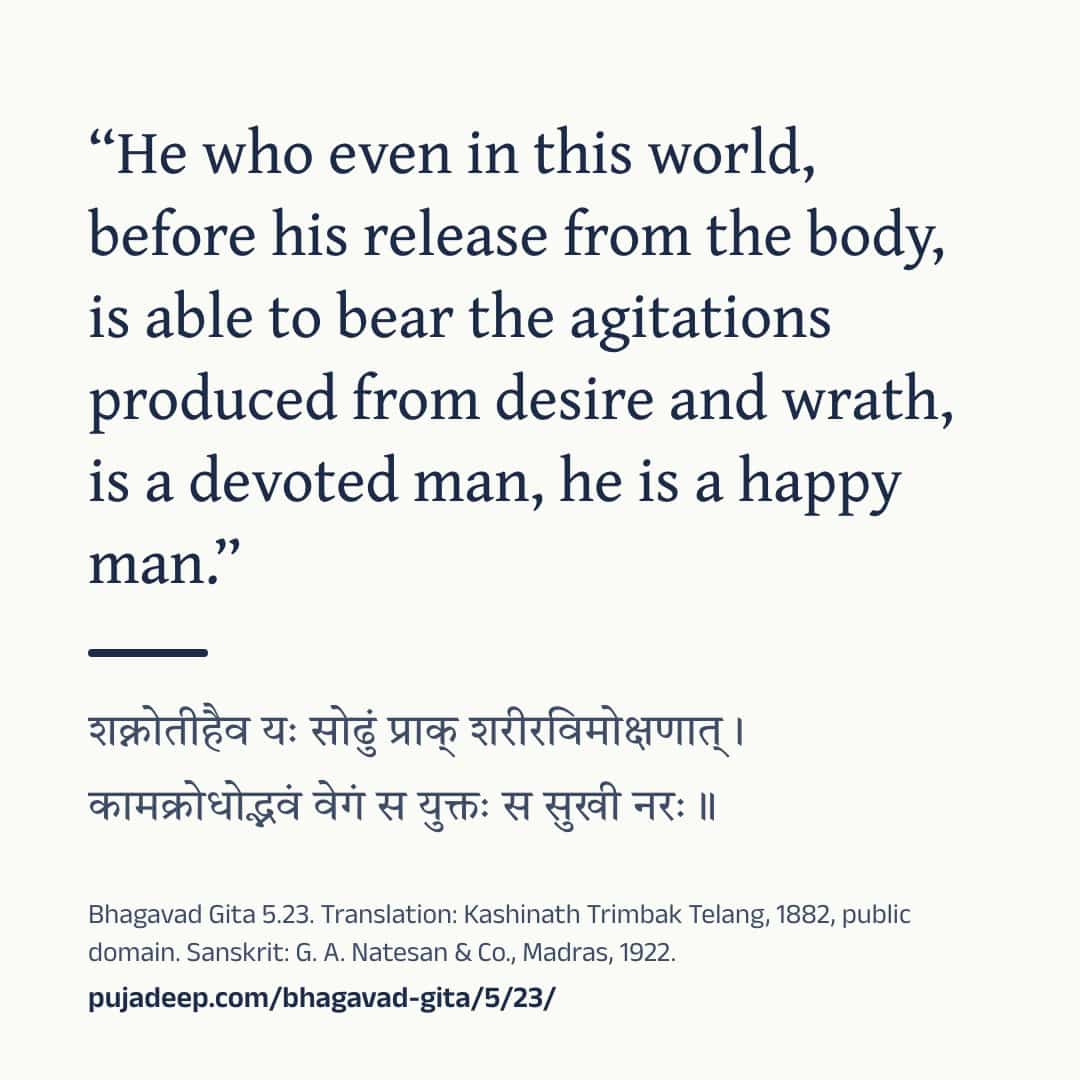
Drawing the picture
See the words
Bhagavad Gita 5.23

शक्नोतीहैव यः सोढुं प्राक् शरीरविमोक्षणात् ।
कामक्रोधोद्भवं वेगं स युक्तः स सुखी नरः ॥

“He who even in this world, before his release from the body, is able to bear the agitations produced from desire and wrath, is a devoted man, he is a happy man.”
(K. T. Telang, The Bhagavadgîtâ (The Sacred Books of the East, vol. VIII, Oxford: Clarendon Press, 1882), p. 66, public domain)

“He who is able to endure here on earth, ere he be liberated from the body, the impact produced by desire and passion, he is harmonised, he is a happy man.”
(Annie Besant, The Bhagavad Gîtâ, or The Lord's Song (London: Theosophical Publishing Society, 1895), p. 62, public domain)

“He who can withstand in this world, before the liberation from the body, the impulse arising from lust and anger, he is steadfast (in Yoga), he is a happy man.”
(Swami Swarupananda, Srimad-Bhagavad-Gita (Mayavati: Prabuddha Bharata Press, 1909; first printed in Prabuddha Bharata, 1907–1909), p. 117, public domain)

Sanskrit: G. A. Natesan & Co., Madras, 1922.
https://pujadeep.com/bhagavad-gita/5/23/ Nothing is sent from this site. Your own app sends it, to the chat you choose. The picture quotes the translation you chose on this page, with its name and year.
Sanskrit text: The Bhagavad-Gita, or The Lord's Song, with the text in Devanagari and an English translation, 1922. Meanings: written for Pujadeep and checked against the cited edition. Source and changes
Questions families ask
Who speaks Bhagavad Gita 5.23?
Krishna speaks this verse, in chapter 5 (Karma Sannyasa Yoga).
Where does the Sanskrit text come from?
Sanskrit text: The Bhagavad-Gita, or The Lord's Song, with the text in Devanagari and an English translation, 1922. Meanings: written for Pujadeep and checked against the cited edition. See the source
Is the meaning on this page a translation?
Explanation written for this site from the sources listed here, and checked against the cited edition. It is not a translation and not the only way to read the text. Free to quote with credit.
Source and licence
- Sanskrit text
- The Bhagavad-Gita, or The Lord's Song, with the text in Devanagari and an English translation (Annie Besant, G. A. Natesan & Co., Madras, 1922). Public domain. The Sanskrit on these pages was read from this printing’s page images.
- Translation
- The Bhagavadgîtâ with the Sanatsugâtîya and the Anugîtâ, translated by Kâshinâth Trimbak Telang (The Sacred Books of the East, vol. VIII, ed. F. Max Müller) (Kashinath Trimbak Telang, F. Max Müller, Clarendon Press, Oxford, 1882). Public domain. Shown verbatim, as printed.
- Translation
- The Bhagavad Gîtâ, or The Lord's Song, translated by Annie Besant (Annie Besant, Theosophical Publishing Society, London, 1895). Public domain. Shown verbatim, as printed.
- Translation
- Srimad-Bhagavad-Gita, with Sanskrit Text; Paraphrase with Word-by-word Literal Translation; English Rendering and Comments, Index, &c., by the Swami Swarupananda (Himalayan Series, No. XX) (Swami Swarupananda, The Editors and Publishers, Advaita Ashrama, Mayavati, Prabuddha Bharata Press, Mayavati, Almora, Himalayas, 1909). Public domain. Shown verbatim, as printed.
- Common wording
- In this text, 32 words follow today's common wording, checked against sanskritdocuments.org; Sanskrit Wikisource; Gita Press, Gorakhpur; GRETIL, Göttingen and Bhaktivedanta Book Trust.
- Our explanation
- Explanation written for this site from the sources listed here, and checked against the cited edition. It is not a translation and not the only way to read the text. Free to quote with credit.
- Checked
- Checked against the cited edition, October 15, 2026.
- Updated
- October 25, 2026